
Between ongoing street repairs and police-manned barricades set up for a downtown run, getting to the Meyerson Symphony Center Thursday evening was an adventure. But I made it in time for an unusual Dallas Symphony Orchestra program of 18th-century music by German and Austrian composers.
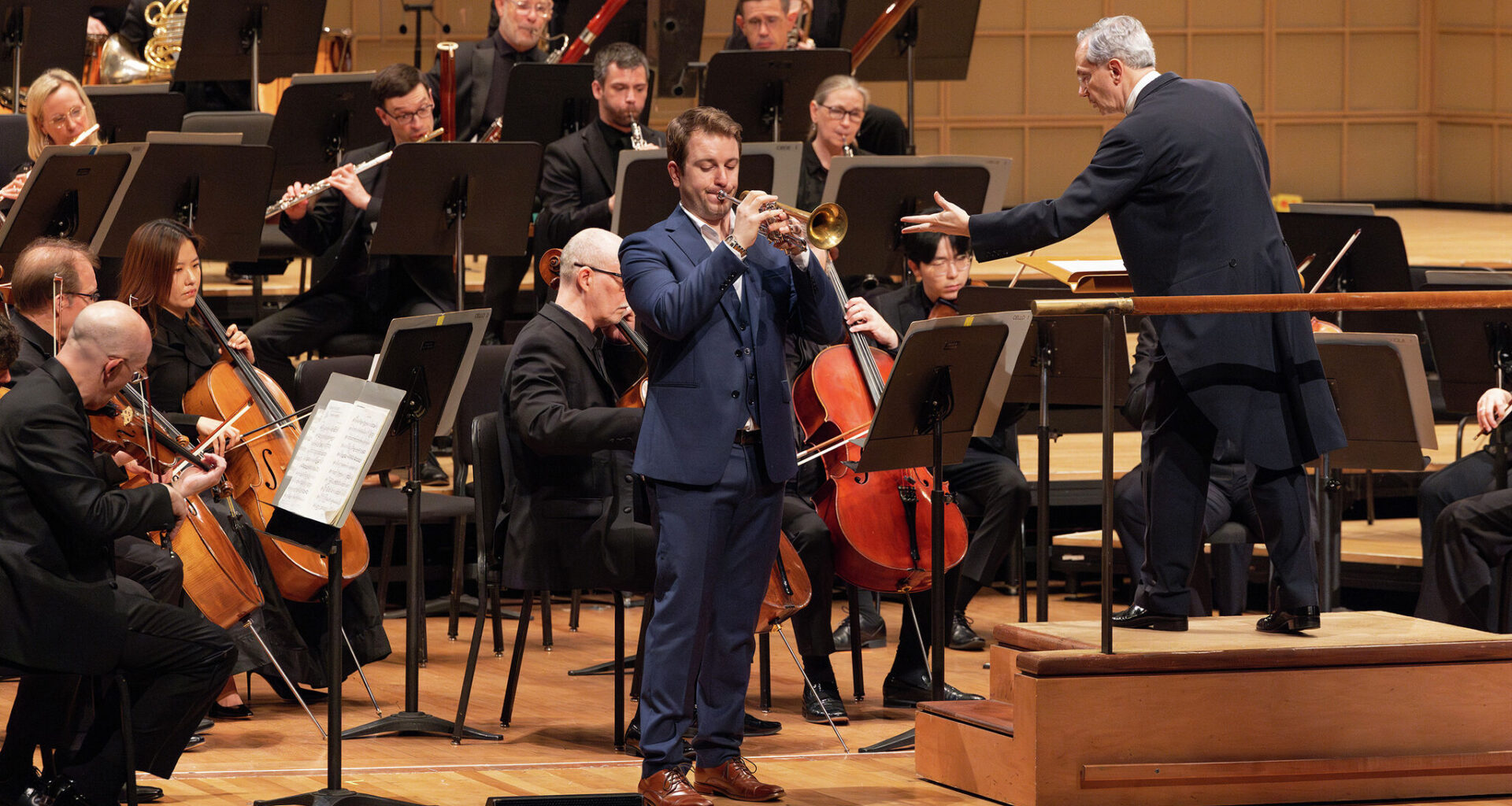
On paper, it was an odd assortment: a Beethoven scena for soprano and orchestra followed by Bach’s E major Violin Concerto (BWV 1042), the Haydn Trumpet Concerto and Mozart’s Haffner Symphony (No. 35 in D major). Featuring two superb DSO musicians as soloists, it wasn’t repertory we’ve associated with music director Fabio Luisi, who was on the podium.
The first three pieces were performed, appropriately, with relatively chamber-orchestra forces, although the Mozart got more of a big-band approach. An audibly enthusiastic audience rewarded every piece with a standing ovation.
The Beethoven is a miniature operatic scene, with a woman alternately raging at and lamenting a lover who’s deserted her. It made no sense in the program’s context until an aha! moment in the slow movement of the Bach.
Although Bach never composed an opera, operatic expressions suffused much 18th-century instrumental music. Indeed, the symphony was originally an outgrowth of opera overtures.
As elegantly, exquisitely played by DSO co-concertmaster Nathan Olson, that Bach slow movement had the feeling of a tender, elaborately inflected operatic aria. Olson dispatched the outer movements with silvery tone, technical finesse and sophisticated shaping.
Both he and the reduced complement of DSO strings applied vibrato sparingly, on long notes here and there, as 18th-century treatises advocate. Luisi gave the music spring and suavity.
In the Beethoven, Kathryn Henry dramatized both emotional extremes, although her soprano was a bit granular for my ears. While her upper range blazed, too many lower notes disappeared. The piece still seemed an oddity on the program.
In the Haydn, DSO principal trumpet Stuart Stephenson supplied gorgeous sounds, gleaming or matte-finished as appropriate. A couple of quiet high notes didn’t quite want to sound, but everything was formed and directed with sophistication, with apt collaboration from Luisi and the orchestra.
Luisi led a spirited account of the Mozart, cultivating clarity and buoyancy even with the evening’s largest instrumental contingent. Tempos were spot-on in all but the third movement, a minuetto he took at a mobile three beats per measure. But considerable evidence indicates these late-18th-century minuets were taken even faster, at quite a brisk one beat per measure.
Given current controversy over deferred maintenance of Dallas City Hall, it’s worth noting that a defining feature of the city’s other I.M. Pei-designed landmark has been out of order for years. Burned-out motors controlling acoustical doors behind grilles around the top of the audience chamber prevent adjusting the hall’s sound for different repertory. This program could have benefited from a bit less reverberation.
Repeats at 7:30 p.m. Saturday and 2 p.m. Sunday (no Friday performance) at Meyerson Symphony Center, 2301 Flora St., Dallas. 214-849-4376, dallassymphony.org.