
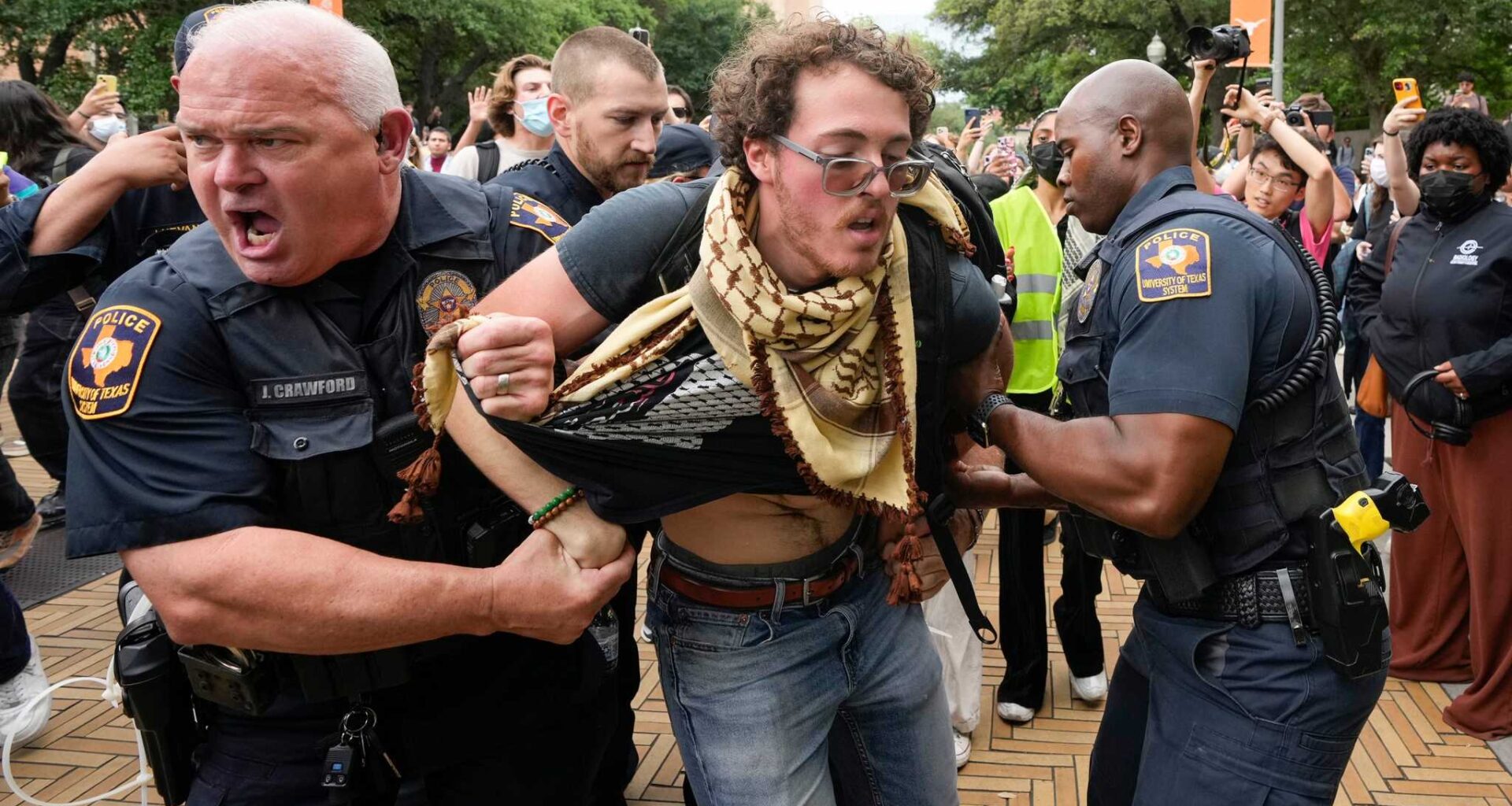
University of Texas police officers arrest UT student Ammer Qaddumi at a pro-Palestinian protest at UT Wednesday April 24, 2024.
Jay Janner / American-Statesman
A federal judge next week will hear a former University of Texas student’s claim that UT violated his free speech rights when the university arrested and suspended him for participating in a 2024 pro-Palestinian campus protest.
On April 24, 2024, then-UT president Jay Hartzell called state troopers to respond to a pro-Palestinian protest he said was disruptive and unsafe. That day, police arrested 57 people, including the plaintiff, Ammer Qaddumi, who has asserted the protest was peaceful.
Starting Monday, U.S. District Judge Robert Pitman will hear arguments from attorneys representing Qaddumi and UT President Jim Davis, who is standing in for Hartzell. Pitman will decide if the university violated Qaddumi’s First Amendment rights through viewpoint discrimination or retaliation. The trial is scheduled to last through Wednesday at an Austin courthouse and will not involve a jury.
Article continues below this ad
Pitman ruled in April that UT must face Qaddumi in court to determine if his three-semester suspension, which ended last August, violated his rights. Though Qaddumi has returned to campus and is set to graduate this May, the suspension on his record threatens his employment and academic future, Pitman ruled.
Qaddumi is asking the judge to strike the suspension from his record, court documents show. Davis, represented by Michael Best & Friedrich LLP, argues in court documents that UT was warranted in its actions and did not discriminate against Qaddumi when enforcing its rules.
This is the first time UT will publicly respond in front of a judge to allegations that it violated students’ free speech rights during the spring 2024 protests. There are at least three pending legal cases against the university; in each, the university has stood by its response to the protests.
What to know
As Israel’s war in Gaza entered its sixth month and Palestinian death tolls climbed, a national student protest movement spread across colleges and universities nationwide. Students camped out on university properties in April 2024 to demand their institutions divest from companies contributing weapons to the war.
Article continues below this ad
Qaddumi, a junior at the time of the protest, served as a leader in the Palestine Solidarity Committee, a student group that has organized demonstrations against Israel’s intervention in Gaza for years. On April 23, the organization announced on social media that it would protest in solidarity with other campuses and “occupy” UT’s South Mall throughout the day.
Officials with UT’s dean of students office proactively canceled the protest that night, citing the student organization’s social media posts. Officials said that if the student group followed national protests’ playbook, it would break institutional rules that barred disruptive conduct and encampments. They warned that students would face discipline up to suspension if they continued with their plans. At the April 24 protest, Qaddumi coordinated with the dean of students office, but proceeded with the planned protest that he asserted would be peaceful and compliant.
Armed state troopers on foot, bike and horseback met the protesters on Speedway and blocked their path to the South Lawn. Eventually, police ordered protesters to disperse.
Qaddumi, who was working to facilitate the dispersal order with police, was the first person arrested that day for alleged criminal trespassing. The Travis County District Attorney dropped charges against him and other protesters the next day, citing lack of probable cause.
Ammer Qaddumi, one of the protesters arrested on Wednesday, April 24,2024, participates in a chant outside the Main Building on campus. Professors, students, and supporters of UT-Austin demonstrated on campus on Thursday, April 25, 2024
Ricardo B. Brazziell/American-Statesman
After investigating his conduct in their university disciplinary proceedings, UT moved to suspend Qaddumi from campus for three semesters. He appealed, and a student conduct panel ruled that Qaddumi should face a deferred suspension instead and take an ethical decision making course. Deferred suspension, which many other 2024 protesters faced, would allow students to remain at school unless they broke another rule.
Article continues below this ad
A university appellate officer overruled that finding and left him with the three-semester suspension. He served that suspension from August 2024 through August 2025 and is set to graduate this May, per court documents.
In August 2024, Qaddumi sued the university for his arrest and suspension, alleging the university was discriminating against his speech due to its content, which was unpopular among state politicians who praised Hartzell’s quick response to the protests.
Qaddumi failed to secure an emergency injunction from Judge Pitman blocking the suspension, but the judge let his case proceed so lawyers could lay out arguments around viewpoint discrimination and retaliation.
The bench trial begins in Austin Courtroom 4 on W Fifth Street at 8:30 a.m. Monday.
Article continues below this ad