
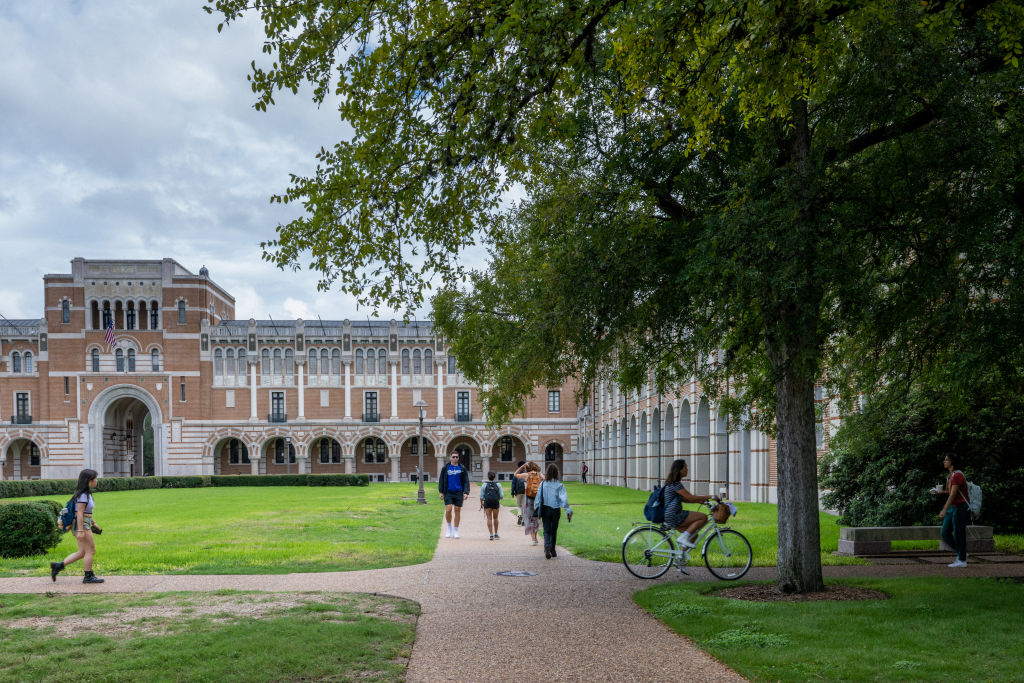
HOUSTON, TEXAS – AUGUST 29: Students walk to class at Rice University on August 29, 2022 in Houston, Texas. (Photo by Brandon Bell/Getty Images)
Brandon Bell/Getty Images
In 1983, the roadmap into higher education in Texas seemed simple: graduate high school, attend a four-year university, earn a degree and step into a stable career.

Forty-two years later, that path looks far less attainable. The cost of college tuition has surged by a staggering 914 percent, according to a recently released JP Morgan report—reshaping what higher education means for Texas families.
Article continues below this ad
In Texas, that shift is already visible with several private universities approaching the $100,000-a-year mark—once tuition, housing, and living expenses are included .
As costs continue to outpace financial aid, higher education experts warn that attending a traditional four-year university is becoming increasingly difficult for middle and lower income Texas families to afford without significant debt.
“We basically put families in a position and students in a position where the only option is to either not go to college at all or to take on loans,” said Michelle Zampini, associate vice president for Institute for College Access and Success.
The institute, also known as TICAS, focuses on college affordability and federal policy. According to Zampini, it’s not just the cost of tuition students are having to shoulder; it’s the added costs of everything else that comes with attending college, such as housing, transportation and meals.
Article continues below this ad
Which Texas schools are nearing $100,000?
Several Texas private universities are already approaching the six-figure threshold once added costs are factored in.
1. Rice University
Rice University currently holds the highest price tag in Texas. For incoming freshmen, the university estimates the total annual cost of attendance at roughly $97,000, including tuition, housing, meals, books and personal expenses.
Article continues below this ad
While Rice says 55 percent of students receive some sort of aid, middle-class families often find themselves caught in the gap of making too much to qualify for aid, but not making enough to fully cover costs.
“Most of the vast majority of American families cannot afford to pay fully out of pocket for college just period, even with grant aid,” said Zampini.
2. Southern Methodist University
Southern Methodist University (SMU) in Dallas follows closely behind, with an estimated total cost of $96,388, according to the school’s website.
On top of tuition, housing predominantly takes a big percentage in the total cost, listed at $20,950 to live on campus for two semesters, or eight months.
Article continues below this ad
Those steep living expenses mirror the broader housing challenges facing students across the Dallas area. In a study conducted by Dallas College, up to 55 percent of students reported experiencing housing insecurity, highlighting the financial strain many college students face beyond tuition costs alone.
SMU Southern Methodist University Dallas Texas
Star Tribune via Getty Images/Moment Editorial/Getty Images
“The pressure is much higher and more complex than most people realize,” said Jordan Currin who currently attends community college in Dallas with plans on transferring to a four-year university in two years.
“From what I’ve seen, housing has become the biggest financial pressure point,” Diaz told Chron.
Article continues below this ad
3. Baylor University
Baylor University in Waco ranks third, with estimated annual costs ranging from $86,000 to $92,299.
Per their website, upfront housing costs appear to be significantly lower compared to schools located in more metro areas, like Houston and Dallas.
A student walks on the Baylor University campus in Waco, Texas on December 8, 2022. (Photo by Andy JACOBSOHN / AFP)
ANDY JACOBSOHN/AFP via Getty Images
However, beyond tuition, students are still expected to budget thousands more annually for transportation, books, supplies and personal expenses, costs higher education advocates say are often underestimated by families planning for college.
Article continues below this ad
“It’s the cost beyond tuition that is the biggest struggle. So living costs, or, you know, rent, transportation, for many students, childcare,” said Zampini, “all of those things come together to influence what people are experiencing with paying for college, even if it’s not necessarily directly related to the cost of tuition.”
4. Texas Christian University
Last on the list at number four is Texas Christian University located in Fort Worth with an estimated total cost of $89,810.
Article continues below this ad
Research shows borrowing is more common at private universities like TCU than at public institutions. However across both sectors, students are increasingly relying on financial aid, with nearly 60 percent of Texas high school seniors completing a FAFSA form this year, an eight point jump compared to last year, according to National College Attainment Network data.
F: An exterior view of Amon G. Carter Stadium . (Photo by Nick Tre. Smith/Icon Sportswire via Getty Images)
Icon Sportswire/Icon Sportswire via Getty Images
As prices continue to climb, financial experts warn the burden could become even more severe for future generations. JP Morgan’s report estimates the total cost of attending a private university for four years could range from roughly $263,000 for a current first-year student to as much as $632,000 for a child born today due to continued tuition inflation.
Article continues below this ad
If those trends continue, families could eventually face close to $1 million in total costs to send a child to a private four-year university by 2044.