
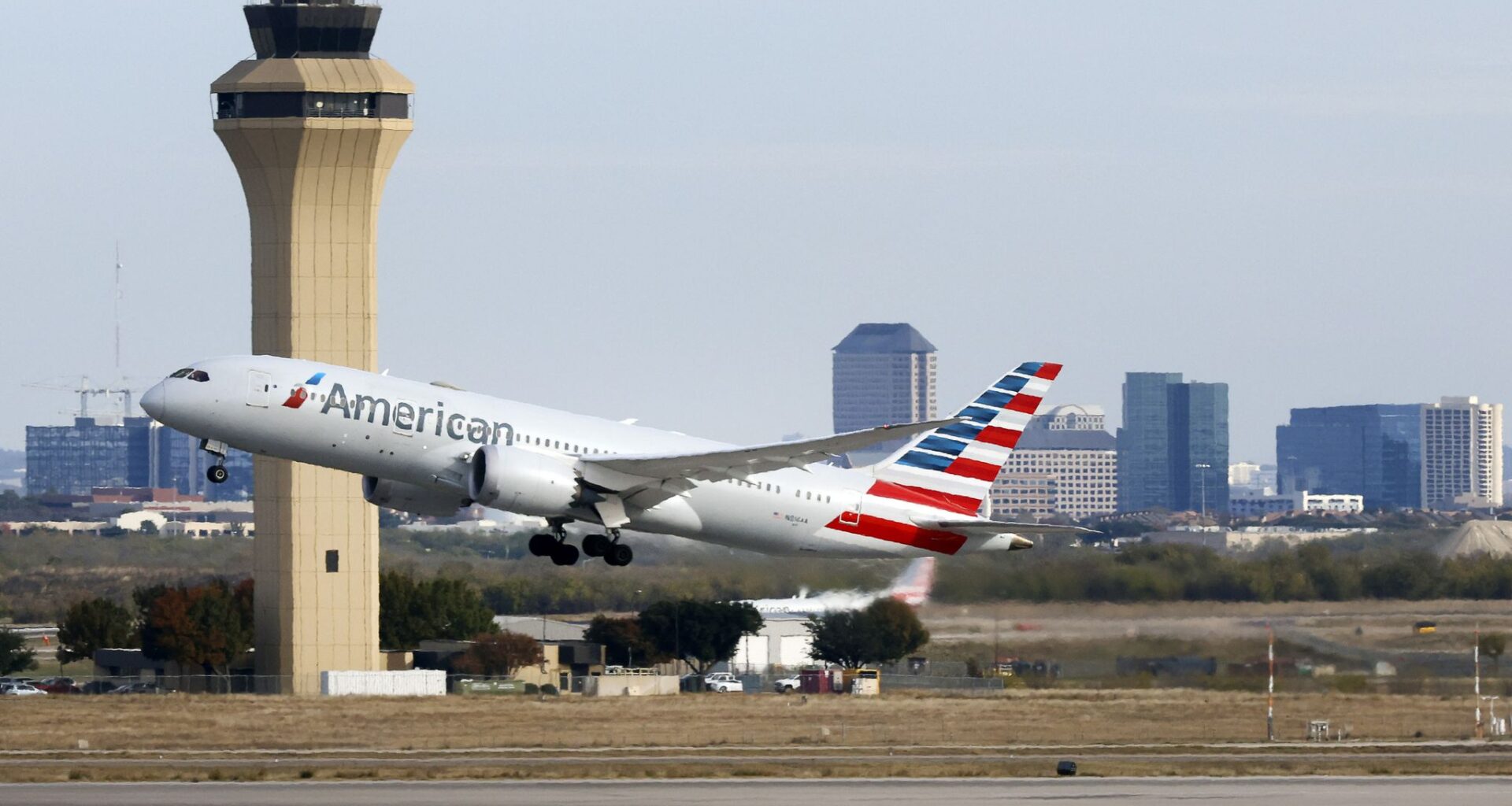
An American Airlines jet takes off past the control tower at DFW Airport.
Tom Fox/Staff Photographer
As the home of two of the nation’s four largest airlines – Fort Worth-based American Airlines and Dallas-based Southwest Airlines – aviation has had a huge impact on North Texas.

Nowhere is that more apparent than at the region’s two major airports: DFW International Airport (DFW) and Dallas Love Field (DAL).
Article continues below this ad
But how do the two airports compare? What are the benefits and downsides of each?
Here’s what you need to know:
Airport size
DFW Airport is, by far, the region’s biggest and busiest airport. In fact, DFW is the second-busiest airport in the country by passenger volume, servicing nearly 86 million passengers in 2025. It is the fourth-busiest in the world, behind Atlanta, Dubai and Tokyo Haneda.
Article continues below this ad
Make Dallas News a preferred source so your search results prioritize writing by actual people, not AI.
Add Preferred Source
Traffic at DFW flows through five distinct terminals connected externally by International Parkway. The airport is also connected by the Skylink light rail that can take passengers between terminals once they go through security.
By comparison, Love Field’s operations are more limited. The airport, which serves as Southwest’s main hub in the area, serviced just over 16 million passengers in 2025, according to the airport’s passenger statistics.
A Southwest Airlines jet from Tampa in March pulled up to the gate at Dallas Love Field as another took off. The jet continued nonstop to Seattle-Tacoma International Airport. The flight, which is the longest nonstop flight from Dallas, is now year-round after being just seasonal.
Tom Fox/Staff Photographer
Airlines and destinations
DFW is the main hub for American, but services 32 airlines, according to its website. That includes the three largest domestic carriers in the United States – American, Delta and United – but also a bevy of international airlines like Air France, Emirates, Japan Airlines, Qantas and more.
Article continues below this ad
It has more than 160 gates and flies to more than 270 destinations worldwide. Its furthest routes include a nearly 18-hour flight to Melbourne and flights to Hong Kong, Shanghai and other major Asian cities, according to flightsfrom.com.
Only two airlines fly to Love Field – Southwest and Delta – with the former making up 98% of the airport’s traffic last year.
Love Field has 20 gates which service 79 routes domestically across the United States. Those destinations range from Seattle to Miami to Boston.
A DART train arrives at the station at Terminal C at DFW International Airport.
David Woo – AP
Location and transportation
Built almost exactly between Dallas and Fort Worth, DFW Airport is essentially in the geographic center of the D-FW area. It is about 20 miles from downtown Dallas and 24 miles from downtown Fort Worth. That makes it relatively accessible to travelers across North Texas.
Article continues below this ad
Love Field, on the other hand, is less than seven miles from downtown Dallas. That makes it a more convenient option for travelers from the city of Dallas or from suburbs on the eastern side of the region who are looking to avoid a longer drive.
For those looking for public transportation in and out of the airports, both airports offer options on Dallas Area Rapid Transit (DART). DFW also has connections to Fort Worth via the Trinity Railway Express (TRE) and TEXRail. Travelers headed to and from Denton can take the A-Train to DFW with transfers to DART’s Green Line and then to the Orange Line.
For DFW, the DART’s Orange Line light rail has trains going directly to Terminal A with connectivity to other light rail lines in downtown Dallas. The new Silver Line also offers light rail service from Plano to its endpoint in DFW’s Terminal B. TEXRail connects downtown Fort Worth directly to Terminal B. Those on TRE can reach the airport from the CentrePort station via the TRE Link Shuttle. Find more information on DFW’s public transit connections here.
Love Field is connected to the public transit network via the Love Link (Bus route No. 005), which runs between Love Field’s terminal and the Inwood/Love Field light rail station. The station services DART’s Orange and Green Lines. Find more information here.
Article continues below this ad
DFW International Airport features the American Express Centurion Lounge.
American Express
Amenities
Both airports feature a wide variety of dining and shopping options as well as other amenities geared toward families and fliers with pets. You can find more information for DFW here and for Love Field here.
However, one major difference between the two airports is the presence of traveler lounges at DFW. That includes lounges from travel credit card issuers like Capital One and American Express, as well as airline lounges like American’s Admirals Club, Delta’s Sky Club and more.
Article continues below this ad
Moving forward

By signing up, you agree to our Terms Of Use and acknowledge that your information will be used as described in our Privacy Policy.
The “DFW Forward” project, a nearly $12 billion capital improvements plan, marks the future of the region’s largest airport. The biggest change this will bring is the addition of a sixth terminal with 31 new gates already committed to American Airlines. The initial phase of Terminal F – 15 new gates – is slated to open in 2027 while the rest of the terminal is expected to open in 2030. The project also includes billions in investment to renovate and expand Terminals A and C as well as numerous other smaller projects across the airport.
There are also various ongoing improvement projects at Love Field, though nothing on the scale of “DFW Forward.” Projects at Love Field include parking garage repairs and construction of new taxiways.
Article continues below this ad
Beyond Love Field and DFW, commercial aviation is also expanding in other parts of North Texas. McKinney National Airport (TKI) is about 30 miles north of Dallas and is in the middle of a $79 million project to add a passenger terminal, which is set to begin operations in late 2026. Houston-based ultra-low-cost carrier Avelo Airlines, which signed a five-year use-and-lease agreement with the airport in 2025, will be the first to fly out of McKinney.