
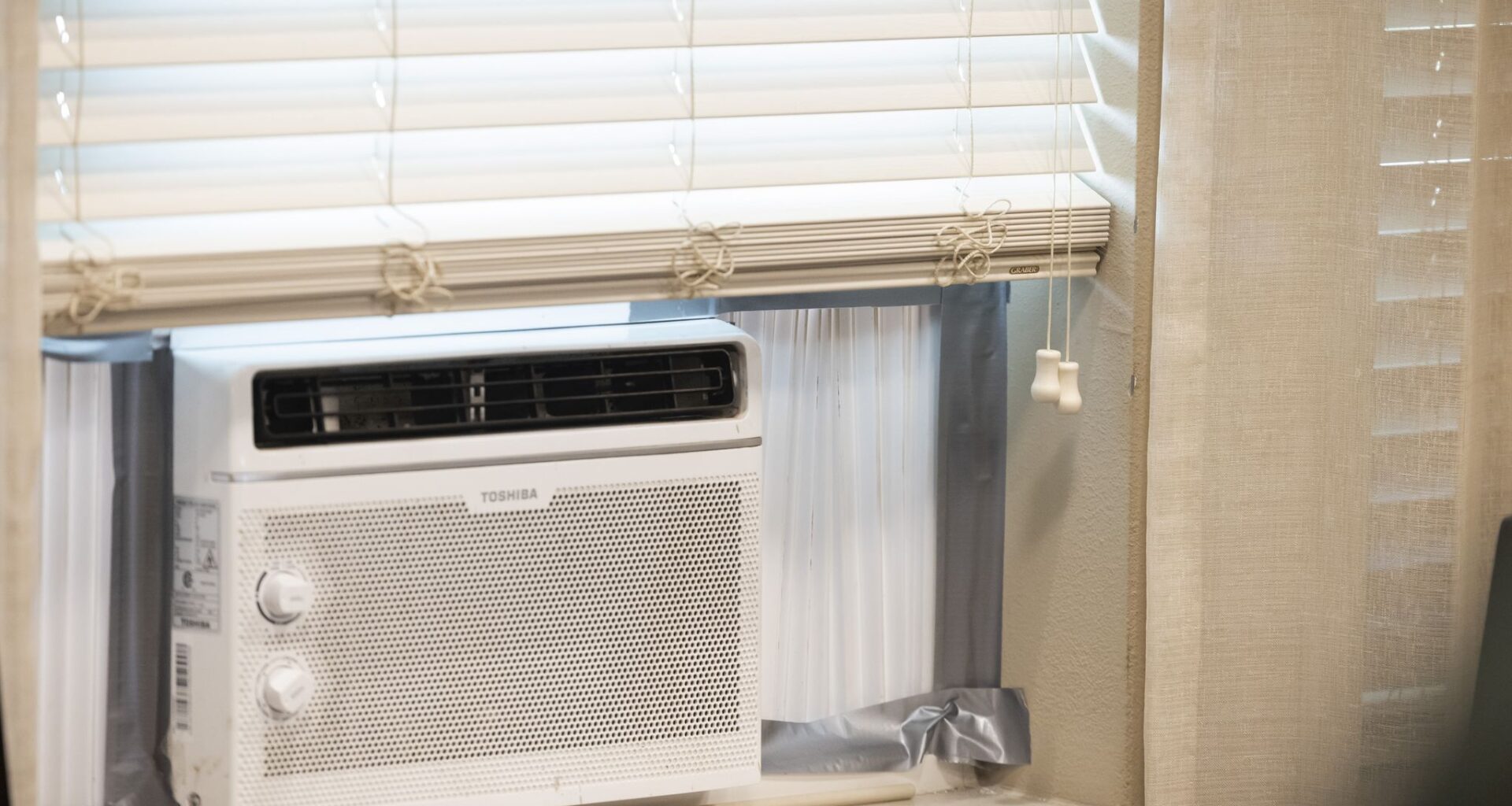
A window air conditioning unit is secured with duct tape in the common room of Wheatley Park Senior Living in San Antonio in September 2025. Increasingly, Texans are trying to reduce costs by using less energy — no matter how uncomfortable or even dangerous that is — because they can’t afford it, our guest columnist writes.
Josie Norris/San Antonio Express-News
Roberto Loera places a box fan in the kitchen of his West Side home in June 2023. The Texas Energy Poverty Research Institute’s survey data rated Bexar County and San Antonio as having high vulnerability in which households face significant difficulty managing energy costs requiring sacrifices or behavioral changes, our guest columnist writes.
Jerry Lara/San Antonio Express-News
It’s warm outside, and it’s about to get a lot hotter. For most Texans, air conditioning is a fact of life — a necessity to get through summer days.

But for millions of our neighbors, air conditioning is too expensive to turn on, especially in the face of rising energy prices.
Article continues below this ad
Energy impacts almost every facet of our lives, from health to work to food security. It powers our communication devices, connects us to jobs and schools, and keeps our homes livable, even through extreme heat and cold.
Yet in Texas, more and more people are trying to cut costs by using less energy — no matter how uncomfortable or even dangerous that is — because they cannot afford it.
The Texas Energy Poverty Research Institute’s survey data of almost 7,000 low- and moderate-income households reveals the challenges people have affording energy, with 50% of respondents reporting difficulty paying their electricity bills each month.
ALSO READ: CPS Energy says it will ‘get through summer’ before deciding whether to ask for rate increase
Article continues below this ad
Falling behind on energy bills can lead to bigger problems for Texans, forcing painful trade-offs with other necessities. In the TEPRI survey, 72% of respondents reported cutting back on household spending such as medicine and school supplies, and 65% reported practicing energy-limiting behaviors such as turning off their air conditioning in the summer to control costs.
The TEPRI rated Bexar County and San Antonio as having high vulnerability in which households face significant difficulty managing energy costs requiring sacrifices or behavioral changes.
These troubling trends are not surprising. New research from the TEPRI shows that electricity bills have risen 30% since 2020, due in part to extreme weather and the need to fortify our energy system to avert future outages. The TEPRI projects that costs will rise another 30% over the next five years, largely due to growing infrastructure needs.
The result is that millions of Texans can’t pay their bills.
Article continues below this ad
According to a report published this month from the U.S. Energy Information Administration, Texas leads the nation in electricity disconnections. While Texas households represent 9% of U.S. electricity customers, they account for 22.5% of electricity shutoffs. More than 3 million Texas households had their power cut off in 2024 — and energy prices continue to rise.
The federal government offers a bill-assistance program in Texas, but the system crashed last year when more than 100,000 Texans applied for 5,000 slots.
Texans are protected during extreme weather, as they cannot have their power cut off when it is very hot or very cold, or if they have a critical medical condition, but those protections are not sufficient.
Texas is the nation’s energy capital. We are at the forefront of innovation in batteries, solar and new household-level technologies that have the potential to deliver affordable and reliable energy year-round.
Article continues below this ad
Energy-efficient upgrades, especially in older homes and apartments, can provide meaningful savings. Demand response programs have the ability to compensate customers for the full value of conservation. Future technologies for optimizing batteries and smart thermostats have the ability to provide deeper savings.
The Texas energy system is at a pivotal moment. We must modernize to meet the moment and the needs of our neighbors.
Margo Weisz is executive director of the Texas Energy Poverty Research Institute.