
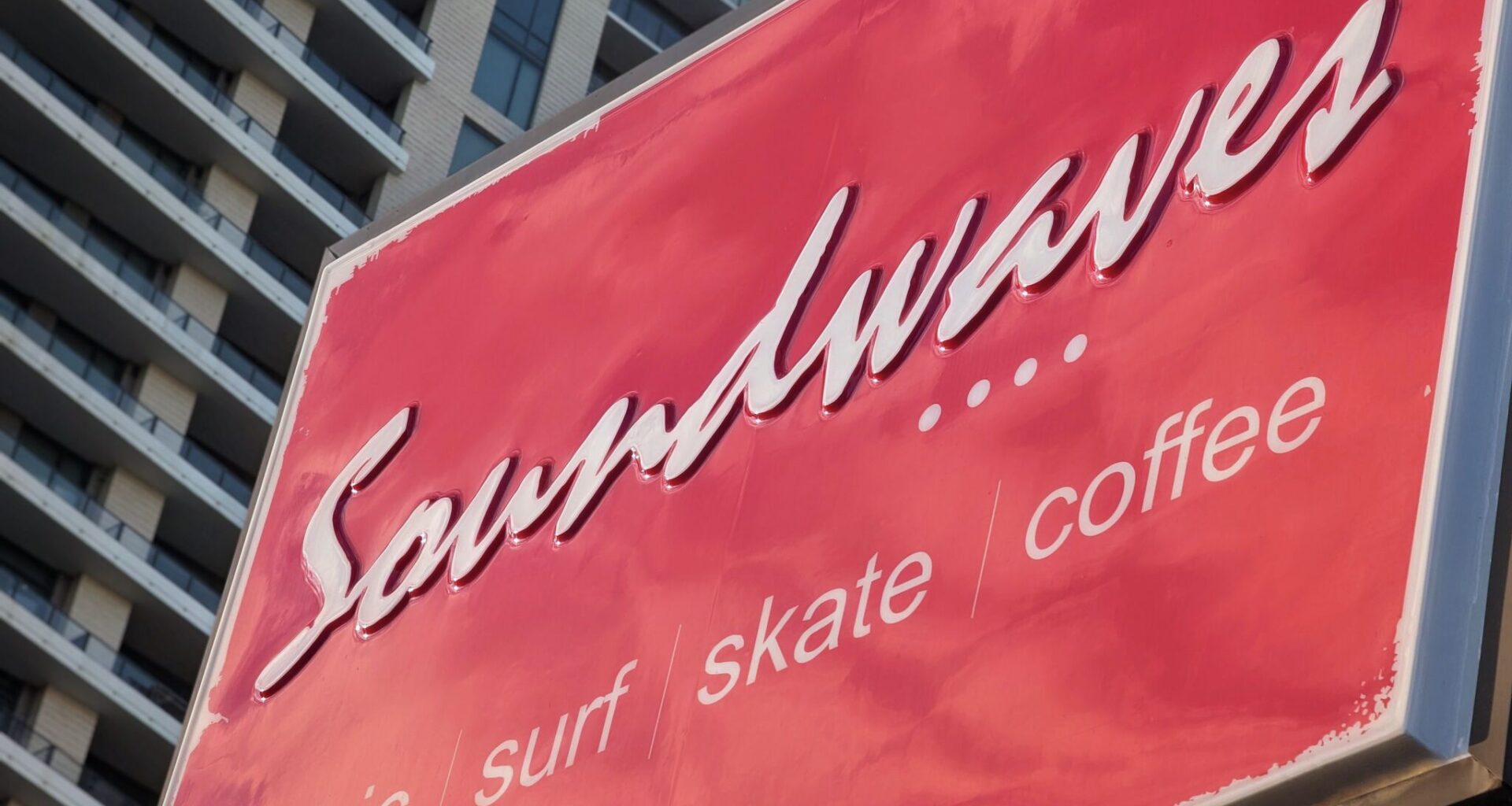
Soundwaves, a landmark on Montrose Blvd., has closed.
Cary Darling
Soundwaves’ last Houston outpost, the record store’s Montrose location, has closed. The timing feels significant to me: It’s happening as I am too leaving Montrose for family life in the Heights. Both Montrose and I have changed.
When I was in Pearland High School, from 1997 until 2001, we would skip school on Tuesdays at midday, meet in the parking lot and point my rusty, scratched ’91 Buick LeSabre there. Back then, four teenagers chipping in $5 apiece for gas could amount to a full tank, enough for us to tool around the second-hand shops and get back in time for someone’s 5 p.m. shift at Kroger.
Jeff Spargo, founder of the Soundwaves chain, at the Montrose flagship store in 2000. Spargo said that his willingness to stock edgy music gave him an advantage over discount megastores.
Ben DeSoto/Houston Chronicle
Our stops in the city usually included Van Loc, a Vietnamese restaurant off Milam. We’d drive by music venues like The Oven, Proletariat, and Numbers, and check the Houston Press (the print edition, of course) to figure out the next show we wanted to see. When it was 21+, we were forlorn.
Article continues below this ad
And invariably, we stopped at Soundwaves. There, asking an older person about a band or album was thrilling. First, you wanted to impress them with your query; second, you wanted to acquire that recording; and third, you hoped to build a rapport so the next time you’d be recognized as savvy and maybe get another recommendation that would elevate your taste.
Somehow, the world felt much, much bigger before social media and illegal file-sharing, before every single piece of music ever recorded could be streamed from a computer in your pocket.
In 2001, Sean Combs (now known as Diddy, formerly Puff Daddy and P. Diddy) signed autographs at a Soundwaves store in Houston.
Andrew Innerarity/Houston Chronicle
My specialty was street punk, starting with my love of California’s Rancid, a Bay Area band with a slurring singer, two mohawks and Clash-like branding. With each visit to Soundwaves, I’d level up, like passing a course. Oh, you liked Discharge? Well, have you heard Motorhead?
The used LPs and discs meant that, for a few dollars less than a new album, we could take a chance on something wild and interesting. We’d bring handwritten lists, checking for a band someone at a house party had hipped you to, or an artist’s name you heard another artist name-check in an interview.
Article continues below this ad
Sometimes we had to special-order an album at the service desk. That felt godly, like summoning knowledge from other realms — or at least a distribution office in the UK.
Soundwaves, seen here in 2005, carried not just music but also surf and skate gear.
Bill Olive/for the Chronicle
The drive home was all about showing off our purchases for a few songs. I’d play DJ as my friends cracked open their CD jewel cases and handed me their new discs. I learned more about my friends with each cut.
One friend was all about sturdy, crestfallen emo. Another was obsessed with Norwegian mod punk, which had punchy synths, garage-rock fuzz and vaguely socialist lyrics.
My friends made fun of my crucial bands, full of stoic dudes in Doc Martens and Fred Perry polos, singing songs about working-class heroes. Hey, to me, stocking milk and biscuits at Kroger was the same as working on the docks in Bristol.
Article continues below this ad
Later, I would befoul my parents’ beloved Sony turntable. They preferred it to be occupied by the “Grease” soundtrack or a Queen album. I’d play 7-inch vinyl singles by Hot Water Music and The Business, or second-wave ska LPs by The Specials and The Selecter.
In February 2000, fans waited outside Soundwaves to meet members of Smashing Pumpkins.
E. Joseph Deering/Houston Chronicle
We suburban kids probably annoyed people who lived in Montrose. But for us, the neighborhood was magical: It was where we found our subcultures and figured out how we fit into the world.
We’d come back to Pearland with some new knowledge or street sensibility. We’d see a trans person at Disco Kroger buying hairspray, a gutter punk begging for change in front of Condom Sense, a beleaguered tattoo artist getting a Red Bull at the corner store before a long shift of etching tribal art into someone’s arm.
In 2008, Vans skateboarding sneakers cost $39.95 at Soundwaves.
Steve Ueckert/Houston Chronicle
Later, in my early 20s, I’d browse the aisles at Soundwaves for more eclectic sounds, like Funkadelic, Bad Brains, glam-era Lou Reed or stoner-rock groups like Kyuss and High On Fire. Some of the same clerks were still working the checkout line. I hoped they admired my progress. Later on, when I became a music writer, I realized those trips to the record store were incredibly impactful, tactile first steps.
Article continues below this ad
And at last, by my mid-twenties, I moved into Montrose myself. I became part of the place.
Maybe, to teenagers visiting from Pearland, I looked like I belonged.
Craig Hlavaty loves playing weird and annoying music for his stepsons on the way to school in the hopes that someday they will love it as much as he does.