
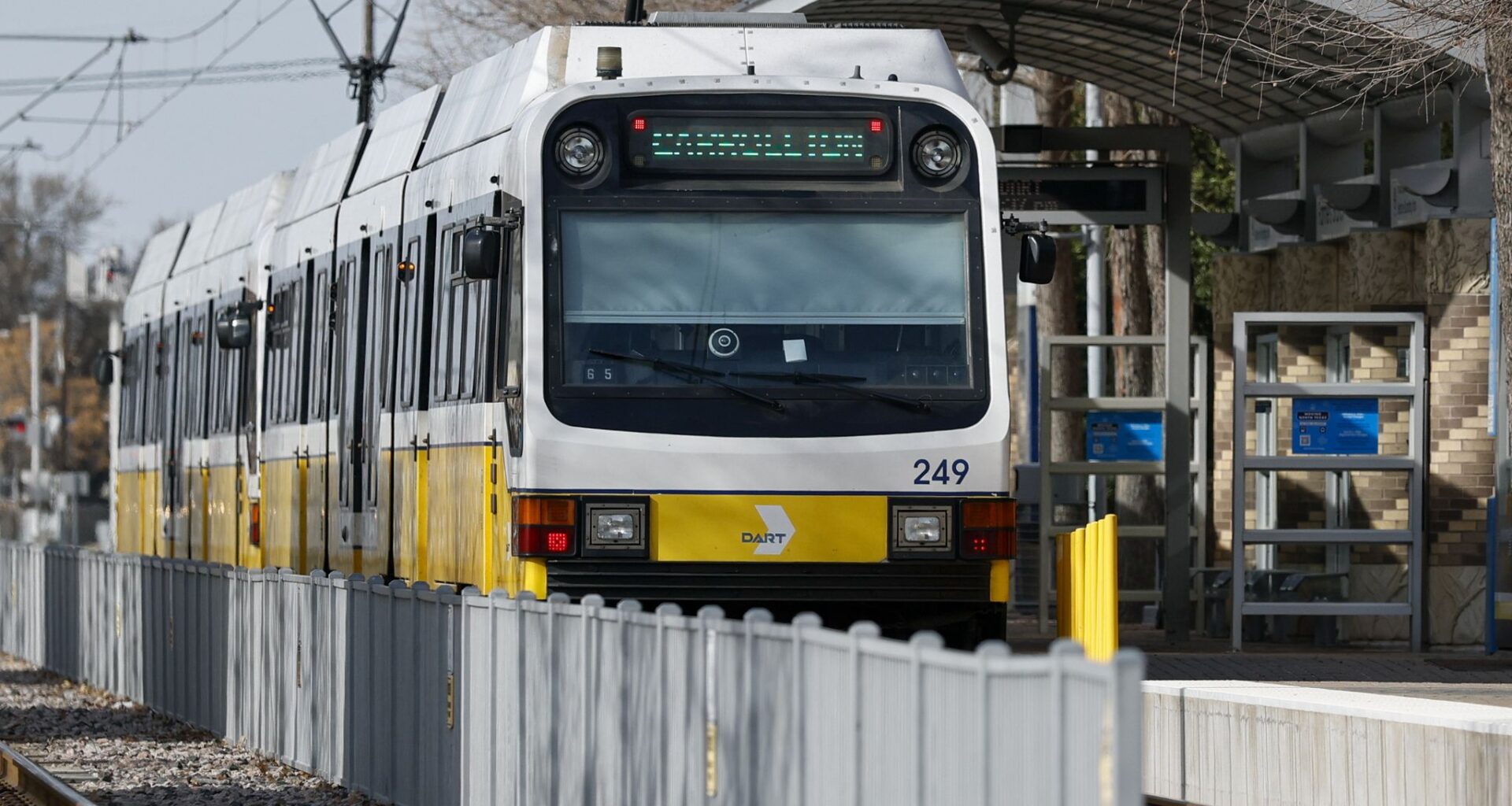
A DART Green Line train rolls into the Farmers Branch Station. Farmers Branch is one of 12 member cities that are part of DART.
Elías Valverde II/Staff Photographer
Dallas Area Rapid Transit (DART) has become central to North Texas’ public transportation infrastructure since its founding in 1983.

It has now expanded to five light rail lines, regional rail services and hundreds of bus routes across 12 member cities in the Dallas area. DART serves more than 170,000 daily passengers in its 700-square mile service area, according to its website.
Article continues below this ad
Here’s everything you need to know about the agency:
What cities are a part of DART?
There are 12 member cities that are part of DART.
Addison
Carrollton
Cockrell Hill
Dallas
Farmers Branch
Garland
Glenn Heights
Irving
Richardson
Rowlett
Plano
University Park
Article continues below this ad
What services does DART offer?
DART’s transit options include trains, buses and more.
Make Dallas News a preferred source so your search results prioritize writing by actual people, not AI.
Add Preferred Source
Its 93-mile light rail network is among the nation’s longest and has five lines that stretch from Plano to south Oak Cliff and from DFW International Airport to Rowlett. DART also features a regional rail network highlighted by the Trinity Railway Express that connects Dallas and Fort Worth.
Article continues below this ad
The agency manages more than 100 bus routes, the on-demand GoLink service, paratransit services and more throughout the Dallas area.
How much does it cost to ride DART?
A DART day pass for local service costs $6 for unlimited rides starting the day it is activated until 3 a.m. the following day. A local 3-hour pass costs $3 and is valid for unlimited rides for three hours after activation. A regional day pass is $9 and is valid for rides on the Denton County Transportation Authority’s A-Train and Trinity Metro’s TEXRail.
Article continues below this ad
There are special fares for the TRE, the Dallas Streetcar and paratransit services. The agency offers local and regional 31 day passes.
DART also offers 50% reduced fares to qualifying passengers, including veterans, people 65 and older, students, persons with disabilities and more.
DART passes can be purchased on the mobile GoPass app, at a DART ticket vending machine or with a GoPass tap card. Contactless payment is available on all DART bus, light rail and Dallas Streetcar vehicles with a contactless credit or debit card and with a payment-enabled mobile phone.
How is DART funded?
The vast majority of DART’s funding comes from local sales taxes. Under Texas law, cities can collect up to two cents of every dollar spent locally with DART’s member cities each giving one penny to the agency.
Article continues below this ad
Related: Who pays for public transportation in North Texas? How DART is funded and governed
Those revenues added up to just over $26 billion, which made up 82% of DART’s funding for the 2025 fiscal year. Other sources of funding include federal funds, operational revenues and more.
‘The future of DART’
Highland Park residents voted to leave DART in May 2026 after spending more than 40 years as part of the transit network. It became the first city to leave since Coppell and Flower Mound did so in 1989.
Article continues below this ad

By signing up, you agree to our Terms Of Use and acknowledge that your information will be used as described in our Privacy Policy.
As such, DART services in Highland Park will be discontinued after May 13.
It was a relatively positive outcome for DART when you consider that half a dozen other cities also considered leaving the agency. Addison and University Park voters chose to remain with DART. Farmers Branch, Irving and Plano also considered leaving, but the three cities canceled potential exit elections after reaching a compromise with the agency earlier this year.
In the aftermath of the 2026 withdrawal elections, DART Board Chair Randall Bryant said the agency will continue to look beyond its current borders even after losing Highland Park. He called expansion north to McKinney and in the agency’s southern sector “the future of DART.”