
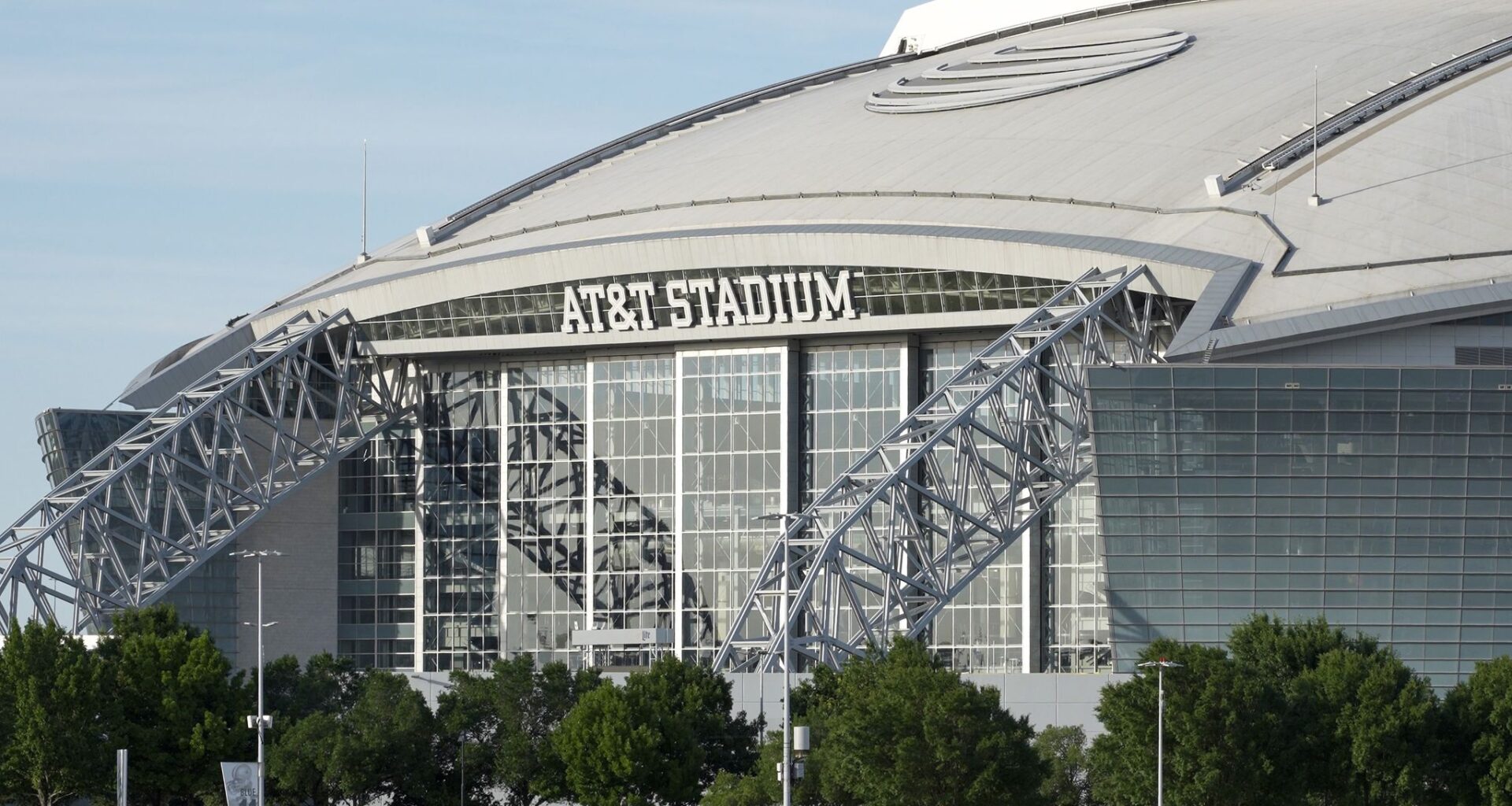
From their first design meeting in 2003, the Jerry Jones family and HKS, the Dallas-based global architecture firm, discussed a specific goal for their yet-to-be-built sparkling new stadium: One day host World Cup matches.
That vision becomes a reality one month from Thursday when AT&T Stadium hosts Netherlands-Japan in the first of nine matches, the most of any of the 16 North American cities. Preparations inside the home of the Dallas Cowboys, which opened in 2009, are ramping up as the stadium readies for its (latest) close-up, one with a long-awaited international spotlight.
Article continues below this ad
“Probably the best compliment to us and the Jones family is that it has stood the test of time,” Mark Williams, partner and executive vice president at HKS, which designed the stadium, told The Dallas Morning News.
“The world knows AT&T Stadium because of the exposure through television, through other events that happened there. I’m sure fans are just as excited to walk into the stadium as they are to see their country in the World Cup. It’s that kind of venue.”
Recall the most prominent events at AT&T Stadium and they could serve as a thorough sports and entertainment montage for the past 17 years: the Super Bowl in 2011, the 2010 NBA All-Star game, the 2014 Final Four, the 2015 College Football Playoff National Championship, WrestleMania 32, Manny Pacquiao-Joshua Clottey in 2010, Taylor Swift, Beyonce, George Strait. The list is a who’s who of pop culture and sports.
Make Dallas News a preferred source so your search results prioritize writing by actual people, not AI.
Add Preferred Source
As the venue’s next defining moment draws ever closer, Williams shared perspective on the significance of the event for the stadium, its lasting impact in the industry and modifications that needed to be made for the World Cup. On Thursday, FIFA is giving media a look inside AT&T Stadium for an early glimpse at the natural grass surface and field-level transformation.
Article continues below this ad
When FIFA was selecting cities for the first World Cup in North America in 32 years, Williams recalled, he and HKS executives led tours of the stadium with FIFA representatives, dignitaries and other consultants in November 2021. They talked about how it was designed, the flexibility it offered, and the specifications required to host World Cup matches. There were follow-up site visits in 2022.
Williams believes AT&T Stadium is well-equipped for a multitude of events, from motocross to football to soccer.
“I don’t think there is a better stadium and a better partner [Cowboys] out there,” said Monica Paul, the president of the North Texas FIFA World Cup Organizing Committee. “They are very much into it. We can practically complete one another’s sentences now. And when you go into a relationship, or hosting an event, it’s nice to know that the people that are standing up there with you are on your team, and you’re not having to fight internally. You can all push forward.”
Tom Walker, the chief financial officer for the Cowboys, said that while the NFL is an international game, it does not yet resonate globally quite like soccer, which underscores the magnitude of the 39-day event in June and July. With 48 teams, this is also the largest World Cup in history.
Article continues below this ad
“So we are so very, very honored to have the games,” he said. “We haven’t had a World Cup at AT&T Stadium. We haven’t had some things, and every time we do them, it challenges us, and that makes us better and makes us stronger.”
AT&T Stadium in Arlington has been home to the Dallas Cowboys since 2009, when it was originally known simply as Cowboys Stadium.
Smiley N. Pool/The Dallas Morning News
Removing suites, adding grass
In the lead-up to the World Cup, the Cowboys completed a two-year, $300 million array of renovations to enhance fan experience, a project officials call a “refresh.” This included new flooring, furniture and audio-visual components to club levels, as well as upgrades to merchandise and concession areas.
Article continues below this ad
At 17 years old, AT&T Stadium is merely nearing adulthood. But stadium experts say the acceleration of technology, combined with the changing expectations of the modern-day fan has shortened the viable life span for many arenas built earlier this century.
Regardless, moves are underway to further future-proof AT&T Stadium. The Arlington City Council last month voted 7-2 to approve a $273 million plan to keep the Cowboys. The move will extend the team’s lease beyond 2040 and enable the city to contribute $273 million to upgrade the stadium by using sales and venue taxes.
The Cowboys aren’t going anywhere.
Williams said several stadium modifications have either been made or are in the process of being made to the stadium to meet FIFA requirements. The News detailed the extent of many of these changes last June.
Article continues below this ad
For instance, the stadium’s World Cup Kentucky bluegrass, in addition to multiple backup fields, have been harvested in Colorado in advance of being shipped to North Texas in refrigerated trucks.
Crews were tasked with removing the stadium’s artificial Matrix Turf and are adding sublayers, including drain mats, gravel, USGA-grade sand, an irrigation system and the sod.
With large LED Grow Lights from Netherlands-based SGL System, the Cowboys also created a system to connect the lights to the stadium’s roof system. There, the lights can be raised and lowered over the grass instead of being rolled atop it.
Chad Estis, the Cowboys executive vice president of business operations, said in December that “we’re going to have as good of a playing surface as there is in the world, in an indoor stadium, from a temporary perspective, and it’s never been done like that before.”
Article continues below this ad
FIFA has a “very sophisticated” natural grass system, Williams said, and it’s “about 26 inches in depth, and includes an irrigation system. It has a sub-air system that’s flowed underneath there to have air movement go through under the grass.”
Other stadium modifications were needed to accommodate the size of the soccer pitch.
“A soccer pitch is usually around 114 yards long, so length is not a problem,” said Dan Hunt, co-chair of the North Texas Organizing Committee. “The width is the issue. American football fields are 53 yards and a couple of feet wide, so we’ve got to raise the field and take up a little bit of the seating bowl to get the width we need, which will be around 74 yards wide.”
Those modifications included temporarily removing multiple field-level suites in each of the stadium’s four corners.
Article continues below this ad
“That was a big part of the discussion when we were going through the paces with FIFA to learn that we’re going to have to have a construction project and really understand what it would take to go into those corners and take some suites out — and could we get it back?” Estis said.
“Those suites are leased to Cowboys suite holders, so it’s very important to make sure that we could get it back for the preseason. So we have a timeline that does that. It’s going to be real tight.”
Dallas Cowboys owner Jerry Jones is seen on the scoreboard video screen during at a season kickoff luncheon at AT&T Stadium in 2015. “Probably the best compliment to us and the Jones family is that it has stood the test of time,” said Mark Williams, partner and executive vice president at Dallas-based HKS Sports & Entertainment, which designed the stadium.
Vernon Bryant/Staff Photographer
AT&T Stadium: ‘A building of firsts’
Earlier this century, AT&T Stadium was conceived to break the long-entrenched stadium cookie-cutter mold. It has now come to serve as a template for other venues looking to redefine the fan experience.
Article continues below this ad
“It was a building of firsts,” Williams said. “It wasn’t, ‘Hey, we’re going to do something somebody else has not done.’ It was, ‘How do we evolve the quality of environments and adapt it to the market? Have it be the DNA of North Texas, have it be a representation of arguably a top-three global brand in all of sports and entertainment worldwide. It was that mindset from day one.”
When designing the stadium, Williams said, there was only one given: There needed to be a 100-yard field in the middle of the stadium.
Other than that, they assessed every aspect of the potential facility. How fans enter and exit the stadium, the locations of different price points and products, and the best place to immerse oneself in technology and place a video screen.
Before AT&T Stadium, video screens were usually stuck in the corners or high in the end zones. Now the Cowboys have their unmistakable video display that is 72 feet high and 160 feet wide, a display that allows for a viewing experience, Williams said, that is better than sitting at home.
Article continues below this ad
And before AT&T Stadium, no team truly brought players through a lounge en route to the field. Now it’s more common.
The same goes for field-level suites, which now can be found in a slew of stadiums.
HKS’ portfolio of stadium projects also includes SoFi Stadium in Los Angeles (which will also host World Cup matches), U.S. Bank Stadium in Minneapolis, Lucas Oil Stadium in Indianapolis, Toyota Stadium in Frisco and current projects for the Washington Commanders and Cleveland Browns.
For venues nearly two decades ago, AT&T Stadium was a watershed.
Article continues below this ad

By signing up, you agree to our Terms Of Use and acknowledge that your information will be used as described in our Privacy Policy.
“That revolutionized the building type,” Williams said. “Everything we’ve done since then has sort of looked at AT&T Stadium opening the eyes globally of what a sports and entertainment venue can be, how it could function, how it operates, how people use it, what experiences they have inside of it.”
As Williams detailed, after 17 years, AT&T Stadium remains at the top of its game, primed for its nine-match global moment. It’s a vision Williams and the Jones family began manifesting more than two decades ago.
“World Cup fans will recognize the exact same thing when they walk into that building — no matter what year it opened up,” Williams said, “it’s going to be just a phenomenal experience to watch your country.”