
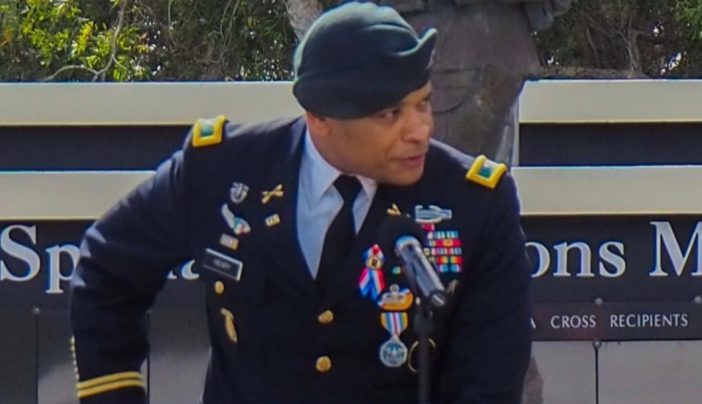
UT MD Anderson treats colon cancer recurrence
Lawrence did well for years. His family moved from Florida to Dallas. Then, scans in January 2025 revealed a new nodule in his right lung and some activity in lymph nodes in his abdomen. A biopsy confirmed a colon cancer recurrence that had spread to his lymph nodes, making it stage 4 disease.
A friend who was treated at UT MD Anderson recommended that Lawrence make an appointment.
“He told me, ‘If you have something like a broken arm or chipped tooth, go to the hospital. But cancer treatment is very specialized. So, you need to go to an institution that specializes in treating cancer, and UT MD Anderson is the best cancer hospital in the world,’” Lawrence recalls.
He had his first appointment at UT MD Anderson on March 12, 2025.
“UT MD Anderson stood out right away from other hospitals I’d been to – just in how thorough they were performing my CT scan,” he recalls. “The technicians use state-of-the-art equipment, they know what they’re looking for, and they understand how to take the pictures to provide the doctor with the best perspective. And I got my results quickly.”
Gastrointestinal medical oncologist Van Morris, M.D., went over treatment options with Lawrence, including the roles of surgery and chemotherapy.
“Dr. Morris said we could either do nothing, do chemotherapy or do chemotherapy and surgery,” Lawrence says. “He and his team walked me through each option, making sure I had a clear understanding of the pros and cons for each.”
Lawrence chose to undergo chemotherapy and surgery. He completed six rounds of the chemotherapy regimen FOLFIRI locally in Dallas and came to UT MD Anderson for scans and bloodwork. Doctors wanted the chemo to shrink the metastasis in Lawrence’s lung before surgery. The chemo did shrink the tumor.
On July 26, colon and rectal surgeon Brian Bednarski, M.D., completed surgery to remove lymph nodes in Lawrence’s abdomen, three of which were found to be cancerous.
“Dr. Bednarski had great bedside manner,” says Lawrence. “He really helped me prepare mentally for the surgery. He had normal human conversations with me. He made me laugh. He showed me he’s still a doctor, but he also possesses a human side.”
On Aug. 29, thoracic surgeon Kyle Mitchell, M.D., performed a wedge resection to remove the cancer from Lawrence’s lung.
“What I appreciate most about my surgeons was not their cultural competence, but their cultural intelligence,” he says. “They asked me about my preferences and my feelings, so they could understand the fears and concerns I had. That made me feel very comfortable proceeding with the surgeries.”
Since November, Lawrence’s scans have shown no evidence of disease, and his blood tests have shown no signs of cancer coming back. He remains off treatment for colon cancer and comes to UT MD Anderson every three months for checkups. What he most looks forward to on his visits is eating a half-pancake from the restaurant at the Rotary House Hotel. He dubs them the best pancakes in the world.
“Throughout everything, I’ve had the support of my wife, family, friends, faith and my work,” he says. “I kicked it up a gear in the community by hosting programs that put me in front of a lot of people, so I could share my story.”