
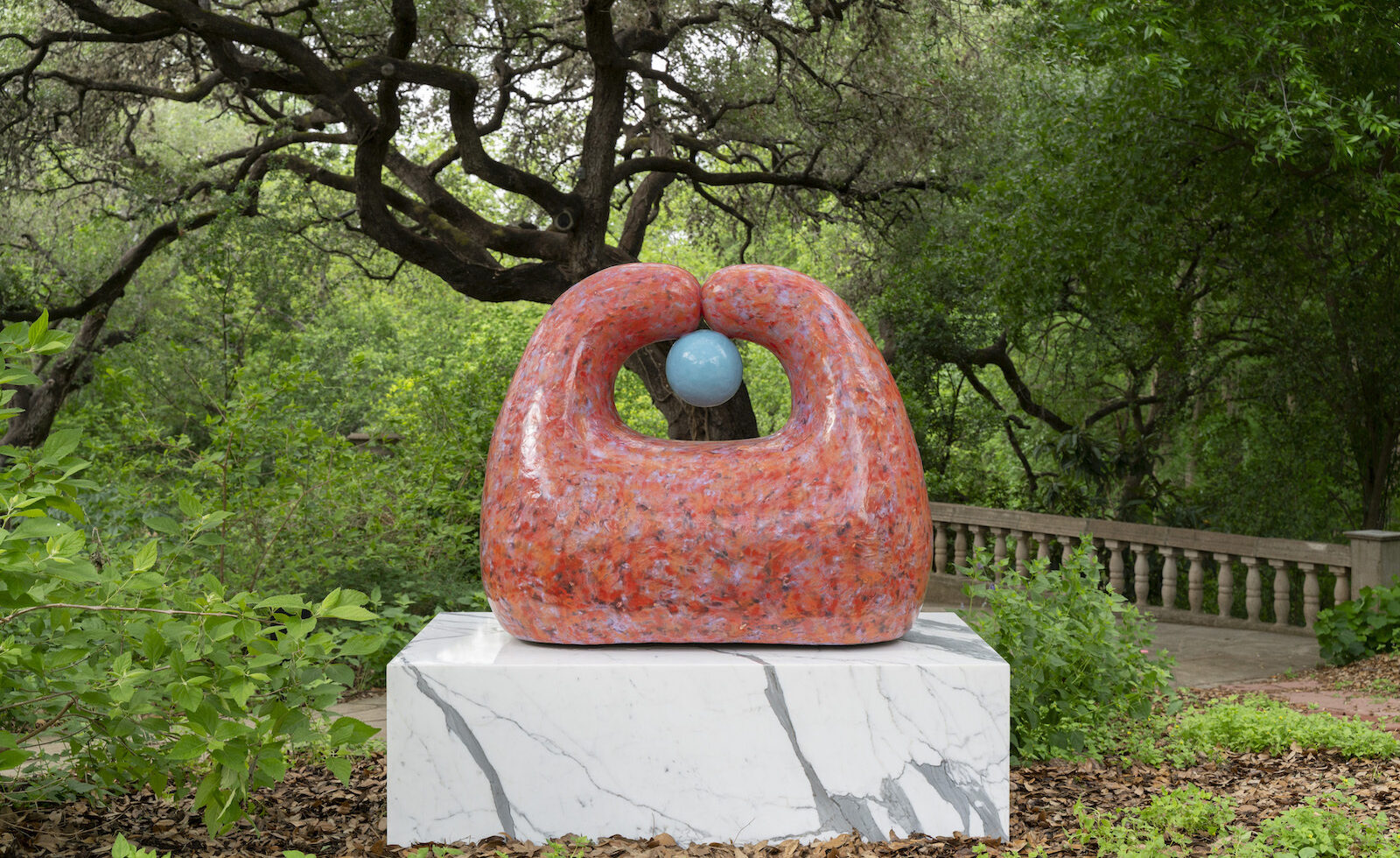
It typically takes nine months for a human to bring another human into being. So, it seems appropriate that, for Laura Lit—whose reinvention as an artist began when she became a mother—it took nine months to create Impossible Beings, an exhibition of four charming abstract sculptures at Laguna Gloria.
The works anchor a first-of-its-kind show, the outdoor debut of The Contemporary’s HOST series, which opened on April 23, and continues through January 17, 2027. It’s also Lit’s first-ever solo museum exhibition, and she was ready for it when the museum approached her last summer. “I was like, hell yeah, it’s about damn time,” she says now. “As an artist, you always hope for something like that to happen, but you don’t think it’s ever really gonna happen.” Lit also appreciated the opportunity to have a deadline for her work—dream-like images, which often come to her during focused meditation sessions. “I’ve waited my whole life to do this,” she says. “I’m ready.’”
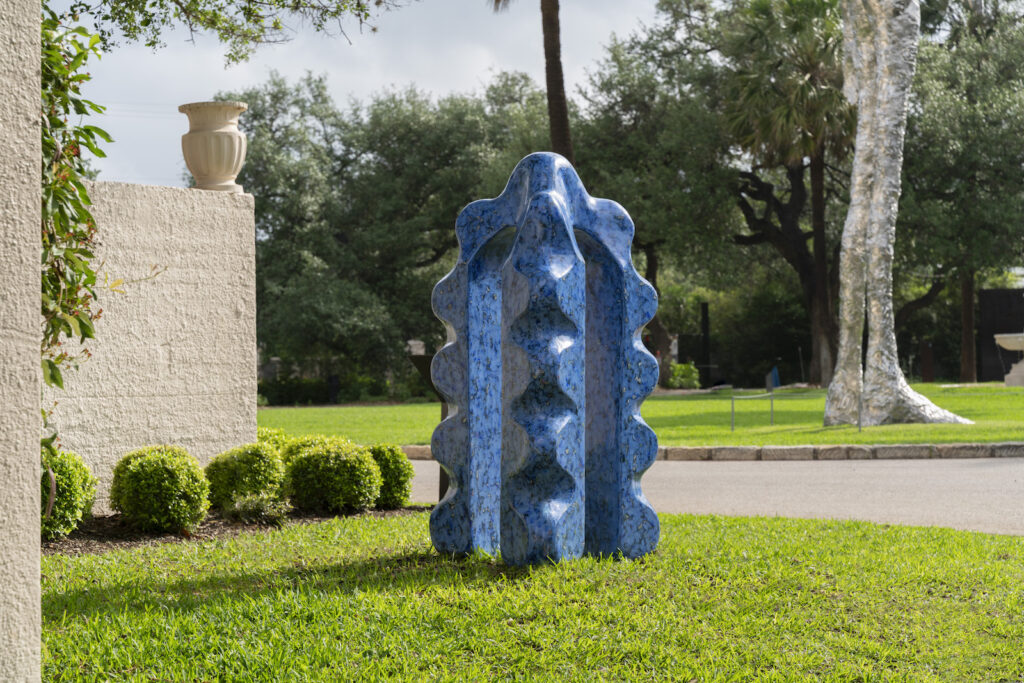
It’s the latest step in an evolution that began in 2020, a few years after becoming a mother first prompted a change in her approach. She had primarily been a figurative artist, drawing and painting realistic images of people and places around her, earning spots in well-received shows like “Where You End and I Begin” in 2017. But she began to feel restless and unsatisfied, and started creating abstract characters, which she calls “beings.” Those inventions bore the influence of her background in doing special effects for films and working in architectural restoration. Slowly, the characters began to expand beyond the canvas, with some works having protrusions that vaguely resemble body parts. The move to three-dimensional sculpture was a logical next step.
Her challenge was finding a destination for the work, not to mention support for the materials to build them in her East Austin studio. Enter Laguna Gloria, and the show’s curators, Julie Le and Rachel Eboh, who had been following Lit’s work for years. “When Rachel and I visited her studio, Laura was starting to work in three dimensions and thinking about her work outdoors,” Le says. “It felt like a perfect opportunity to work together and commission new works from her.”
“She has such technical skill,” Eboh adds. “Learning about her process, it really blows me away.” After conjuring the being during her meditation process, Lit draws the figure using pencil on paper, then sculpts a small version out of clay to make sure it’s structurally sound. From there, she’ll use an array of industrial materials, including large blocks of expanded polystyrene, which she hand saws into the desired shape. Finally, the artist covers that shape with foil and attaches Pal Tiya—a durable sculpting material that cures without firing and requires her to wear personal protective equipment. The first pass is typically scratchy, so then she does it again to create a smooth, matte texture. Between those passes, Lit takes wet towels and covers the entire sculpture, some of which are about twice as tall as she is. “I never want to see a wet towel again,” she jokes.
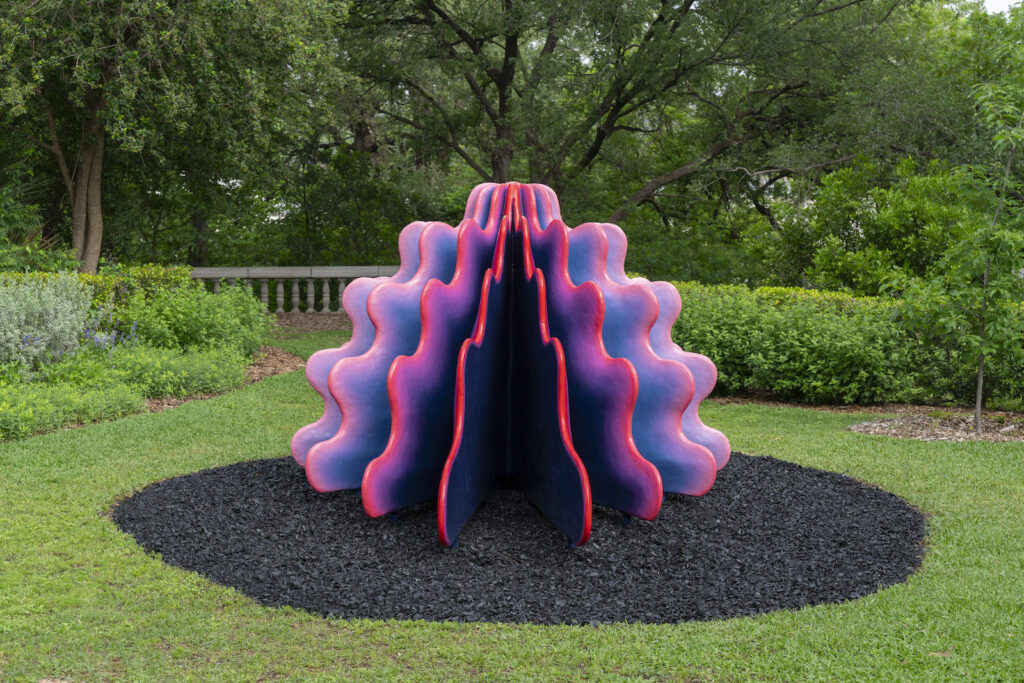
This period lasts for 30 days, after which she can undertake the next arduous task of drying and painting. For “Arpeggiator,” an undulating sculpture that resembles sound waves or the ruffles of a dress, she had to carefully position herself to hand paint between its deep ridges. It’s a painstaking process.
“Arpeggiator” is among the show’s four new works, which are displayed on the upper grounds near the Driskill Villa, offering visitors the chance to see Lit’s work in unique ways as the days and seasons shift during the exhibition. (The artist’s smaller works will also be shown at a companion show, opening in September at The Jones Center.)
Lit is particularly excited for visitors to see her work from different angles by, say, laying in the grass. “It’s this looming figure, but it’s not scary,” she says of her oversized work. “It’s beautiful. It emits its own vibration and its own energy, and it’s a positive energy. I don’t know how that works, but it does.”