
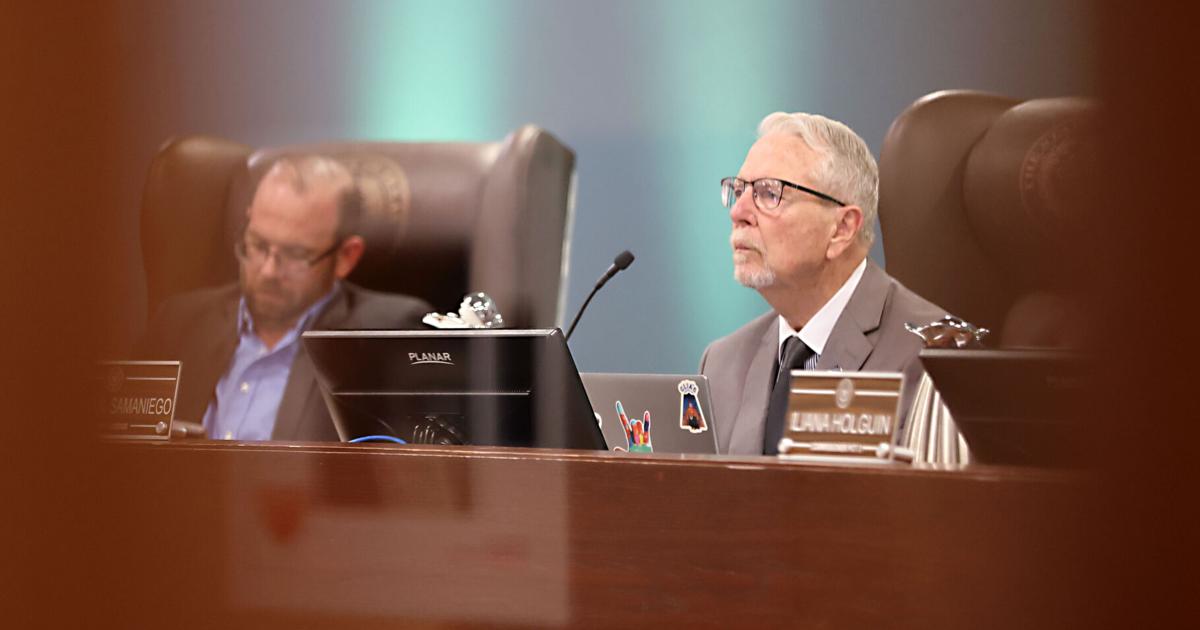
El Paso County commissioners voted unanimously to open management of the County Coliseum to competitive bids, launching a public process clouded by allegations of a “backdoor” deal with UTEP and possibly ending the El Paso Sports Commission’s two-decade stewardship of the venue.
“We will be pursuing a (request for proposals), and we’re going to be as transparent as possible,” said El Paso County Judge Ricardo Samaniego at the Commissioners Court meeting Monday.
The county will solicit proposals for management of one of El Paso’s major venues and the sports tourism business tied to it, a role held by the Sports Commission since it signed its original contract in 2003. The agreement’s most recent renewal was in June.
Both the sport’s tourism and Coliseum’s management contract end in September. Sports Commission officials said they planned to respond to the RFP to continue managing the Coliseum.
Accusations of a ‘backdoor’ deal
During a Commissioners Court meeting earlier this month, Janet Vargas, CEO of the Sports Commission, and Tony Rodriguez, Coliseum events director, addressed commissioners, highlighting their progress in upgrading and maintaining the Coliseum.

El Paso County Judge Ricardo Samaniego speaks with Betsy Keller, the county’s chief administrator, during Monday’s Commissioners Court meeting at the El Paso County Courthouse.
Ruben R.Ramirez
The Sports Commission had presented an unsolicited request for a 30-year extension of its contract, which was not approved at the May 4 meeting.
Vargas told county commissioners the Sports Commission would invest $12 million of its own funds into the Coliseum.
At the end of the Sports Commission’s quarterly report, Rodriguez said he was troubled by rumors that the University of Texas at El Paso had already been offered the management responsibilities for the Coliseum.
“Four people have already told us that this has already been promised to UTEP, from four different organizations,” he told Commissioners Court. “When you hear the same thing from four people, it’s not a coincidence.”
At that time, members of Commissioners Court appeared surprised by Rodriguez’s statements.
Samaniego asked the court if anyone had heard of promises being made to UTEP about replacing the Sports Commission. Commissioner Illiana Holguin said she had not, and Commissioner Sergio Coronado said he was “taken aback” by the rumors.
“We didn’t know anything about it, and it’s out there,” Samaniego said, “That sort of throws us off, to say if there’s been a discussion about that, but it’s never come through Commissioners Court.”
Holguin said she had legal questions regarding the RFP process, and the discussion moved into a closed-door executive session after the regular agenda.
At the subsequent Commissioners Court meeting on Monday, May 11, Samaniego acknowledged that “we did have discussions with UTEP, but there were never any agreements or any concessions that were made in those discussions.”
Samaniego said discussions involving interlocal agreements with outside entities “is something typical,” and added, “Obviously, it would have been brought back to Commissioners Court if there had been anything to agree on.”
He also said pursuing RFPs for the Coliseum’s management “is no reflection of the capability and the success that the present management has had.” He said the county is “extremely happy with our present management” and called the RFP decision a way “for everybody to present what they can offer.”
Also addressing Commissioners Court Monday was El Paso lawyer Brian Kennedy, a former City Council member and former Sports Commission director for 23 years.
Kennedy said he was speaking “exclusively as a representative” of his private company, which plans to respond to the RFP, and he had serious concerns about the process.
He reiterated that since the “beginning of last September, there were meetings, lunches and substantive agreements about handing the Coliseum over to UTEP with an interlocal agreement that would not require a bid.”
He provided names of people he said were involved in these discussions, including “a member of the county administrator’s office and Jorge Vasquez from UTEP.”
Any contract negotiations for the Coliseum management should have “at least one member of Commissioners Court be a part of it to keep the communication truthful and honest,” he said, adding, “I would hope that you would take strong and decisive action against any more actions that I consider backdoor.”
In an emailed statement to El Paso Inc., university officials said UTEP “regularly has exploratory discussions with our close community partners like El Paso County about how we can work together to improve the quality of life in our region.”
Asked whether it would respond to the RFP for the Coliseum’s management, UTEP said in its statement, “We are currently unaware of any published request for proposal (RFP) from the county regarding the El Paso County Coliseum. If an RFP is published that aligns with UTEP’s mission, we will evaluate to see if submitting a proposal makes sense for UTEP and make a decision at that time.”
What does the law say?
During Monday’s meeting, Erica Rosales Nigaglioni, assistant county attorney, said the contract between the county and the Sports Commission includes provisions to “prepare for a potential transition of the management and operation of the facilities if a new vendor takes over this responsibility as early as October 2025.”
Nigaglioni also outlined the options that guide the legal selection of county vendors.
One option is to follow the County Purchasing Act, which includes an adherence to competitive bidding, she said. But Chapter 791 of the Texas Government Code (interlocal cooperation contracts) does not require RFPs.
Another option is to invite governmental entities to submit bids, even though that is not required by the interlocal law, Nigaglioni said.
“All of these options are legally available to the Commissioner’s Court,” she said. “It is not required to go out to bid for goods and services for contracts with another government entity, in accordance with Chapter 791, the interlocal law.”
Speaking after Nigaglioni, Samaniego emphasized that “at Commissioners Court, we have the legal right to go into an interlocal agreement without going into an RFP.”
Commissioners voted unanimously in favor of entering the RFP phase under “local government code 262.030” and Samaniego said the public process will begin as soon as the county “determines a preliminary structure of the agreement.”
Commissioner David Stout said pursuing RFPs for sports tourism and Coliseum management was the best decision for the community.
“I have been one of the strongest proponents of doing so, and I’ve tried to push the county to do so because for me it’s a good governance issue,” he said. “I think anybody who is in government understands that best practices and good governance is going out to bid for contracts every three to five years.”
Stout also expressed frustration with allegations that the county had violated any law or policy by communicating with UTEP about Coliseum management.
“The court clearly communicated during prior (contract) extensions that future requests for proposals would be necessary and appropriate. It has been made very clear to the Sports Commission, and there have been no negotiations that are improper,” he said. “There have been no secret agreements, and there is no pre-selection of UTEP as the vendor that would be taking over.”
El Paso County Judge Ricardo Samaniego at Monday’s meeting
Ruben R.Ramirez
El Pasoans voice concerns
Residents who signed up for public comment during Monday’s meeting expressed support for the Sports Commission’s management of the Coliseum and said they were concerned with the managerial capacity of UTEP.
“There were a lot of problems with the BTS (concert), and we don’t want that to happen over there either,” said Dora Villanueva, president of the Valle Verde Neighborhood Association, referring to the Coliseum.
El Pasoan Brandon Beltran said he opposed any effort to hand Coliseum management to UTEP.
“Why would the county consider replacing a proven high-performing team with an outside entity that has struggled to maintain consistent bookings outside of its core focus?” he said in a letter read during the meeting.
Nikki Gonzalez, the executive director of Kaleidoscope Art Market, also spoke of her concerns.
“Over the last few years, I personally witnessed the growth and positive changes that have happened at the Coliseum during the El Paso Sports Commission, since they’ve been involved,” Gonzalez said. “The Coliseum previously was not being utilized anywhere near its full potential for community-driven events.”
In a letter read during the meeting, Patricia Ojeda Gomez encouraged Commissioners Court to “consider the proven track record and longstanding partnership of the El Paso Sports Commission,” and asked commissioners to “adhere to strict ethical standards regarding communication, including avoiding private or undisclosed discussions that could undermine public trust or the integrity of the process.”
No public comment was given in support of changing the Coliseum’s management team.
Who said what, and when, between UTEP and El Paso County
According to reporting from KVIA – which obtained information through an open records request for the county – and a review of recent County Commissioners meetings, here is a timeline of communications between UTEP and the county and events leading to the May 11 RFP approval.
Both UTEP and County Commissioners have stated that the communications were lawful and customary, but some potential competing vendors and El Pasoans have expressed concerns.
Sept. 18, 2025: Melissa Carrillo, executive director of operations for the county emailed Jorge Vasquez, executive director of the Office of Special Events at the University of Texas at El Paso, proposing a “possible collaboration between UTEP and the county.”
Sept. 19, 2025: Vasquez responds via email and agrees to meet.
Sept. 24, 2025: Vasquez and Carrillo, via text messages, confirm a meeting for Oct. 4, 2025.
Oct. 27, 2025: Vasquez sends a message to Carrillo urging her to call him. Carillo told Vasquez she was at a conference in Tampa but said she would call him on a break.
Dec. 4, 2025: Carrillo sends Vasquez a message stating, “I want to check in and let you know I’m planning on my end,” and they schedule a lunch meeting for Dec. 12 at Cafe Central.
Dec. 4, 2025: After the lunch meeting, Carrillo thanks Vasquez for the meeting, and she adds that they “stay in touch over the next few months.” Vasquez replies with “Yes, let’s communicate as you work through this.”
Jan. 15, 2026: Vasquez sends a text message to Carrillo, and requests “the current contract to take a look and finalize the report on my side.”
Jan. 21, 2026: Carrillo responds and agrees to send the “current contracts on the facilities and sports tourism” and she suggests another lunch meeting for February.
Jan. 23, 2026: Carrillo messages Vasquez that the contracts will be sent to him and again proposes a lunch meeting for the middle of February. In this exchange, Carrillo also tells Vasquez that “On 2/9, the Sports Commission will be presenting their monthly report to the court. The meeting is on YouTube. You may want to tune in and see.” Carrillo also wrote, “I’ll text you to keep you updated so you’ll know when they’re up.” They both also agree to a lunch meeting for Feb. 18, 2026.
Feb. 9, 2026: During a County Commissioner’s meeting, Commissioner Iliana Holguin made a motion to delete the presentation from the Sports Commission. The motion to delete the item passed after it was seconded by County Judge Ricardo Samaniego.
April 8, 2026: Vasquez texts Carrillo requesting a call back.
April 13, 2026: Vasquez again texts her, and sends an email, requesting a phone call.
May 4, 2026: El Paso County Coliseum Events Director Tony Rodriguez addressed Commissioners Court, telling them he was troubled by rumors that UTEP had been offered the management responsibilities over the Coliseum. Commissioners said they were not aware of any discussions favoring UTEP as the new managers of the Coliseum.
May 11, 2026: Commissioners Court defended the county’s communications with UTEP, while approving a public Request for Proposals for a new contract to oversee the operations of the Coliseum.
May 12, 2026: UTEP officials release statement that they are “currently unaware of any published Request for Proposal (RFP) from the county regarding the El Paso County Coliseum,” adding that “if an RFP is published that aligns with UTEP’s mission, we will evaluate to see if submitting a proposal makes sense for UTEP and make a decision at that time.”