
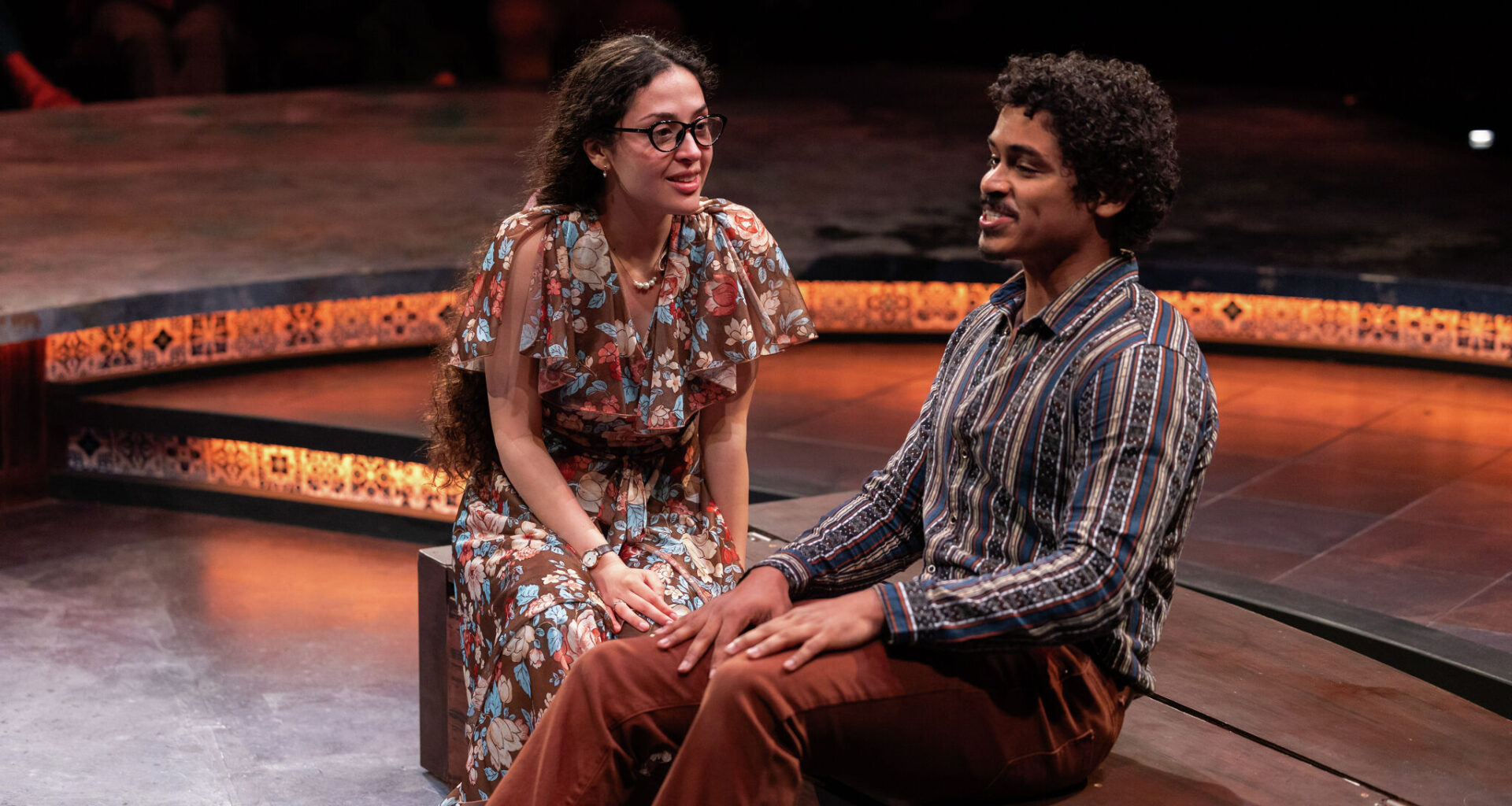
Sophia Marcelle and Antonio Lasanta in ‘drive thru monterey’ at Stages in Houston.
Melissa Taylor
Playwright Matthew Paul Olmos poses for a portrait before a dress rehearsal of his show, So Go the Ghosts of Mexico, Part Three, A Poet Sings the Daughter Songs Saturday April 13, 2019 at Undermain Theatre in Dallas. The theatre production is co-directed by Katherine Owens and Danielle Georgiou. Ben Torres/Special Contributor
Ben Torres/Dallas Morning News
Playwright Matthew Paul Olmos poses for a portrait before a dress rehearsal of his show, So Go the Ghosts of Mexico, Part Three, A Poet Sings the Daughter Songs Saturday April 13, 2019 at Undermain Theatre in Dallas
Ben Torres/Dallas Morning NewsCourtesy of Stages
Beginning as part of the Stages’ Sin Muros Latinx Theater Festival in 2024, “that drive thru monterey” is now a fully realized production set in East Los Angeles in 1971. With universal themes such as ambition, the emotional vicissitudes of everyday life, and identity, it features Monterey, a young woman experiencing her first love.
As a Mexican American, she is experiencing the cultural and political shifts that dominated the 70s, and is a kind of coming-of-age story set in that kaleidoscopic decade. This play is the first Sin Muros production to be developed and presented as a full production, underscoring the festival’s mission as a springboard for new plays from Latinx voices and promoting artistic growth.
When: Friday-June 7 at 7 p.m. Wednesdays through Saturdays and 2 p.m. Saturdays and Sundays
Where: Stages at the Gordy, 800 Rosine
Details: $30-$89; 713-527-0123; stageshouston.com
Directed by Stages artistic director Derek Charles Livingston, it also focuses on male identity at the time. Livingston notes in a description of the play that it offers “a nuanced portrait of masculinity—its tenderness, its pressures, and the space in between.”
Article continues below this ad
Family issues and the role of “machismo” over generations is also an element of the drama. The ensemble cast includes Sophia Marcelle as Monterey,
and the exceptional Houston favorite Elissa Cuellar as Lydia.
Playwright Matthew Paul Olmos is proud of his heritage as a Mexican-American, and grew up in Los Angeles. But his career was based in New York City where he received an MFA in playwriting at The New School for two decades. Now he is back in Los Angeles, where he has been influenced by the communities associated with his family and upbringing.
He thinks of this time as “a new chapter.” Olmos shared that this play was inspired by his own mother, and was begun only because he found a
long-lost legal document that opened up a door to her earlier years in California. He found a marriage certificate from an early marriage that he did not know about, and it was an opening up emotional memories for his mother, and a way for him to understand her past in an unexpected way.
“The marriage certificate had a different name. At first, she denied it, and gave vague answers, but later admitted ‘I was married before your dad’,” She had never discussed it, but when she started talking about it, “she couldn’t get through it without emotion,” Olmos recalled.
Article continues below this ad
He kept thinking about why this situation was interesting, and interviewed his mother in depth as he started a new play for a workshop. He wanted to think about what was unique about her early experiences with love, and it gave him “a glimpse into her past. I had never heard that kind of emotion
from her.”
She would call and offer more details, so Olmos “drove her up to the Old Fort in Northern California where these events happened in the 70s. She hadn’t been there since she was 21. It held a fascination for me as a son and an artist.”
When asked why she wanted to hide it, Olmos said that she “took away all evidence—a denial.” Yet he was interested in how “we can move forward if we don’t talk about it.” He said this “small window” into his mother’s past was “a beautiful thing.” He also learned that this former husband “was a good man.”
Olmos was able to take this story and create a script that centered on the love story while also using theatrical devices dramatizing premonitions and other phenomena that push the limits of more traditional realism. For “that drive thru monterey,” Olmos said that he wanted audiences that to know that this play is a romance and a personal story, and one that asks the viewer to think about the relationship between time and memory, and the ways that love and loss are processed. The dream-like landscape makes the present and the past blur, using the fluidity of time to dramatize the ways we keep and relinquish and experiences.
Article continues below this ad
For this play, and theater in general, Olmos said “it feels like given the world we live in, we can be reminded that the connections we have with others help us get through, and responding to an unabashed love story is a reminder that the world can be good, and we can have something beautiful.”
He hopes his play will lead to conversations and discussions. While conceding that when his mother sees the production that “I think she will be a mess,” that likes how theater allows everyone “to see the world be crystallized through a playwright” a way to “show something beautiful and something to think about.”