
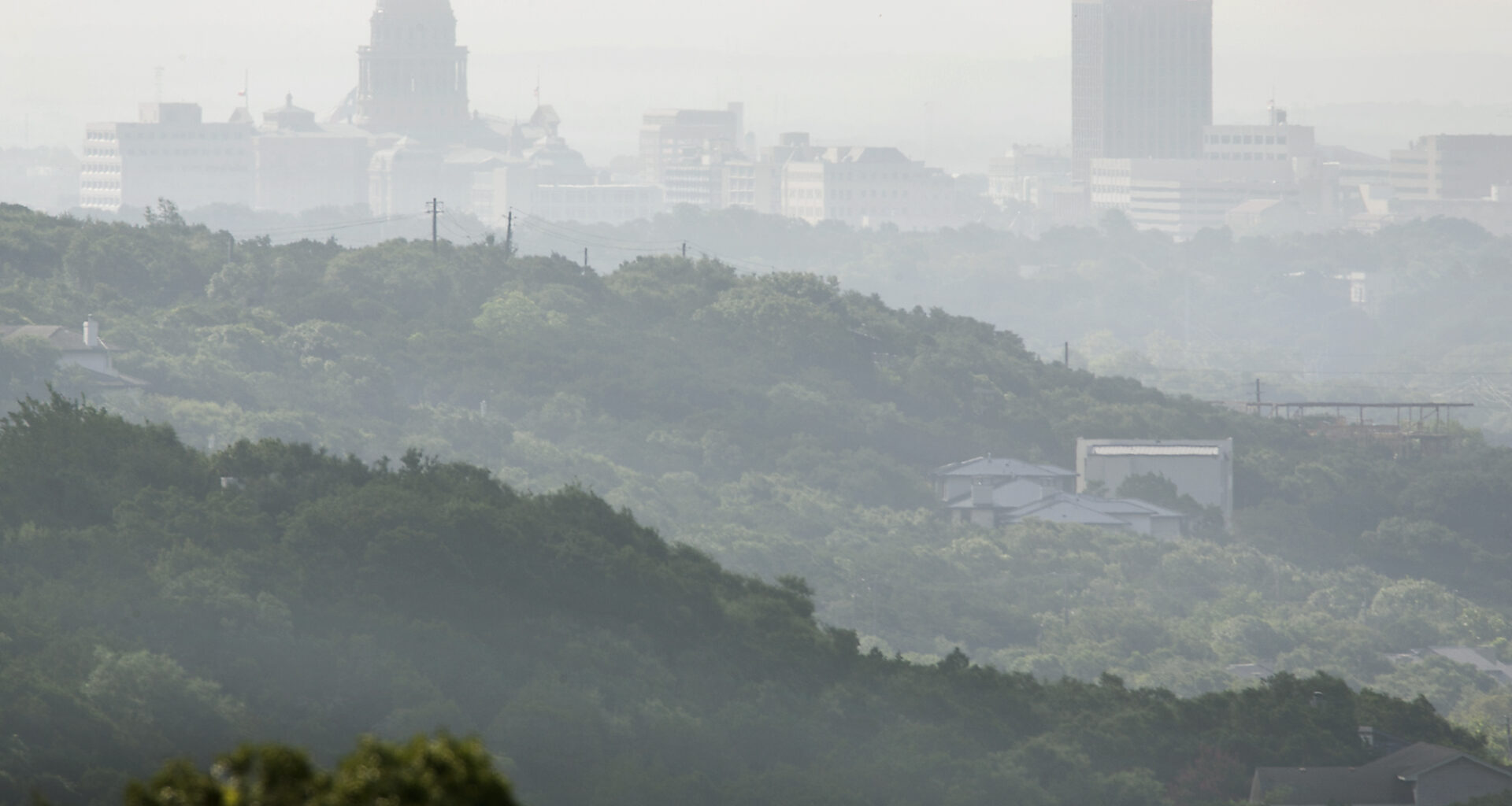
This is a view looking east of the city skyline in July 2015 from the scenic overlook along the Capital of Texas Highway west of Austin. Ozone is the primary air pollutant of concern in the Austin area and high ozone levels can negatively affect asthma and other upper respiratory illnesses. When the levels become high officials urge people to telecommute from home and not fuel their cars or mow lawns during daytime hours.
Ralph Barrera/Austin American-Statesman
This week’s weather across the Lone Star State is taking on a summertime feel, with abundant sunshine, warm temperatures and light winds. A ridge of high atmospheric pressure has settled over Texas, limiting air movement and allowing pollutants to become trapped near the surface in the layer of the atmosphere where we live and breathe.

Because of these stagnant weather conditions, the Texas Commission on Environmental Quality (TCEQ) has issued an Ozone Action Day for Wednesday for several of the state’s largest metropolitan areas, including Austin, Dallas, Houston and San Antonio.
Article continues below this ad
Heads up! TCEQ is forecasting ozone may reach levels ‘unhealthy for sensitive groups’ tomorrow, Wednesday, May 13th.
Children, older adults, and folks with pre-existing health conditions should refrain from extended outdoor activity.
Learn more at https://t.co/LCyAGnpboR pic.twitter.com/7ut6Dir8pV
— Air Central Texas (@AirCentralTexas) May 12, 2026
In the Austin metro area, air quality levels are expected to reach the “unhealthy for sensitive groups” category, meaning people with respiratory conditions or other health sensitivities could experience adverse effects, while the general public is less likely to be affected.
LIVE AIR QUALITY MAP: Check our Austin Air Quality Map with data updating every 10 minutes on air quality ratings and smoke forecasts.
How ground-level ozone forms
Ground-level ozone is unique because it’s not emitted directly into the air but is formed when pollutants from vehicles, industrial plants and other sources react with sunlight. It’s typically a summer pollutant, but it also can form when these ingredients are present in the air and hot weather functions as a catalyst, leading to a higher concentration.
Article continues below this ad
This graphic from the Environmental Protection Agency illustrates how ground-level ozone forms.
Environmental Protection Agency
Several weather conditions can significantly influence ozone levels during the ozone season, which typically runs from March through November in Texas, according to the TCEQ:
Sunlight increases ozone formation rates.
Heat waves not only increase the rate of the chemical reactions that form ozone but also contribute to higher energy consumption, leading to more emissions from power plants.
Temperature inversions occur when the air close to the ground is cooler than the air above, acting like a cap or blanket on the atmosphere and trapping pollutants near the surface. Over time, this leads to higher concentrations of ground-level ozone.
Article continues below this ad
The temperature over the next few days will be hotter than normal, with highs in the upper 80s and low 90s.
Temperatures on Wednesday will run about 5 degrees above normal, accompanied by plenty of sunshine and light east to southeast winds.
Pivotal
Although ozone is primarily known as an urban issue, that is not always the case because of the overall wind direction.
“The pollutants that form ozone can travel hundreds of miles, affecting areas far downwind from the location where they formed,” said Carrie Paige, a retired environmental scientist at the U.S. Environmental Protection Agency. “So, we can get high ozone levels in rural areas as a result.”
Article continues below this ad
High ground-level ozone concentrations can lead to a range of health issues, particularly for vulnerable groups like children, older adults and those with respiratory conditions such as asthma, emphysema, or bronchitis.
“The ozone issue is that you don’t see it, but you might feel it as you are breathing,” Paige said. Symptoms may include coughing, throat irritation, and worsening of asthma or other lung diseases. The best way to stay healthy is to limit outdoor time on alert days.
What are Ozone Action Days?
Although stratospheric ozone is beneficial, as it shields us from the sun’s harmful ultraviolet radiation, ground-level ozone is detrimental to people and the environment when it reaches unhealthy levels. When that happens, the TCEQ may declare an Ozone Action Day to alert the public about potential health risks and to promote measures to reduce ozone formation and exposure.
Article continues below this ad
Heat rises from the highway as cars travel down Interstate 35 in downtown Austin during the evening rush hour. The heat and chemicals in car exhaust help create ozone, which can be harmful to respiratory health.
Sara Diggins/American-Statesman
“If you must drive and you have more than one vehicle, use your newest one because it will be the most fuel-efficient, cleanest and emits the fewest number of pollutants,” Paige said.
You can also refuel your car in the evening instead of during the day because gasoline emissions evaporate more readily in the heat of the day. Avoid using gas-powered lawn equipment because it can produce as many emissions as 11 new cars.
Article continues below this ad
The number of Ozone Action Days varies by region from year to year. Texas tends to experience more alert days during particularly hot summers.
“While climate change exasperates the higher levels of ozone, by reducing the activities that contribute to ozone formation, you are reducing the activities that contribute to climate change,” Paige said. “They go hand in hand.”