
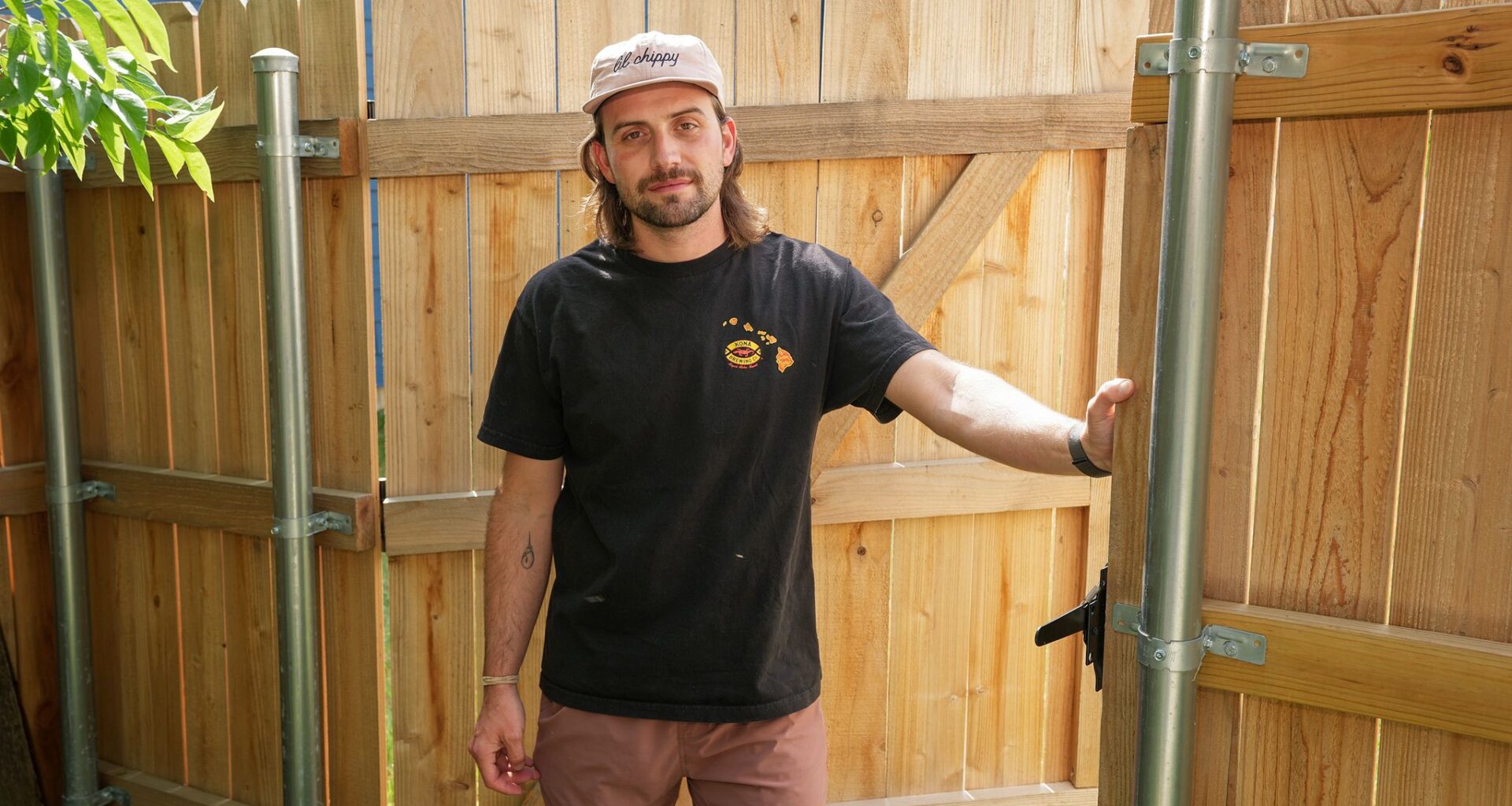
Sometime after 1 a.m., Austin police chasing a car thief kicked in the unlocked gate outside Spencer Harder’s home. Harder awoke that April 2025 morning to find $1,035 in damage that was now his problem.
“I was like, ‘What the hell?’” the software engineer recently told me from his Northeast Austin home. “But I thought that maybe we can get (the city) to pay for this. It’s very obvious what happened.”
Instead, he learned that when Austin police break it, you buy it — even if you’re just an unlucky bystander.
Article continues below this ad
We all want police to catch criminals and reach people who might need help. Sometimes that involves breaking down doors or gates. As I noted in the first installment of this “Damaged for Good” series last week, the question is what happens next: Who bears the collateral cost for public safety in Austin?
In theory, the city has a process for people to seek reimbursement for damages caused by police. But that system, built on a narrow reading of a contested area of law, is as broken as Harder’s gate.
This is the second installment in our “Damaged for Good” series about Austin’s broken claims process for people whose property is damaged by police.
This column shows how the city’s claims process is designed to say no, even as some courts have said residents shouldn’t be stuck with the tab.
The first column showed how even in one of the most deserving cases — police busting open the door of the wrong apartment — the city refuses to pay for repairs.
The third column will explore the damage from welfare checks and domestic/family violence calls and the implications of leaving those residents less safe.
Austin’s Law Department received 135 claims for building damages caused by police over the past six years. Each time, the city refused to pay. Those damages arose from everything from welfare checks to suspect pursuits to a handful of times officers kicked in the wrong door.
Article continues below this ad
One of the most maddening aspects of the claims review process is the pretense that there is one. Officers typically apologize and give residents the contact information to file a claim with the city’s Law Department. Residents write up what happened, submit photos and sometimes include receipts, believing there is a decent chance they’ll be reimbursed.
Then the Law Department arrives at a denial with such binary efficiency that a chatbot could do it.
As long as the case does not involve a car crash — which falls under different liability standards — the city cites governmental immunity and “respectfully denies” the claim. The process is so geared toward denial that sometimes the city tells residents the particulars don’t matter.
Article continues below this ad
“Even without yet knowing the specific facts of your case,” claims investigator Mike Hennessey wrote in December to a woman with a broken front door, “I can make an informed judgment that the City of Austin and Austin PD will not be liable for your claimed damages.”
A credible process would account for individual circumstances, yet everyone who files this type of claim gets this rote response. A fifth of the police-related property damage claims filed from January 2020 to December 2025 involved bystanders or people victimized by strangers — people, like Harder, who did nothing wrong. Often they had gates or fences broken as officers chased a suspect. In other cases, cops kicked in a door while pursuing an intruder in a victim’s home or business. One time a stray can of tear gas was hurled through a window, meant for a neighbor targeted by SWAT.
Among the recent residential claims, the median repair bill was $1,071. For some people, that’s a week’s earnings or a month’s worth of groceries. It’s real money.
Article continues below this ad
Yet the city of Austin treats it as an acceptable cost to shift onto law-abiding residents.
“A public service that I pay taxes to just broke my property and left,” said Harder, who eventually paid for a new gate. “I definitely expected better from Austin. It seems crazy they wouldn’t pay for that or consider the ramifications of damaging someone’s property.”
The quest of the cousin-lawyer
If anyone had a shot at getting reimbursed, it would have been Harder. He had a resource not everyone has: an attorney in the family — his wife’s cousin — who made the case his quest.
Article continues below this ad
Matthew Streety, a commercial and real estate litigator, researched the law and argues it isn’t nearly as settled as the city suggests.
The city relies on the Texas Tort Claims Act, which largely exempts local governments from liability for damage caused by public employees carrying out their duties, except in car crashes.
“This legal protection makes it possible for first responders to save lives and property without the government being exposed to liability for things that may accidentally or intentionally get broken in the course of emergency responders doing their jobs,” Hennessey wrote in 2021 to a resident left with a broken front door after a medical emergency call.
But a 1980 Texas Supreme Court ruling, Steele v. City of Houston, says that immunity is not absolute. The court held that “innocent third parties are entitled by the [state] Constitution to compensation for their property” when police damage or destroy it.
Article continues below this ad
Spencer Harder’s gate was ripped from the fence posts after an Austin police officer kicked it in last year while chasing a suspect through the neighborhood. “A public service that I pay taxes to just broke my property and left,” Harder said.
Courtesy of Spencer Harder
That case arose from a 1975 incident in which three escaped inmates holed up in a home while the residents were away. Houston police fired “incendiary material” to smoke the fugitives out, and Houston’s fire department let the building burn — destroying the dwelling and everything inside.
The residents and their landlord sued. The city of Houston said it had governmental immunity under the Texas Tort Claims Act.
But the plaintiffs argued this wasn’t just about wrongfully inflicted damages, the kind of claims governed by tort law. It was a governmental taking of property without compensation.
Article continues below this ad
The Texas Supreme Court agreed, finding the state Constitution asserts a “governmental duty to compensate for damaging and destroying a citizen’s property.”
SIGN UP FOR THE AUSTIN ANGLE and get Statesman commentaries in your inbox
Streety cited the Steele case in a four-page demand letter seeking reimbursement for Harder’s gate repairs. It didn’t matter.
“Your demand notwithstanding,” Hennessey responded, “the City of Austin’s position on the claim has not changed.”
Article continues below this ad
The only way to press the issue would be to file a lawsuit — a process that would cost far more than the $1,035 gate repair. Harder let it go.
He said he pressed the issue “because of the principle of the thing. But not everyone has time to pursue everything out of spite with their cousin-lawyer.”
Treat the costs as a shared burden
The Steele case is on point. Why doesn’t it factor into the Austin Law Department’s review of claims like Harder’s?
Article continues below this ad
Responding to my questions in writing, City Attorney Deborah Thomas said the claims investigators only apply the Texas Tort Claims Act, the law granting the city broad immunity in most cases.
“The claims team does not resolve constitutional claims,” she said. “Constitutional claims are properly resolved through judicial proceedings and the application of case law.”
Meaning: If you want the Steele standard, you have to file a lawsuit to seek it.
“They’re just assuming that nobody will get a lawyer to fight them on it,” Jeffrey Redfern, an attorney with the Institute for Justice, told me. “It’s definitely not what the Texas Supreme Court has said.”
Article continues below this ad
A Ring camera image from Sept. 3, 2025 shows an Austin police officer force open the locked gate at the North Austin home owned by Bryan Rubio. Officers were trying to reach the backyard of a neighboring home to arrest a burglary suspect.
Courtesy of Bryan Rubio
But the debate continues. Redfern is lead counsel for Vicki Baker in her lawsuit against the city of McKinney after SWAT destroyed her home in 2020 while pursuing a fugitive hiding inside. A jury initially awarded her nearly $60,000 after the judge ruled “it cannot be the case that public good could be done at the cost of the individual.”
The case is now tied up in appeals. The Texas Municipal League, of which Austin is a member, filed a brief arguing that requiring cities to pay for such damage would “undermine established emergency response protocols and throw municipal budgeting into disarray.”
“If first responders waste precious time evaluating and pursuing options aimed at minimizing property damage, lives will inevitably be lost,” the league’s attorneys wrote.
Article continues below this ad
Yet no one is arguing against life-saving police action. The question is whether cities can shift certain public safety costs onto unlucky bystanders instead of treating those costs as a communal burden.
While the U.S. Supreme Court declined in 2024 to hear the Baker case, liberal Justice Sonia Sotomayor, joined by conservative Justice Neil Gorsuch, noted it raises important questions.
“Had McKinney razed Baker’s home to build a public park, Baker undoubtedly would be entitled to compensation,” Sotomayor wrote. “Here, the McKinney police destroyed Baker’s home for a different public benefit: to protect local residents and themselves from an armed and dangerous individual.”
It makes no sense for one person to bear that cost for the common good.
Article continues below this ad
Austin could just do the right thing
Now set aside, for a moment, the debate over what the law requires.
The city of Austin could simply choose to do the right thing. It could evaluate the claims and provide reimbursement when bystanders are saddled with damages that aren’t their fault.
Why doesn’t the city’s Law Department do that?
Article continues below this ad
Bryan Rubio shows a broken gate at a house he owns in Austin. Rubio said Austin police broke the gate while planning to apprehend a suspect at a nearby home in September 2025, causing about $750 in damage. The busted gate is fortified with leftover pieces of decking.
Jay Janner/Austin American-Statesman
“We understand the frustration of people who may be in that situation,” Thomas said. But she said consistently applying the Texas Tort Claims Act “prevents government employees from having to create individualized exceptions or make discretionary decisions that would lead to inconsistent treatment or favoritism.”
It is not fairness to treat law-abiding residents the same way as wanted suspects — as if they equally deserve to be stuck with the bill for broken doors, busted fences or tear-gassed belongings after police do their essential work.
Article continues below this ad
And it is eminently doable for claims investigators to distinguish between the two, drawing on police reports, 911 calls and videos from officers and residents alike. What is lacking is a directive from the Austin City Council to use discernment and reimburse residents under certain circumstances because it is the right thing to do.
Thomas said the city’s Law Department is “at the beginning stages of reviewing the claims process for potential refinement.”
Mayor Kirk Watson agrees it needs to be improved, although he noted that city attorneys have raised another concern: If the city is not required to reimburse someone, then any payment could be construed as a gift — an unpermitted use of public funds.
“Now I will tell you that that tightens me up in my gut, because I feel like it may be lawyers lawyerin’,” Watson, himself an attorney, told me.
Article continues below this ad
Because intuitively, we all understand it’s not a gift to fix what you break. It’s the responsible thing to do, and other communities have done it.
In Pittsburgh, after a 2023 police shootout with a barricaded man left several neighbors’ homes with bullet holes and toppled fences, the city council reimbursed those bystanders for thousands of dollars in damages.
In Jacksonville, Fla., after SWAT destroyed a man’s fence and ruptured his sewer line while trying to apprehend a murder suspect next door, the city agreed in 2021 to cover the innocent neighbor’s damages. (Notably, that happened only after media attention and public pressure forced the city to pay up.)
And under Minnesota state law, local governments are required to compensate “an innocent third party” for any property damage caused by police when they are executing a search warrant or arresting a suspect.
Article continues below this ad
Talking with broken-fence people for this piece, I heard a common refrain.
“I have nothing against the police,” said Bryan Rubio, nonprofit fundraiser and entrepreneur who still owns the North Austin family home where police last September forced open the locked gate to try to reach the backyard of a burglary suspect at a neighboring house. Repairs would cost about $750, so for now the busted gate is fortified with leftover pieces of decking.
“There just needs to be some care and concern for the community, for the burden it puts on folks that have to do repairs for a situation that has nothing to do with them,” Rubio said.
In Central Austin, librarian Maria-Elena Cigarroa is glad police arrested the man who was lurking in neighbors’ backyards back in 2024. She’s just frustrated the city quickly denied her $700 claim to replace and repaint the still-mangled pieces of her fence.
Article continues below this ad
“I can’t imagine it’s worth losing the goodwill of citizens by denying this,” she said.
It’s not. And the City Council can set this right.
If it serves a public purpose to damage an innocent person’s property, it should be a public responsibility to fix it.
Article continues below this ad
Reach Editorial Page Editor Bridget Grumet at bgrumet@statesman.com.