
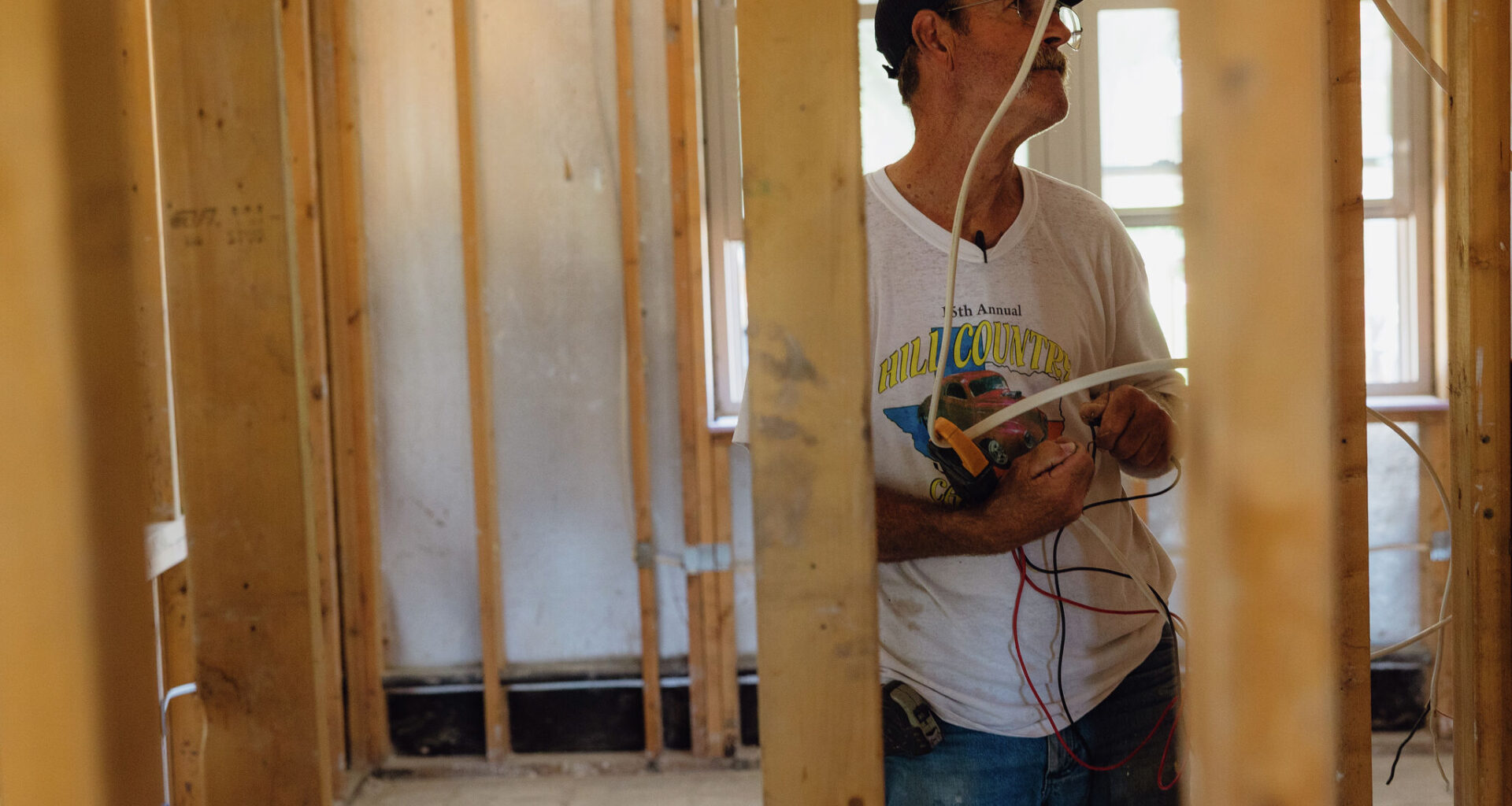
Electricians work on a home in July in Hunt. Texas doesn’t have enough electricians to meet the demands of two competing priorities: building the housing to meet the needs of a growing state and becoming a global leader in AI.
Christopher Lee/Staff Photographer
Abilene builder Gene Lantrip is on the front lines of Texas’ population boom, but a new force is making it harder to finish construction on homes. Data centers are poaching the electricians he needs to install light switches and wiring that power his duplexes.

The state has added more than 2.6 million residents since 2020, bringing in a steady surge of workers and families who need homes. But Texas doesn’t have enough electricians to meet the demands of two competing priorities: building the housing to meet the needs of a growing state and becoming a global leader in artificial intelligence.
Article continues below this ad
The centers that drive AI technology require massive facilities to power and cool servers, making electricians critical from construction through long-term operations. Early industry forecasts show data center projects will need thousands of licensed electricians, pulling from a limited labor pool.
Builder Gene Lantrip stands outside one of his homes last month in south Abilene. Housing has become a concern in the community as data center workers and an upcoming expanded mission at Dyess AFB mean a tighter supply of residential options.
Ronald W. Erdrich/For the Texas Tribune
“It’s taken us two months longer to build the houses than what it did before the data centers were coming in,” Lantrip, 69, said. “That’s the downside.”
On the outskirts of Abilene, mega companies OpenAI, Crusoe and Oracle invested into a 4 million-square-foot AI data center, Stargate. It joins more than 300 data centers already operating in Texas with about 100 more projects planned.
Article continues below this ad
Workers wire electricity lines earlier this year at a data center under construction in Garland. Early industry forecasts show data center projects will need thousands of licensed electricians, pulling from a limited labor pool.
Tom Fox/Dallas Morning News
As tech companies rush to build data centers, they are drawing from the same talent that homebuilders rely on — and often come in with bigger pockets to pay. Between 45% and 70% of the entire budget for data center construction goes to electrical subcontractors, according to the International Brotherhood of Electrical Workers, a labor union that represents electricians.
The data center in the Abilene area, for example, offers electricians double the wages his subcontractors can as officials aim to finish the center’s construction by the end of the year, Lantrip said.
Article continues below this ad
“My subcontractors don’t have the people. My electrician, he lost two of his lead men and several of his helpers to the data center,” Lantrip said. “Of course, the guys got to do good for their families.”
Gas turbine towers are lit outside the Abilene DC1 Stargate Project data center in Abilene on April 21, 2026.
Ronald W. Erdrich/For the Texas Tribune
A strain on demand
The rapid buildout of data centers means a critical strain on demand for electricians, in large part because that workforce is aging out.
Article continues below this ad
“The data center workforce impact begins with a truly large construction boom, but then tapers to a more specialized, smaller, longer term operational employment that does involve a lot of electrical and technician roles,” said Mark Muro, a senior fellow at the Brookings Institution. “This is really going to stress those pipelines.”
National trends show roughly 20,000 electricians leaving the workforce each year, with 1 in 3 electricians between the ages of 50 and 70 and nearing retirement.
Texas has about 71,000 electricians employed, according to federal labor data. Even as training programs expand, the pipeline cannot quickly adjust to this spike in demand.
Electrician Igor Meocec builds out a computer work station in a Walmart distribution center in Lancaster in this 2024 photo. Texas has about 71,000 electricians employed, according to federal labor data. Even as training programs expand, the pipeline cannot quickly adjust to this spike in demand.
Tom Fox/Dallas Morning News
Electrician Igor Meocec builds out a computer work station in a Walmart distribution center in Lancaster in this 2024 photo. Homebuilders that used to compete with commercial projects now are competing with data centers for electricians.
Tom Fox/Dallas Morning News
“We haven’t done a good enough job of backfilling with new people coming in,” said Scott Norman, the CEO of the Texas Association of Builders, referring to experienced workers retiring faster than new ones entering the trade.
Article continues below this ad
Becoming a licensed electrician requires years of apprenticeship and hands-on experience, which limits how fast new workers can be added.
“You can’t just snap your finger and say, in six months, we’re going to have all these other electricians,” Norman said.
Recruiting across state lines
Texas is loosening licensing requirements to bring workers from across state lines.
Article continues below this ad
Since November, the state has made it easier for electricians from Iowa, Alabama and Arkansas to transfer their licenses to Texas. The idea is that instead of requiring experienced workers from other areas to start over with testing and certification, Texas could quickly tap into an existing pool of trained electricians through a reciprocity agreement with those states.
State lawmakers last year sought to expand such partnerships, directing the Texas Department of Licensing and Regulation to maximize reciprocity agreements with other states, so long as the level of training and testing is comparable.
Cameron Dodd, a journeyman electrician and the political director of the Austin chapter of the International Brotherhood of Electrical Workers, said it’s too early to see the effects. Still, he’s optimistic that broadening eligibility will attract experienced workers who can step directly onto job sites, particularly for large, labor-intensive projects such as data centers and industrial developments.
“We’re trying to recruit more folks who are ideally already licensed … All the baby boomers and older electricians are going to retire,” Dodd said. “The reciprocity agreements, that should help.”
Article continues below this ad
Recruiting students
Various programs within the state are upping their efforts as well. For example, Texas State Technical College aims to grow its programs that train students in electrical skills. Its college officials are advertising the opportunity and higher wages that come with this workforce at job fairs.
Meanwhile, smaller builders are feeling the strain. For them, competing for a shrinking pool of electricians often means delaying projects or taking on the cost of training themselves.
Scotty Wristen, the owner of WE Electric in Abilene, lost five workers to the data centers. He can afford to pay employees only $20 an hour. The data centers outmatch him at $35 an hour, in addition to overtime and per diem benefits, he said.
Article continues below this ad
“Some of them were guys that I’ve had for eight years, five years. They came, they got trained, and they left to go out there,” Wristen said. “I don’t blame them. … It’s less strenuous work but more time on the clock, or more money to take home to the family.”
Scotty Wristen, an Abilene electrician, wires a fuse box April 21 in a new Abilene home. Wristen has taken to recruiting young people as apprentices in his industry in response to the Abilene DC1 data center depleting the labor pool of local electricians. “I train anybody I can get. We hire them, get them an apprentice card and start their time on it,” he said.
Ronald W. Erdrich/For the Texas Tribune
Wristen tried to get trained electricians on board. But after dozens of students visited his job sites with their teachers, none came back for a job, he said.
To fill the gap, Wristen is hiring teens as apprentices right out of high school.
Article continues below this ad
“They’re new. They don’t even have a set of tools,” Wristen said. “It’s usually about four or five months of hell where we have little mistakes that cost us time and money. It’s fixable. … And once they are trained in it, you don’t have those little deals anymore.”
The Texas Tribune is a nonprofit, nonpartisan media organization that informs Texans about public policy, politics, government and statewide issues. The Texas Tribune partners with Open Campus on higher education coverage.
Article continues below this ad