
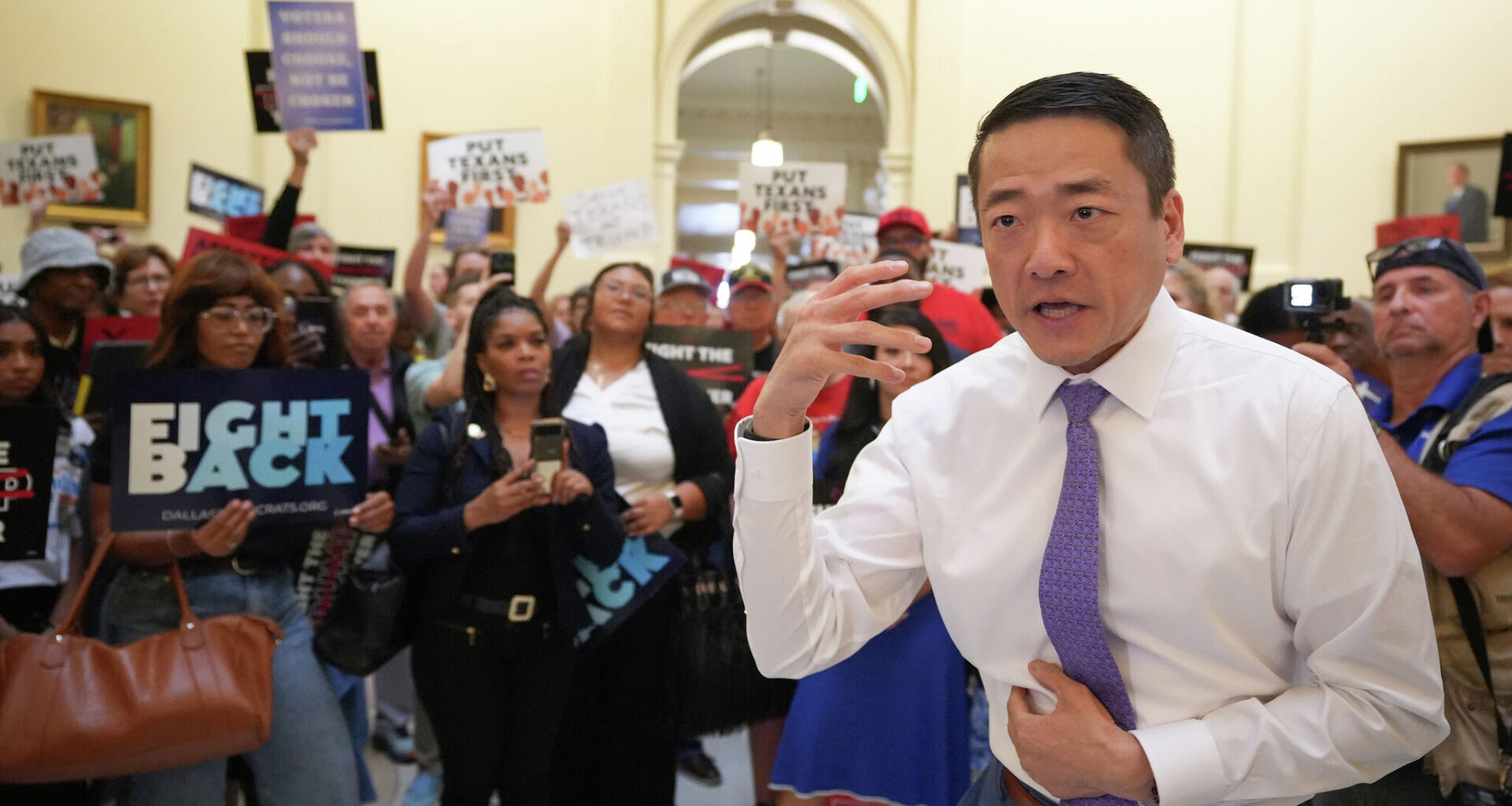
Rep. Gene Wu, D-Houston, protests redistricting plans before the hearing of the House Select Committee on Congressional Redistricting at the Capitol in Austin, Friday, Aug. 1, 2025.
Jay Janner/Austin American-Statesman
Gov. Greg Abbott is prodding the Texas Supreme Court to act on his months-old lawsuit to force state Rep. Gene Wu from office because of the Houston Democrat’s role leading last year’s quorum break that delayed the Republican-led plan to redraw Texas’ congressional district boundaries.

“He (Wu) clearly abdicated the remainder of his current term,” Abbott’s lawyer Trevor W. Ezell wrote to the justices in April, the most recent filing in the case that has yet to be scheduled for a hearing.
Article continues below this ad
The lawsuit by Abbott is an unprecedented move by a sitting Texas governor. And it’s the last lingering ramification for Texas House Democrats, who’ve already been financially punished by their Republican counterparts for fleeing to the state to fight a map that gives the GOP an advantage in the midterms.
In an interview, Wu called Abbott’s lawsuit a sideshow that should be brought to an end and said that he no longer reads the court documents “because they’re all just the same nonsense again and again.”
“I miss having adults in the room,” said Wu, who leads the Texas House Democrats. “I really miss having adults in the room in government. Yes, this is politics, but this is serious.”
Article continues below this ad
Abbott spokesman Andrew Mahaleris said the governor also sees the matter as serious, and that he has no intention of backing down.
“Governor Abbott is committed to holding absent Democrats like Wu accountable for their dereliction of duty,” Mahaleris said in a statement. “This matter remains pending before the Texas Supreme Court. State law—and common sense—require the removal of legislators who violate their constitutional oath.”
If Abbott persuades the court to oust Wu, it would only be for the remainder of his current two-year term. Wu is up for re-election in November and if he wins, would be sworn into a new term in January ahead of the next legislative session.
Article continues below this ad
But that outcome could be a deterrent for future lawmakers considering a quorum break.
READ MORE: How Houston Democrat Gene Wu is battling racism and cultural norms to lead his party
In April, the Texas House Republican majority imposed fines on the group of more than 50 Democrats who fled the state to fight redistricting.
Last week, Wu announced last week that he had paid the $8,000 fine, which amounted to $500 for every day Democrats were absent and a reimbursement for the effort to round them up. He said he and others in the caucus made the calculated decision to pay their fines rather than wage a protracted battle that would have been equally expensive.
Article continues below this ad
“We’re not going to spend a half-million dollars to fight a half-million dollar fine,” Wu said, referring to the combined total owed by the 50-plus Democrats who broke quorum.
The civil lawsuit by Abbott, which bypassed the lower courts and was filed directly with the Texas Supreme Court, targets Wu as the architect of the effort that took most of the Democrats to Illinois. Some of the members later went to other states run by Democrats in an effort to gain nationwide attention to the redistricting move that had been originally pushed by President Donald Trump.
In court filings, Abbott and his legal team accused Wu of abandoning his duties as an elected state lawmaker by failing to report to the House chamber for the special session the governor had called.
“What is at stake here? Nothing less than the future of Texas,” Ezell said in the original filing on Aug. 5. “If a small fraction of recalcitrant lawmakers choose to run out the clock today, they can do so for any, and every, Regular or Special Session, potentially bankrupting the State in an attempt to get their way.”
Article continues below this ad
Wu’s legal team argued that because the Texas Constitution requires that two-thirds of the members of both the House and Senate be present to conduct anything more than ceremonial business, the framers had implicitly recognized the right to break quorum. Further, the team has argued, the state Constitution grants the legislative chambers, and not the governor, the responsibility of policing themselves.
“The Governor has no standing,” Wu’s lawyers said in a filing.
READ MORE: Texas House panel votes to enforce fines on quorum-busting Democrats
Although more than three dozen briefs and other documents have been filed since the legal action was first started last summer, the nine-member, all-Republican Supreme Court has not yet set a hearing.
Article continues below this ad
In the most recent filing submitted by Ezell, he accused Wu of flouting the provision in the House rule that requires the members themselves, and not their political donors, to pay the $8,354 fine. On the day that the House panel formally set the amount, Wu told reporters that the Democrats were not bound by that provision, and he later issued a fundraising appeal online.
“Their (Republicans’) objection is to wear us down, demoralize us and drain our resources,” he wrote. “We won’t let that happen.”
Ezell said in his April 14 letter to the court that Wu was soliciting “bribes in exchange for breaking quorum.”
Article continues below this ad
Wu said he paid his fine with personal funds.