
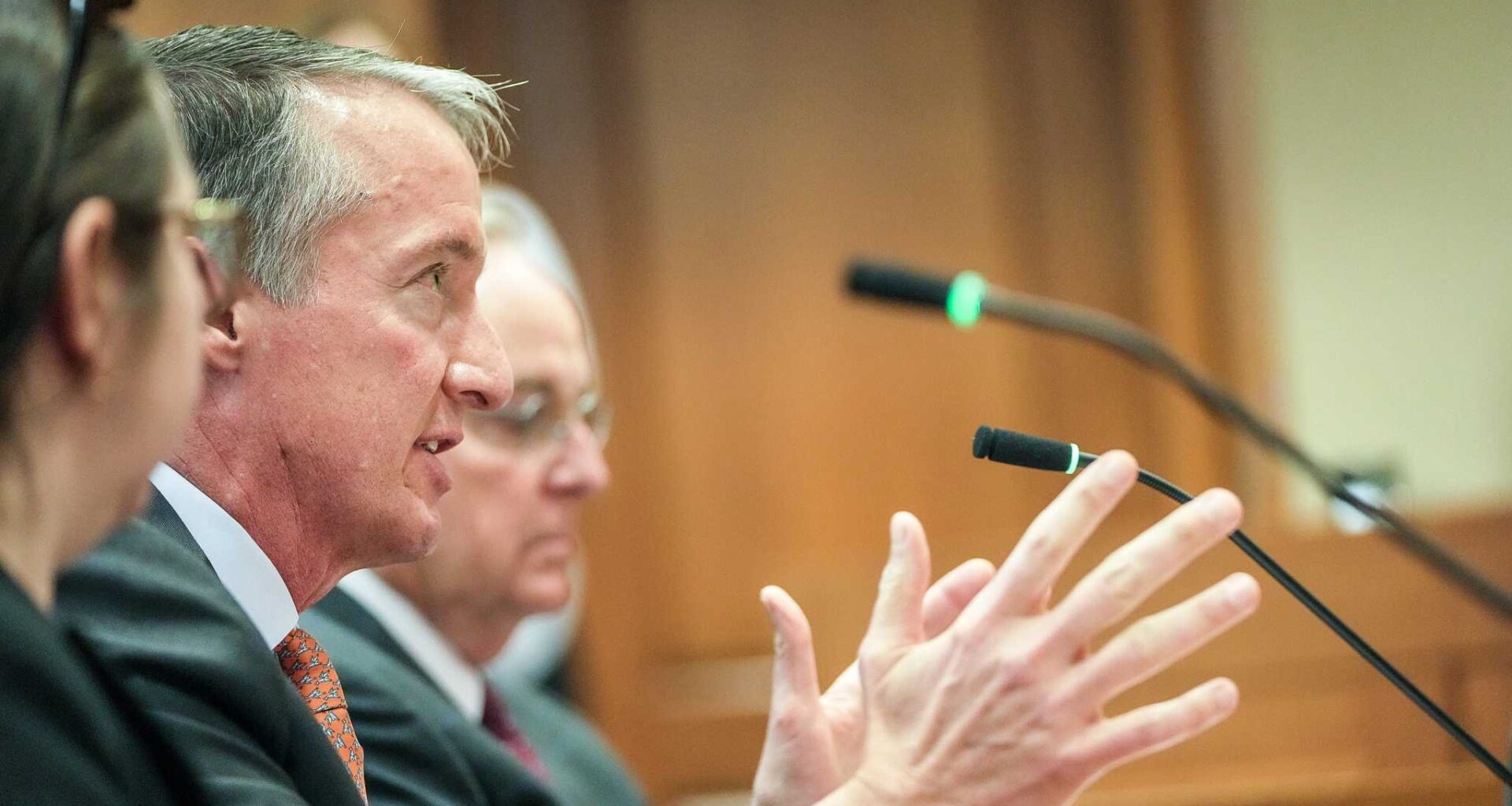
Jay Hartzell, President of the University of Texas at Austin, spoke before the Senate Higher Education Subcommittee on Monday, Nov. 11, 2024 at the State Capitol. On Tuesday, he testified in a federal trial over UT’s response to 2024 pro-Palestine protests.
Ricardo B. Brazziell/American-Statesman
Former University of Texas President Jay Hartzell returned to Austin on Tuesday to testify that he was not in contact with Gov. Greg Abbott during a 2024 pro-Palestinian protest that resulted in the arrest of more than 50 people. The current leader of Southern Methodist University insisted that he decided to cancel the 2024 demonstration due to worries it would disrupt campus, not over the viewpoint of the protesters.

In two hours under questioning, Hartzell connected the actions of Austin pro-Palestinian protesters to the tactics of a national movement disrupting colleges across the country with widespread student encampments or building occupations in spring 2024.
Article continues below this ad
“Columbia (University) was front and center on my mind,” Hartzell said. “It looked to me that the clear intent was to do things at UT Austin that happened at Columbia.”
Attorneys called on Hartzell as a witness at a Tuesday hearing to determine if the university’s suspension of pro-Palestinian protester Ammer Qaddumi violated the former student’s First Amendment rights.
This is the first lawsuit that has gone to trial related to the April 24, 2024 protest where 57 people were arrested for conduct protesters asserted was peaceful, but university leaders, including Hartzell, said broke university rules. The trial began on Monday and is expected to wrap up by Wednesday.
Article continues below this ad
Hartzell, who led the university at the time, cancelled the protest on April 23, 2024 because he believed it would resemble other pro-Palestine encampments taking place across the country.
Students and community members still gathered on April 24, setting the stage for a stand-off between protesters and law enforcement on Speedway and UT’s South Lawn. Qaddumi, a student leader with the Palestine Solidarity Committee, which organized the April 24 protest, was the first person arrested at the demonstration, which student leaders, including Qaddumi, insisted would abide by university rules.
After UT’s dean of students ruled to suspend Qaddumi for three semesters for his role in the protest, the former UT student sued the university for retaliation and viewpoint discrimination under the First Amendment. U.S. District Court Judge Robert Pitman will decide whether to strike the suspension from Qaddumi’s record. Qaddumi is expected to graduate from UT in May, according to court documents.
At Hartzell’s request, more than 100 state troopers and 30 UT police officers responded to the event. Though Abbott oversees the Department of Public Safety, Hartzell acted alone in asking for help, he said.
Article continues below this ad
“I decided that it was intended to be disruptive and I couldn’t let that happen,” Hartzell said about the protest. The Palestine Solidarity Committee seemed to be “echoing what appears to be a playbook across the country that was disrupting operations like the ability to go to class,” he said.
‘Context matters’
Sporting a purple tie instead of his old signature burnt orange, Hartzell faced questions from both sides over his decision to cancel the protest and send state troopers in to respond.
The former UT president said he decided to cancel the protest not because of a single statement from UT’s student group, but based on a “pattern of evidence” that suggested the organization intended to violate university rules and disrupt campus.
Article continues below this ad
That evidence included Instagram posts that used branding and language nearly “identical” to Students for Justice in Palestine, a student group that had organized protests across the country, Hartzell said.
In a situation like this, “context matters,” Hartzell added.
He denied that the protesters’ viewpoints factored into his decision, saying the university allowed other non-disruptive pro-Palestinian protests held by the same organizers to proceed without incident earlier that year.
Qaddumi’s legal team sought to connect Hartzell’s cancellation to Abbott’s March 2024 executive order calling on universities to enforce campus rules against pro-Palestinian student organizations, including the Palestine Solidarity Committee. Hartzell said he was not aware of Abbott’s post on X during the protest — where the governor promised arrests would continue — nor was he considering Abbott’s order during the protest or the day before.
Article continues below this ad
Qaddumi’s team also emphasized communication from Palestine Solidarity Committee that countered the allegations their protest would be disruptive or break university rules. Lawyers discussed a schedule posted by the group that said the day’s events would end after 7 p.m., and a member’s emailed reply to the cancellation saying the demonstration would be peaceful and not have an overnight encampment.
Attorneys also pointed to operations plans from UT police and the Department of Public Safety before the protest began that concluded there was no credible threat to campus.
Hartzell said he was unaware of the law enforcement assessments before the protest and held different standards for disruption than the law. He stood by calling on police to enforce university rules and said though he was concerned about safety, his primary motivating factor was limiting disruption on campus.
‘We wanted to be compliant’
Qaddumi, who attorneys questioned for nearly four hours, said he and other student organizers had access to materials from Students for Justice in Palestine, a national organization that organized encampments across the country, including at Columbia University. The UT group did not “heavily” consult those materials, Qaddumi said.
Article continues below this ad
He said students planned the Austin protest amongst themselves and did not intend to stay overnight, adding that his organization is not funded or directed by the national group.
Though student organizers sought to “push” the line of conduct, they intended to comply with university rules and adjusted their plans when asked, Qaddumi said. Though Qaddumi and other student leaders initially proposed bringing tents when brainstorming about the event, that possibility was later abandoned; no member of his organization brought tents to the April 24 event, he testified.
“We discussed having a tent as a symbolic representation but ultimately decided not to do that,” Qaddumi said. His group was aware of the university rules because “we wanted to be compliant.”
Article continues below this ad
At the protest, the police presence was “shocking” to him, Qaddumi said — as was his arrest. His father and sister were present for the protest, and he would “never” have put their safety in jeopardy, he insisted.
Both legal teams expect the trial to conclude Wednesday, but said they do not know when a verdict will be reached.