
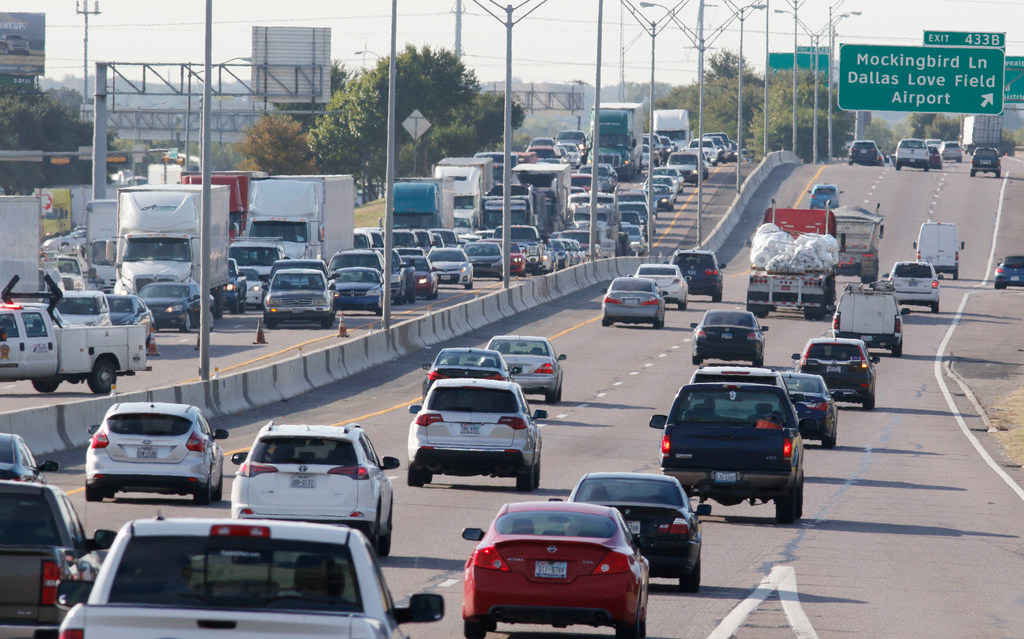
Traffic was backed up for hours on I-35N just south of Empire Central after an early morning pile up that shut down the freeway for several hours on Wednesday, October 11, 2017 in Dallas. (David Woo/The Dallas Morning News)
David Woo/Staff Photographer
With the arrival of summer in North Texas comes an increase in air quality alerts.

The Texas Commission on Environmental Quality issued an Ozone Action Day for Dallas-Fort Worth on Thursday, likely the first of many in 2026.
Article continues below this ad
Ozone Action Days are a specific air quality alert issued when atmospheric conditions are expected to produce high levels of ozone air pollution.
TCEQ encourages residents to minimize how much pollution they generate on ozone action days, suggesting they walk, bike or share rides as well as conserve energy.
What is an air quality alert?
Air quality alerts are issued by state environmental agencies such as TCEQ to indicate when pollution levels have become a health risk. The National Weather Service relays these alerts.
Article continues below this ad
Make Dallas News a preferred source so your search results prioritize writing by actual people, not AI.
Add Preferred Source
Matt Stalley, a NWS spokesperson, explained that air quality alerts are largely issued on behalf of sensitive populations.
Alerts can be found on the U.S. government’s air quality data website, AirNow.gov.
These alerts are visible on mobile devices through apps such as iPhone’s Weather and Apple Maps apps, Google Maps and alternate weather apps.
Article continues below this ad
What triggers an air quality alert?
Air quality alerts are issued when state and national data point to unhealthy pollution levels.
The National Oceanic and Atmospheric Administration maintains a national air quality forecast system. The NWS website details how this system tracks ozone, particulate matter and other pollutants, incorporating supplementary data from state and local partners.
The NWS also maintains an air quality index that tracks how polluted the air is in a given location and what the associated health risks might be. The Environmental Protection Agency calculates the index based on ground-level ozone concentrations, particle pollution, carbon monoxide, nitrogen dioxide and sulfur dioxide.
Article continues below this ad
This index indicates how severe pollution is with color-coded categories. Green marks air quality levels that are good for everyone, yellow alerts sensitive groups to monitor the air quality, orange indicates unhealthy levels for sensitive groups and red, purple and maroon indicate unhealthy levels for all.
State agencies draw upon this data to determine when air quality warrants an alert, utilizing the categories to determine the alert’s severity.
In North Texas, TCEQ distributes warnings when ozone concentrations are forecasted to rise above the federal standard of 70 parts per billion of ozone, becoming unhealthy for sensitive groups, according to the TCEQ website.
Stalley explained this often occurs on days that are characterized by low wind and warm temperatures, favorable conditions for pollution to gather.
Article continues below this ad
TCEQ defines ozone, sometimes referred to as smog, as a gas formed in the atmosphere. Ozone naturally occurs in the upper atmosphere, shielding Earth from the sun’s ultraviolet rays. Ground-level ozone is not naturally occurring, rather a pollutant forming as organic compounds react with heat and sunlight.
The North Texas Council of Governments attributes the majority of ozone pollution to vehicles, construction equipment and aircraft.
What should residents do on air quality alert days?
When air quality alerts are issued, the NWS and TCEQ recommend limiting time outside and minimizing use of gas-powered vehicles and lawn mowers, which produce pollution. For example, Stalley recommends against idling in a car at a drive-through on air quality alert days. People are also encouraged not to burn yard waste.
Article continues below this ad
The NWS also recommends monitoring the air quality index.
What are the health risks of poor air quality?
The NWS reports that ozone pollution can lead to asthma attacks, lung irritation, coughing, wheezing and increased risk of respiratory illness. More broadly, the NWS links air pollution to eye, throat and nose irritation as well as heart attacks and other cardiovascular and respiratory problems.
Sensitive groups including children, elderly people and those with preexisting health conditions are at a higher risk for these complications and should exercise additional caution in light of air quality alerts.
Article continues below this ad
When do air quality alerts tend to happen?
Air quality alerts are more common in the summer months due to wind patterns and high temperatures, Stalley explained.
Ozone pollution specifically is most prevalent during ozone season, from March 1 to Nov. 30 in Dallas-Fort Worth.
Article continues below this ad
The American Lung Association ranked Dallas-Fort Worth the 9th worst area in the country for ozone pollution this year. In their April “State of the Air” report, the organization credited this ranking to the area seeing 27.8 “unhealthy” air quality days per year. Dallas, Collin, Denton and Tarrant were among the North Texas counties receiving an “F” grade for ozone pollution.
The Dallas Morning News previously reported that during Ozone season last year, North Texas saw 44 days with air quality that was unhealthy for some.