
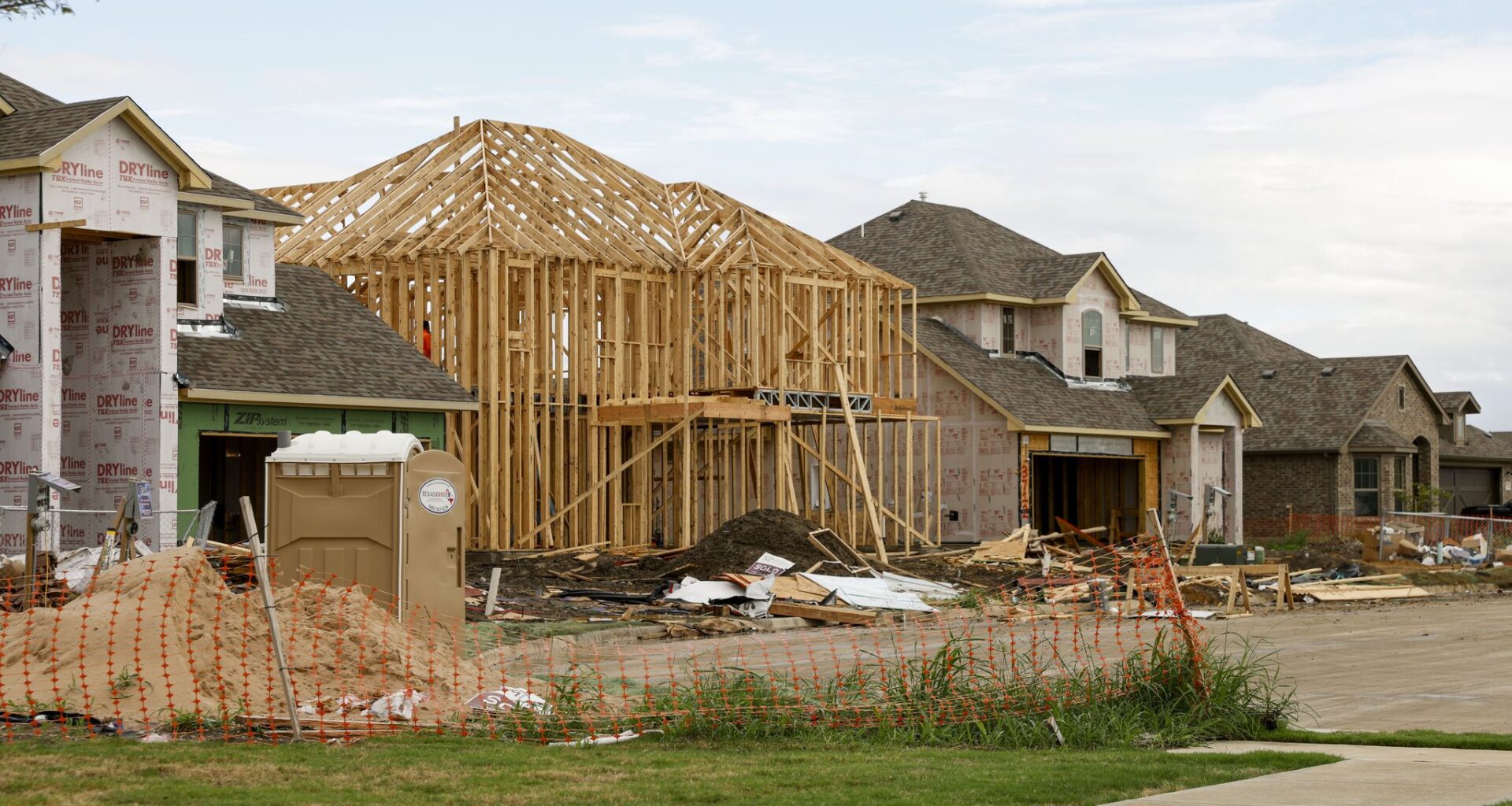
Homes are under construction at The Homestead at Ownsby Farms development in Celina.
Elías Valverde II/Staff Photographer
Four of the country’s five fastest growing mid-size or large cities are in the Dallas-Fort Worth metro region, according to Census data released Thursday, suggesting North Texas’ famous growth story has recently remained on track even amid a broader national population growth slowdown and a dimming of Texas’ long hot economy.

Those four cities are all located in Collin County. Celina, which ranked as the country’s fastest growing city by percent increase among cities with at least 20,000 people, is primarily located in far northwest Collin County but also stretches into Denton County. It was followed on the list by Princeton, Melissa and Anna, which ranked as the country’s third, fourth and fifth fastest growing, respectively. The newly released data measured American cities’ population changes between July 1, 2024 and July 1, 2025.
Article continues below this ad
It was the second time in three years that Celina — a suburban city in the northern reaches of the metro whose population has more than tripled over the past half decade — ranked as the country’s fastest growing. The city added nearly 13,000 residents for a new population above 64,000, representing a nearly 25% increase compared to a year earlier. That population gain also ranked fourth nationally in numeric terms, behind only far larger cities.
“It’s exciting. I think it shows the momentum that Celina has,” said Ryan Tubbs, the city’s mayor.
Tubbs cited the city’s strong schools, safety and location along the expanding Dallas North Tollway as factors behind the city’s growth. He also said he wasn’t surprised by the latest fastest-growing designation, and emphasized that years of rapid growth were bringing both opportunities, including new retail and economic development, as well challenges, including new demands on the local water infrastructure.
Article continues below this ad
Make Dallas News a preferred source so your search results prioritize writing by actual people, not AI.
Add Preferred Source
“Personally, I try and have a positive outlook for it,” he said. “If we could control the growth that would be a different reality, so we just try and embrace the positives [and] work toward a better life for the residents that are here as well as the residents that are coming for the future.”
Even after years of growth, the city could still get much larger: Tubbs has previously said a full buildout would put Celina’s population at around 350,000.
In an email to The News, Bridget Saxton, a representative for the city of Melissa, also said the city was not surprised to rank among the country’s fastest growing. “People are choosing Melissa because of the quality of life, strong schools, and the sense of community that still exists here,” she said.
Article continues below this ad
Fort Worth also recorded a major growth spurt. Tarrant County’s largest city added around 19,500 residents during the time period, which ranked second among all U.S. cities by numeric gain. With the additional residents Fort Worth — a city whose economy has also lately been booming, thanks in part to a burgeoning film industry — registered a population of around 1.028 million, ranking it the fourth most populous city in Texas and 10th most populous in the country, narrowly ahead of Jacksonville and Austin.
“Honestly, it comes with significant responsibility,” Fort Worth mayor Mattie Parker said during a State of the City address in October, after remarking on the one million resident milestone. “This is our defining moment of growth and opportunity.”
Other North Texas cities also ranked highly. Among American cities with at least 20,000 residents Forney, in Kaufman County, ranked as the eighth fastest growing by percent increase, registering a new population of nearly 42,000, and Greenville, in Hunt County, ranked 15th.
McKinney, a prosperous Collin County city that’s been growing rapidly for years, ranked as the country’s 10th fastest growing in numeric terms. The city added 8,500 residents, for a new population of 236,000.
Article continues below this ad
Cities elsewhere in Texas also made notable gains. Fulshear, a Houston suburb, grew by 21%, the country’s second-largest percent increase. Hutto, north of Austin, registered the country’s 13th-largest percent increase.
San Antonio and Houston also added roughly 14,000 and 12,000 residents, respectively, representing the third and sixth largest numeric gains. Austin — a city that’s experienced a long-running population boom in part because of its emergence as a new tech hub — gained over 9,000 residents, for a new population of just over one million residents.
Dallas also gained residents but lagged behind Texas’ other big cities, with a population addition of about 3,400 residents. Dallas’ new population was about 1.33 million, ranking it ninth largest in the country, just one spot ahead of Fort Worth.
The city’s modest gain came as Dallas County actually lost a net of around 2,600 residents during the same time period, according to Census data released in late March. It’s a data point that hints at a major shift underway in the larger metro area, as much of urban Dallas faces major challenges — including widespread commercial real estate vacancy and a homelessness crisis — even as other parts of the region continue to thrive.
Article continues below this ad
“Downtown Dallas needs to have a reckoning,” Steve Triolet, an executive at Dallas-based Partners Real Estate, told The News earlier this year, in the wake of news that AT&T was abandoning its downtown headquarters for Plano.
Although suburban North Texas is growing particularly fast, many American metro areas are experiencing a similar trajectory, with large cities adding population at a much slower pace than smaller suburban cities in the same metro region, the new data showed.
“Big-city growth slowed significantly between 2024 and 2025, with some major hubs even seeing small declines,” Matt Erickson, a statistician with the Census Bureau, said in a release. “In contrast, midsized cities found a ‘Goldilocks zone’ where domestic and international migration, paired with new housing, helped prevent the sluggish growth seen in small towns and larger metropolitan centers.”
Article continues below this ad
In numeric terms, the country’s fastest-growing city was Charlotte, which added nearly 21,000 residents. Yet by percentage growth, the release noted, the Queen City ranked only seventh in its own metro region. The same trend held true in the country’s biggest metro area: New York City’s population dropped by over 12,000, the largest numeric decrease of any city, while four suburbs in the larger New York metro area ranked among the top 200 fastest-growing jurisdictions by percentage growth, the report noted.