
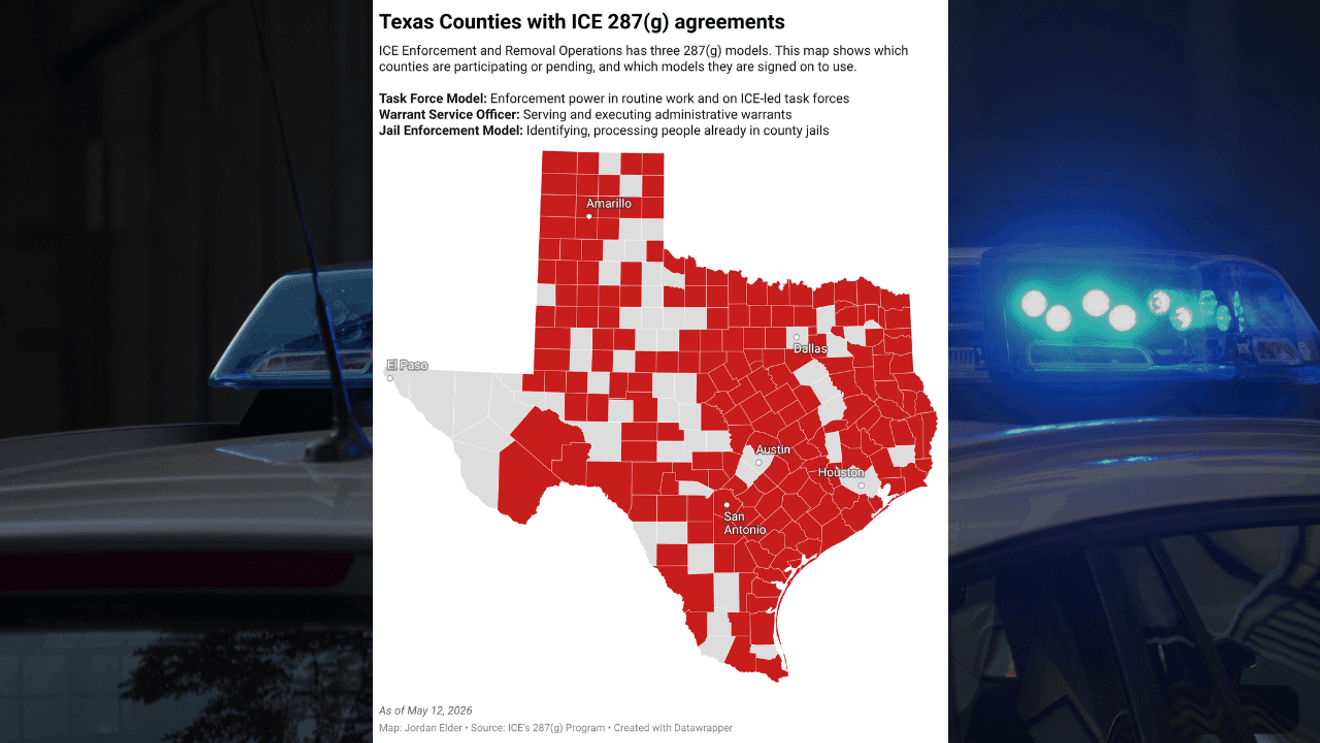
SAN ANTONIO — About 76% of Texas counties have now signed agreements with U.S. Immigration and Customs Enforcement under the federal 287(g) program, expanding the role of local law enforcement in immigration enforcement.
Because of a January 1 deadline in Texas law, sheriffs in counties with more than 100,000 residents are required to enter one of these agreements formally. Counties have until the end of 2026 to sign on and implement one of three enforcement models.
But the News 4 I-Team found it is not just counties signing on.
Several local cities and agencies around San Antonio, including Balcones Heights, Hollywood Park, China Grove and the St. Hedwig Marshal’s Office, have also entered 287(g) agreements with ICE.
Municipalities can choose to enter an agreement, but it is not currently required by Texas law.
The program allows local agencies to choose between three models, or combine them, depending on how involved they want to be in immigration enforcement.
Under the task force model, officers can use enforcement power in routine work or while assisting an ICE-led task force.The warrant service officer program allows local officers to serve and execute administrative warrants on migrants in local custody.The jail enforcement model focuses on identifying and processing people eligible for removal who are already in county jails.
Civil rights groups have raised the strongest concerns about the task force model because it can move immigration enforcement outside of jails and into the community.
“While people are traveling throughout San Antonio, that increases risk if you’re going through one of those local cities that has a 287(g) agreement,” said Sarah Cruz, policy and advocacy strategist with the ACLU of Texas.
Cruz says this model is more out in the community than the others.
The ACLU has also raised concerns about 287(g) agreements more broadly, saying it has fueled racial profiling, civil rights violations, and has opened up law enforcement agencies to the risk of lawsuits.
Among Texas’s most populous counties, Bexar County, home to San Antonio, is currently the only one to adopt a 287(g) model.
Bexar County’s Precinct 3 has signed on to an agreement even though it is not required.
Earlier this year, Precinct 3 Constable Mark Vojvodich told the I-Team he understands how the task force model can be perceived, but says the day-to-day work for his deputy constables likely won’t see significant change.
“We aren’t dedicating any officers to the ICE function per se, there’s not gonna be someone traveling around working directly with them,” Vojvodich said.
He said ICE reached out to lots of agencies in the area about the program.
“I did talk extensively with ICE to know what we are allowed to do and what we can choose to do, because that’s a big thing in our community, and we want to make sure we’re on the right side of it,” Vojvodich said.
For some agencies, reimbursement is also part of the equation.
“I think especially after the funding announcement from the federal government, we started to see a lot more of those agreements,” Cruz said.
ICE is offering benefits to participating agencies, including reimbursement for the annual salary and benefits of each eligible trained 287(g) officer, and overtime coverage up to 25% of the officer’s annual salary. Law enforcement agencies are also eligible for quarterly monetary performance awards based on the successful location of illegal aliens, according to DHS.
Hollywood Park told the I-Team that three of its 17 officers are trained under the 287(g) agreement, and all three have been deputized. The city said it plans to seek reimbursement.
Balcones Heights told the I-Team 23 officers have been trained and formally deputized under its 287(g) agreement. The city said it has 29 officers total, including active and reserve officers.
Mayor Johnny A. Rodriguez Jr. told us back in January that the decision was made as a public safety tool, not a political statement.
The Mayor and City Council set the goals and objectives for the City of Balcones Heights. It is then the responsibility of the City Administrator and the Chief of Police to operationalize those goals through professional judgement and day-to-day management.Our goal is clear and unchanged: to make Balcones Heights the safest suburban city in Bexar County. The decision to enter a 287 (g) agreement authorized by Congress since 1996 was made by our professional leadership as an operational tool to advance that goal. This was not a political statement, but a judgement call by those responsible for public safety. We respect that chain of responsibility and place our trust in our professionals to act lawfully, effectively, and in the best interest of our residents.
The Texas Department of Public Safety also confirmed 100 Texas Highway Patrol troopers have completed the training.
The department’s Criminal Investigations Division has 28 special agents who have completed the training.
Counties that fail to comply with the state law could face legal consequences. The law gives the Texas Attorney General authority to take noncompliant jurisdictions to court.
Statewide, nearly 200 counties and nearly 90 cities, marshals or constables have signed some type of ICE agreement.
ICE is offering benefits to agencies that participate, including reimbursing for the annual salary and benefits of each eligible trained 287(g) officer, including overtime coverage up to 25% of the officer’s annual salary. Law enforcement agencies will also be eligible for quarterly monetary performance awards based on the successful location of illegal aliens, DHS says.
Vojvodich says that was a factor in his decision to join the program, hoping to bring money back to Bexar County taxpayers.
Cruz says the ACLU tracked more agreements being signed after the federal funding was announced.