
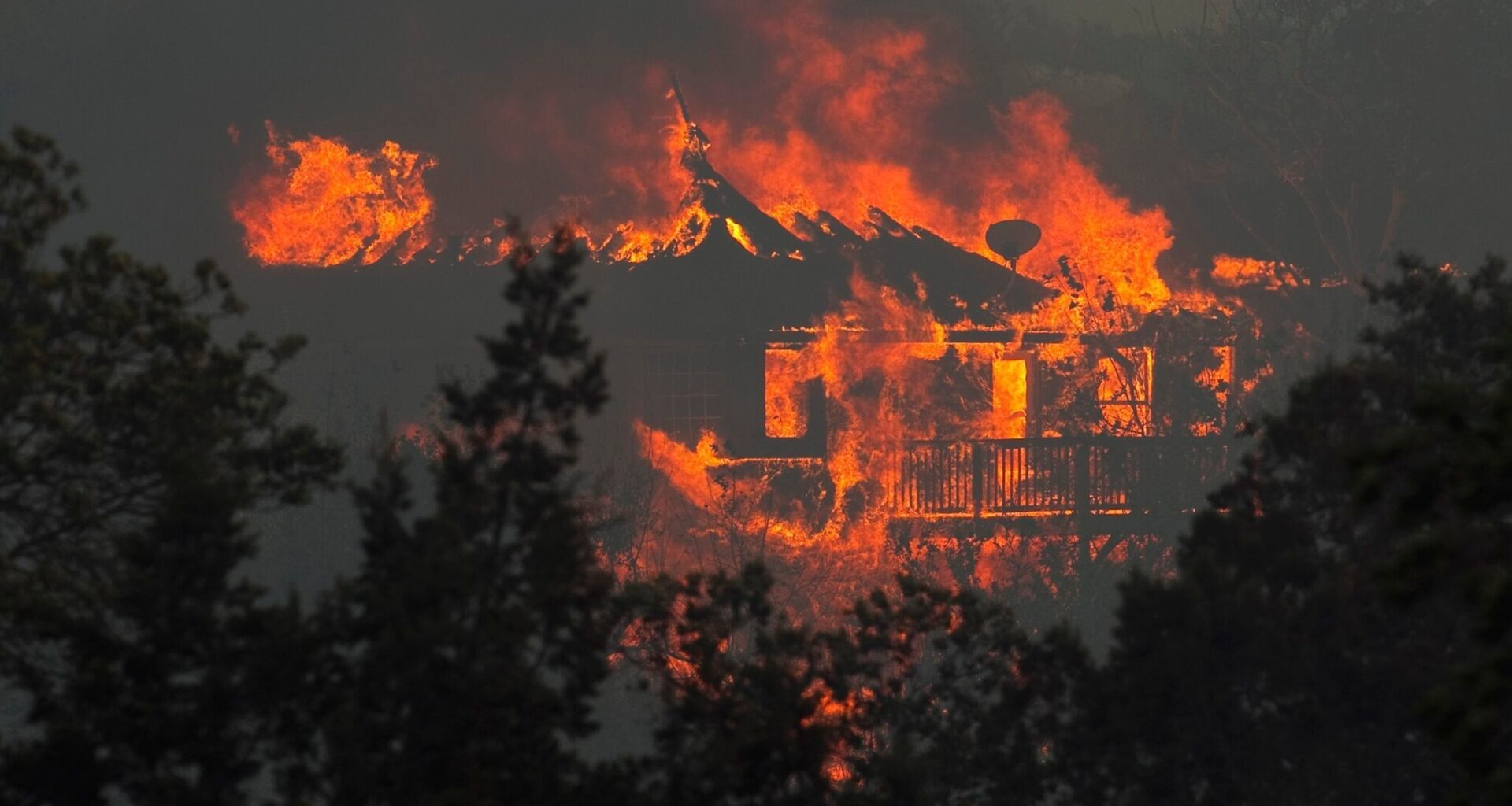
A house burns in the Steiner Ranch neighborhood Sept. 4, 2011, in country not unlike the rugged, wooded hills and canyons that fed the April 1961 fire in Davenport Ranch. Wildfires broke out all over Central Texas in 2011, including a massive fire in Bastrop County that eventually burned more than 34,000 acres.
Jay Janner / American-Statesman
Clearing brush used to be the extent of wildfire preparation for most Austin homeowners. Now the process includes formal checklists, third-party certifications and financial incentives — and a growing industry built around reducing wildfire risk.

Nearly 95,000 Austin-area homes face moderate or greater wildfire risk, ranking the region fifth nationally among major metropolitan areas, according to data cited by the Texas Comptroller’s office. The four metros ranked higher are all in California. Statewide, more than 244,000 Texas homes face significant wildfire risk, with estimated reconstruction costs topping $88 billion.
Article continues below this ad
That growing risk is changing how local officials, homeowners and insurers approach prevention.
The Insurance Institute for Business & Home Safety recently expanded its Wildfire Prepared designation program into Texas and nine other states. The program is based on research into how homes ignite during wildfires and outlines steps homeowners can take to reduce risk.
The designation does not automatically lower insurance premiums. But it gives homeowners a way to show insurers their property meets a recognized wildfire-prevention standard as companies pay closer attention to wildfire exposure.
A market grows around mitigation
Austin has been moving in that direction for years. The city and Travis County are updating their regional Community Wildfire Protection Plan, and Austin enforces a Wildland-Urban Interface Code that sets ignition-resistant building standards based on a property’s proximity to wildland areas.
Article continues below this ad
Jester Estates in Northwest Austin, shown Friday, Nov. 7, 2025, faces increased wildfire risk because of limited access.
Jay Janner/Austin American-Statesman
Local officials also have pushed “home hardening” — structural upgrades designed to reduce fire risk — and recommend maintaining defensible space in three zones extending up to 100 feet from a home.
Private companies are stepping in to meet growing demand.
Article continues below this ad
Wimberley-based Wildfire Prevention Co. announced this month it will serve as a preferred service provider for the IBHS program in Texas. The company offers wildfire risk assessments, home-hardening upgrades and land-management services, including ember-resistant vents, protective deck mesh and fire-retardant applications.
The stakes are especially high in neighborhoods near greenbelts, steep terrain or areas with limited road access.
A previous American-Statesman analysis identified 275 Travis County communities with constrained evacuation routes, affecting roughly 52,500 structures and 81,000 residents. Those neighborhoods can create a dangerous bottleneck during a fast-moving wildfire, with residents trying to evacuate as firefighters attempt to enter.
Texas homeowners generally can rely on standard homeowners insurance policies to cover fire damage, according to the Texas Department of Insurance, which urges residents to review coverage before a disaster strikes.
Article continues below this ad
How to protect your home from wildfire
Austin fire officials say homeowners should focus first on embers, which can travel ahead of a wildfire and ignite homes by collecting in gutters, eaves and other vulnerable areas.
Residents can reduce risk by:
Clearing gutters and downspouts
Sealing gaps in eaves and exterior walls
Maintaining vent and window screens
Keeping vegetation away from exterior walls
Article continues below this ad
The city also recommends:
Removing dried leaves and plants within 5 feet of the home
Trimming tree limbs at least 10 feet from structures
Moving flammable outdoor furniture away from buildings
Using ignition-resistant or noncombustible materials for decks, roofs, vents, eaves, fences, walls, windows and doors when possible
Homeowners also can request a free Structural Ignition Zone Evaluation through the Austin Fire Department.
Article continues below this ad