
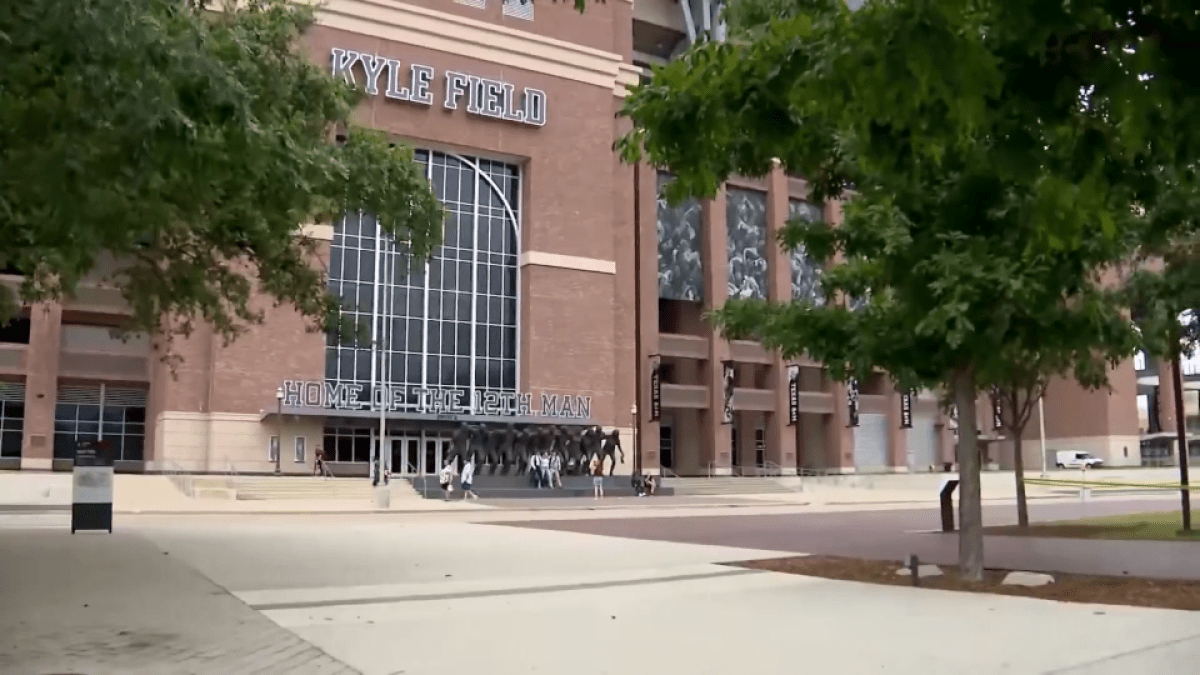
In just a few weeks, Kyle Field will shift from the home of the Fightin’ Texas Aggies to an international soccer stage featuring one of the sport’s biggest stars.
Texas A&M is preparing the stadium for a June 6 friendly match between reigning World Cup champion Argentina and Honduras, a game expected to bring Lionel Messi and tens of thousands of fans to College Station.
Behind the scenes, students and researchers in Texas A&M’s turfgrass science program are leading much of the work to transform the football field into a world-class soccer pitch.
“These are the superstars of superstars that are coming in to play,” said Nick McKenna, Texas A&M’s assistant athletic director for sports fields. “I don’t want to say the term primadonnas, but they will not play on anything short of perfection.”
McKenna oversees the university’s athletic fields and coordinates the conversion of Kyle Field for international soccer.
Over the coming weeks, crews will remove sections of the football turf and expand the playing surface to meet soccer requirements.
“Most people don’t realize it. A soccer field is about 30 to 33% bigger than a standard football field,” McKenna said.
Crews will install 3,000-pound rolls of Bermuda hybrid grass before weaving the new turf into the existing field. Workers will then hand-water the grass daily leading up to the match.
If successful, the field is expected to resemble the pitch Texas A&M prepared for a 2024 match between Mexico and Brazil, which was hosted at the stadium before more than 85,000 fans.
“It’s fun to be able to put that challenge to my team and then watch them rise to the occasion, and then go out and be successful representing Texas A&M at a really high and elite level,” McKenna said.
The university’s turfgrass management program also plays a role beyond campus athletics.
“To have this sports field in perfect condition, there’s a lot of science behind it, a lot of research that the general public doesn’t have any idea,” said Manuel Chavarria, an assistant professor in the Department of Soil and Crop Sciences.
As part of that work, Chavarria and his students traveled to Houston to install grow lights inside NRG Stadium that will help maintain the pitch for the FIFA World Cup.
Graduate student Ashton Franks said many people overlook the work required to maintain athletic facilities.
“A lot of people they see public parks, they come to football games, they even go to play golf, and they don’t actually think that there is somebody’s job to maintain this facility,” Franks said.
Students in the program also get opportunities to work on the sidelines during games.
“[I] definitely like seeing what we do on TV or in-person,” said Cody Patranella, a senior majoring in turfgrass science.
Texas A&M officials are hoping for a sellout crowd on June 6, with potentially 100,000 fans inside Kyle Field and millions more watching around the world.
“I think it’s going to be huge to showcase what we do,” Patranella said.
Chavarria said he hopes the field itself leaves a lasting impression.
“Particularly the landscape — as a turfgrass expert — what we harvest is beauty,” he said.
After the match, crews will convert the stadium back for football summer camps. McKenna said the extra turfgrass will be reused elsewhere on campus.