
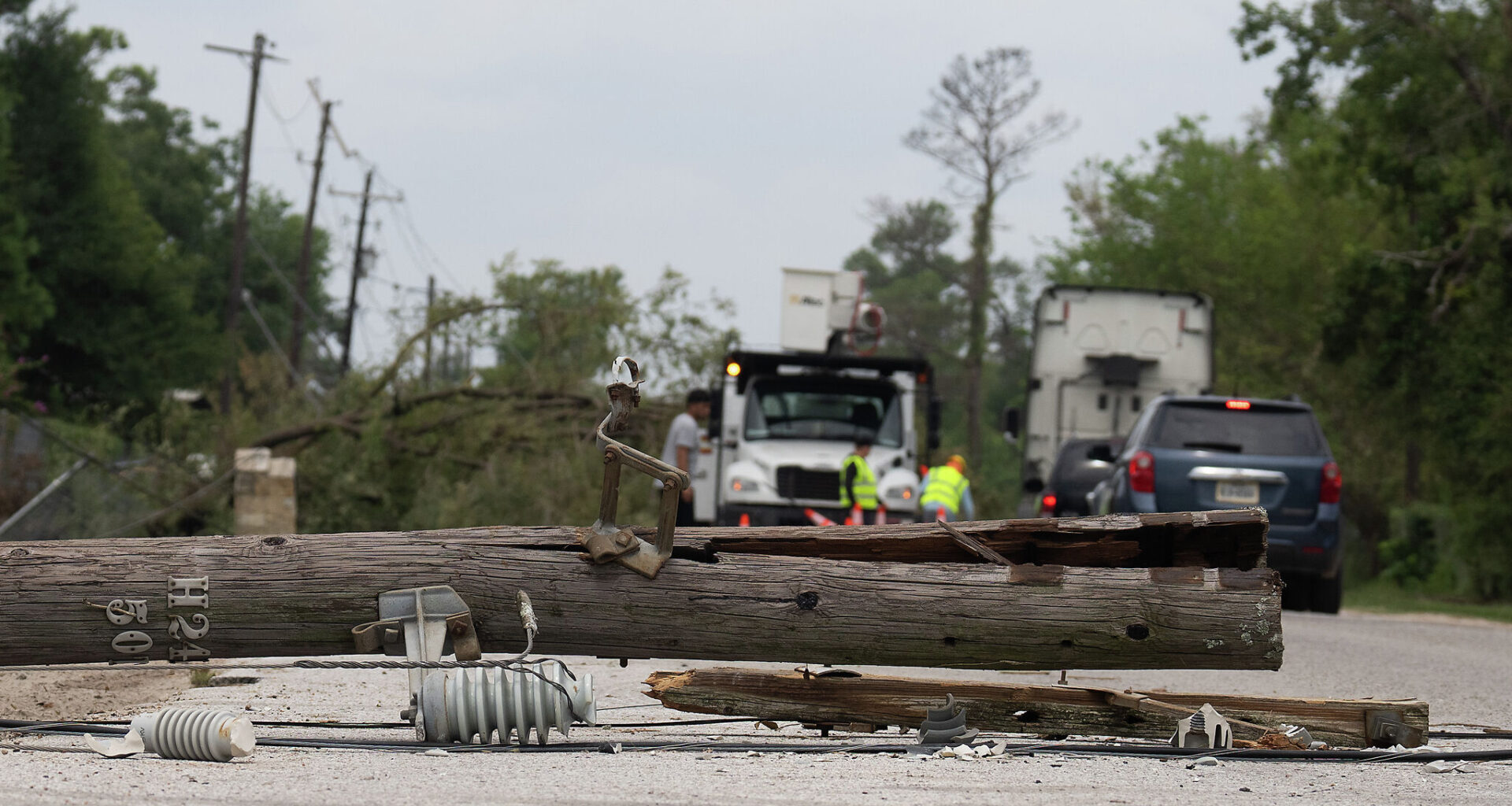
After Hurricane Beryl tore through Houston in 2024 and left thousands without power, I decided enough was enough and we needed some kind of backup power for our home. But we live in a condo community where a gas-powered generator is not an option.
As I wrote later that summer, I wound up buying a power station, a giant battery capable of running essentials in the event of an extended outage. Now, as the June 1 start of the 2026 season approaches, we’ve beefed up our defenses and bought an expansion battery that doubles the station’s capabilities.
It’s all part of how we’re rethinking our digital hurricane preparations. If you’ve lived in Houston for a while, you likely have an annual storm-prep routine — and that includes getting your tech ready, or acquiring what you need to weather extended power outages and provide communications in an emergency. It may be time to modernize and strengthen your gear.
PERSONAL TECH: Free Mac app WhatCable helps users identify what USB-C cables can do
Article continues below this ad
In our case, we decided that the Anker Solix F2000 Power Station we bought almost two years ago could stand an upgrade. Fortunately, we have never had to use it, but if we face a power outage of more than a few hours, our plan is to use it to keep our refrigerator running, along with fans, our fiber internet modem and routers.
The Anker Solix BP2000 expansion battery, perched atop the F2000 Power Station, doubles the available charge the station can provide in case of an electrical outage. Together they weigh over 120 pounds, which makes one grateful for that extendible handle.
Dwight Silverman
Power stations are giant versions of power banks, the external batteries used to charge phones, tablets and even laptops when an outlet isn’t available. The model we chose has 12 different ports for connecting all kinds of devices — standard AC outlets, USB-A and -C ports, connections for dryers and stoves, and even a port for connecting directly into a home’s power grid.
Anker says the F2000, with a 2,048-watt-hour rating, can power a fridge that uses 360 watts of electricity for 11 hours. Our strategy is to let the refrigerator’s thick insulation keep things cold for a few hours, plug it into the power station to cool it back down, then unplug it again for a while, extending that 11-hour estimate.
Article continues below this ad
Once the power station’s charge became depleted, we’d take it somewhere that had power and charge it there (it takes about two hours to go from 0 to 100 percent). We even bought a dolly designed to get heavy items downstairs (we live on the second floor of our condo building) to move the 67-pound F2000 to another location. We haven’t had to test this, either — thankfully!
At the time we bought the F2000, we considered springing for an extra battery as well. The BP2000 Expansion Battery adds yet another 2,048-watt-hours to the station, for a total of 4,096 watt hours. But they’re expensive, so we passed. This year, Anker started running a storm-prep sale on its home backup products, and the expansion battery dropped to $799, or almost half off. We made the leap. (Anker competitors Jackery and EcoFlow also launched pre-storm-season sales.)
The battery, which weighs almost 55 pounds, sits atop the power station. A cable that’s so thick it looks like an exercise gadget sold via infomercial connects the two. When the pair is plugged into an AC outlet, it charges the power station first and then the expansion battery. When you use the combo to provide power in an outage, the expansion battery discharges first. Unfortunately, you can’t charge the expansion battery separately from the power station.
Of course, a power station is only one part of a comprehensive plan for readying your tech gear for hurricane season — and obviously, if you live where you can use a gasoline, diesel or natural-gas generator, those may be preferred options. But for those of us in apartments and condos — and in Houston, we are legion — a power station is the way to go.
I wrote a detailed column last July with more storm-prep tips worth re-reading. Here are the highlights, along with some updates.
Article continues below this ad
Power banks
Make sure you have one power bank available for each smartphone in your family’s collection, and each one should be capable of recharging the phone twice — 10,000 milli-Amp hours (mAh) is a good capacity to look for. Also, if you have power banks that are more than five years old, consider replacing them. Newer models are safer, can recharge faster, are more efficient and many now come with built-in, retractable cables.
Uninterruptible power supplies (UPS)
UPSes are designed to keep critical gear running in case of a power outage, at least long enough for you to save your work and safely power down. Have a UPS for your desktop computer, along with a separate one for your internet gear, such as your provider’s gateway or your own separate cable/fiber modem and router. They also are good surge protectors — I have one on my TV just to keep it safe from power spikes.
Backup internet sources
It may be worth signing up for an additional source of internet for use if your main connection goes out in a storm. You may be able to use the 5G hotspot on your phone, but most people’s service plans limit the amount data you can use this way. Instead, consider temporarily signing up for a cell carrier’s 5G home internet service. All three of the big U.S. providers — AT&T, T-Mobile and Verizon — offer it, as do some smaller carriers. Most do not require a contract, so you can pay for the service during the six-month hurricane season, then cancel it when the season’s over on Nov. 30.
Article continues below this ad
Yes, it’s always possible that a cell tower may be down in a storm, or that an extended power outage will affect emergency power at tower sites. But cellular carriers seem to move a lot faster getting their service back up post-storm than cable or fiber providers, who often must wait for power lines to be fixed before they can repair their own wires.
Satellite calls on a smartphone
Apple introduced in 2022 the ability for iPhones to send texts via satellite when neither Wi-Fi nor 5G service was available. That service has since expanded to allow phone calls and non-emergency texts (though 5G and Wi-Fi must still be unavailable), and other handset makers — including Samsung and Google — have added the feature. Even the telcos are getting into it, with T-Mobile partnering with Starlink, AT&T is working with AST SpaceMobile and Verizon with Skylo. Find out what your smartphone is capable of, set it up and then learn how to use it. iPhones, for example, have a built-in demo to see how satellite connectivity works. Better that you learn this before you have to figure it out in an emergency.
Article continues below this ad