
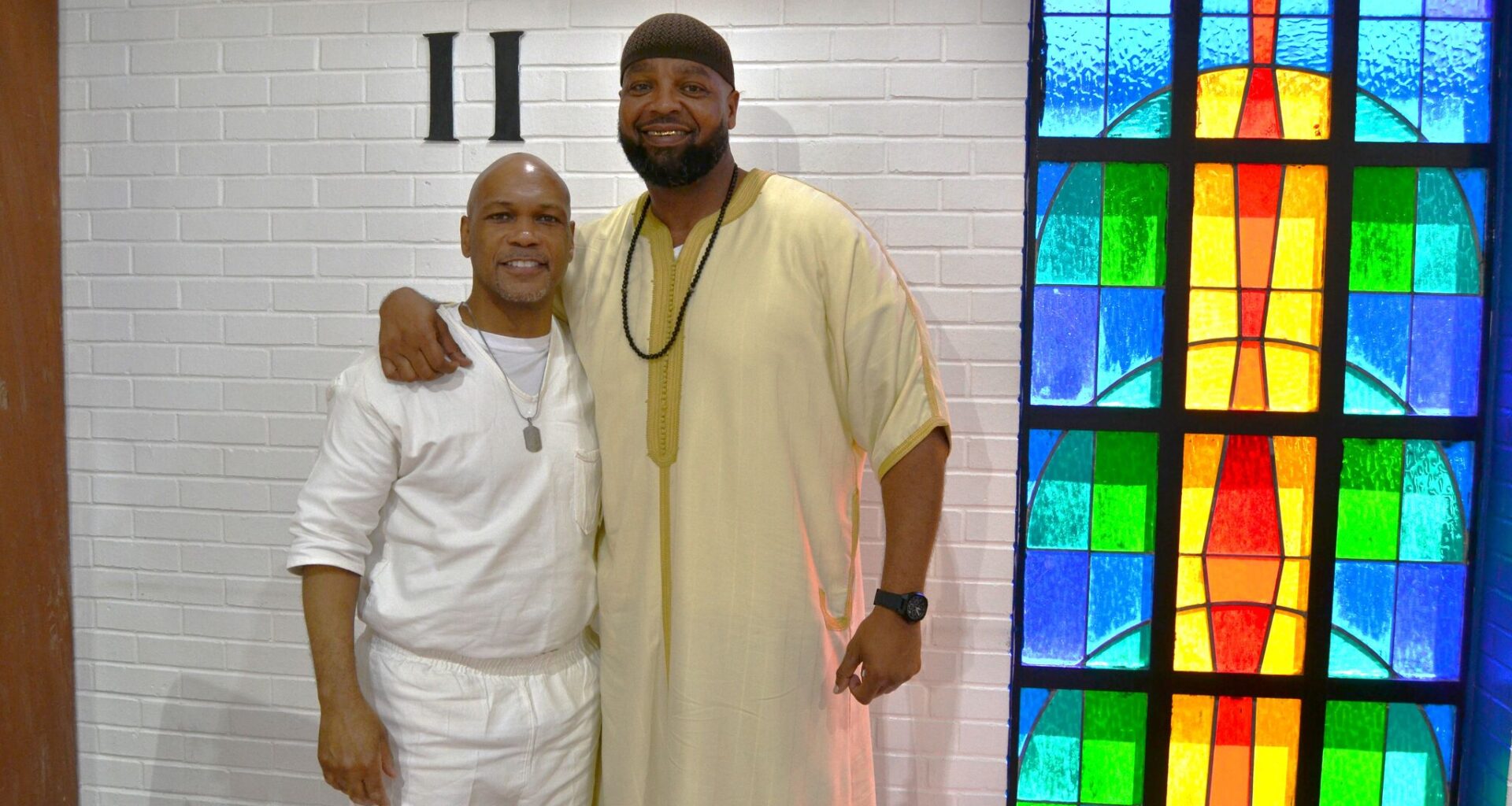
On Thursday, inmates and prison officials are celebrated a graduation ceremony for the Mentorship Education Rehabilitation Integrated Training program, better known as MERIT.
Ahmed Humble (Chron)
There’s a calm energy that fills the air inside the chapel in the Stringfellow Unit in Brazoria County, where incarcerated Muslim men gather for a rehabilitation program unlike any other in Texas prisons.

The same can’t be said as you walk the halls of the prison unit in Rosharon, Texas, where tension and hypervigilance are part of everyday survival for many inmates.
Article continues below this ad
But inside the prison chapel, there’s silence only disrupted by laughter between friends or affirmations about redemption, accountability and faith. On this particular Thursday, inmates and prison officials are celebrating a graduation ceremony for the Mentorship Education Rehabilitation Integrated Training program, better known as MERIT.
Developed in August 2024 by inmate Damien “Speech” Faulkner with full support from the Texas Department of Criminal Justice, the program was created with Muslim inmates in mind to promote good behavior and reduce recidivism.
While Islam serves as the backdrop for the lesson plans, Faulkner, 53, told Chron the curriculum combines teachings from the Qur’an with cognitive-behavioral concepts focused on emotional regulation, communication, accountability and conflict resolution.
Developed in August 2024 by inmate Damien “Speech” Faulkner with full support from the Texas Department of Criminal Justice, the program was created with Muslim inmates in mind to promote good behavior and reduce recidivism.
Ahmed Humble (Chron)
Faulkner entered the Texas prison system at 39 and later enrolled in a four-year Biblical seminary program, eventually earning a Bachelor of Science in Biblical Studies during his incarceration and the COVID-19 pandemic. Although the program was rooted in Christianity, Faulkner said it gave him the opportunity to conduct classes and lead religious services inside prison units.
Article continues below this ad
“It was difficult for a Muslim to go through a Biblical seminary program,” Faulkner admitted. “But we were able to get (MERIT) through to the administration officials, who fully embraced and endorsed it, and now it’s a full time job for me.”
Even though Muslims make up one of the largest religious groups in Texas prisons—and one of the fastest growing religions in U.S. prisons—there are only a handful of employed Muslim chaplains. Many of the inmates Chron met with also noted when they first learned about Islam, there was no proper guidance to understanding Islam and not enough collective efforts to address the shortages.
Inside a Texas prison chapel, Muslim inmates are mentoring others through accountability, rehabilitation and faith.
Ahmed Humble (Chron)
Incarcerated Muslims have then increasingly been filling that gap, sharing the MERIT-gained wisdom with fellow inmates who have been (or are currently are) in their shoes.
Article continues below this ad
Through MERIT, Faulkner now trains fellow inmates from prison units across Texas to become “Muslim coordinators” or “MERIT facilitators” who can mentor other incarcerated men, lead classes and conduct Islamic services. Their first graduation ceremony was held in October 2024 just a few months after the curriculum was finalized and approved by the TDCJ.
“That means they come here for six weeks, go through 120 hours of training, and then they return back to the units with the job title, ‘Muslim coordinator,’ which means they’re able to conduct services and volunteer and do mentorship,” he said. “Right now, I think we have 24 units that we have members from MERIT right now.”
“A different kind of survival”
One of the many facilitators at Stringfellow was Preston “Salahuddin” Mascorro,” who during our first meeting, (where no recorded interviews could be conducted) sat across from me with welled-up tears resting beneath teardrop tattoos while describing his journey into Islam and through the MERIT Program.
Article continues below this ad
As Salahuddin shared his journey into Islam and the MERIT program, I asked him what made him so emotional. He explained how proud his wife and his mother-in-law were of the progress he made, because it felt like he did the impossible.
One of the many facilitators at Stringfellow was Preston “Salahuddin” Mascorro,” who during our first meeting, (where no recorded interviews could be conducted) sat across from me with welled-up tears resting beneath teardrop tattoos while describing his journey into Islam and through the MERIT Program.
Ahmed Humble (Chron)
Salahuddin acknowledged he may not ever experience daylight as a free man due to his extensive prison sentence. Still, he said that the program has helped him find purpose—if he can help someone else learn from his errors, then he can breathe a little easier and “Inshallah,” he will have freedom in the afterlife.
That purpose was on full display Thursday as Salahuddin was the graduation event’s master of ceremonies, where he and prison officials handed six inmates from different units their MERIT certificates.
Article continues below this ad
“There was so much in the curriculum that dealt with cognitive behavioral therapy, social skills and communication skills,” Salahuddin said during his remarks. “At first I was thinking, ‘How are we going to translate this into Islam?’ But as we went through it, it started to unfold.”
He then addressed the graduates directly.
“You brothers have a heavy weight to go back to,” Salahuddin added. “You have a position to represent. You have to do more with love. You have to do it with patience. You have to pick your battles.”
The war beyond prison
Those who have completed their prison sentences like Jason “Abdul Jalil” Gibson have taken their MERIT lessons beyond prison. During Thursday’s graduation, he reiterated that message to Chron, noting that he hadn’t seen a Muslim-supported program like this in the past.
Article continues below this ad
“The Muslims had to fight to get pork-free food, for Jummah (Friday prayers) and have the Qur’an,” he explained.
Those who have completed their prison sentences like Jason “Abdul Jalil” Gibson have taken their MERIT lessons beyond prison. During Thursday’s graduation, he reiterated that message to Chron, noting that he hadn’t seen a Muslim-supported program like this in the past.
Ahmed Humble (Chron)
Jalil now works as a re-entry support specialist for Texas Harm Reduction Alliance after serving 21 years in prison. Yet he still shares pieces of the MERIT program with other formerly incarcerated individuals.
“This program is important because not only is it about reducing recidivism or helping the incarcerated population redeem themselves,” he said. “This program is transformational because it impacts families, communities, neighborhoods—and I think it’ll impact society.”
Article continues below this ad
After serving his sentence, Jalil told Chron the first thing he did after he was released in June 2025 was pray outside as a free man.
“Then I went to Whataburger after prayer,” he said with a chuckle.
Muslim Area Chaplain Melvin LeBlanc echoed that sentiment during the graduation ceremony saying inmates inside Texas prisons waited decades for a program like MERIT.
“You represent something that took maybe 50 years for it to come,” he said during the graduation ceremony. “I ask each and every one of you as a MERIT coordinator: know what battle not to fight. We don’t have to fight all the battles, because then we won’t win the war.”
Article continues below this ad
With full support from the Texas Department of Criminal Justice, the MERIT program was created with Muslim inmates in mind to promote good behavior and reduce recidivism.
Ahmed Humble (Chron)
Maintaining the lessons learned from the MERIT program was paramount regardless of the journey, as it blends theology and emotional survival.
“What’s the war? Saving lives?” Christopher Carter, division director for TDCJ rehabilitation programs, asked graduates during the ceremony. “Why lose an opportunity to win the war over a stupid battle somewhere?”
With the MERIT program, incarcerated Muslims like Faulkner are able to show fellow inmates they’re not alone in their redemption battle through Islam and to hold onto the lessons in and outside prison.
Article continues below this ad
“This is a movement that we’re creating; we’re working with men to teach them how to be Muslim in word and deed,” Faulkner explained. “The challenge is to make it a lifelong process.”
Inside a Texas prison chapel, Muslim inmates are mentoring others through accountability, rehabilitation and faith.
Ahmed Humble (Chron)
At 54 years old, Faulkner still has more than a decade before he becomes eligible for parole. However through MERIT, he says he has already found purpose mentoring younger inmates across Texas prisons. He said the next phase is to develop something similar for the Women’s Prisons.
Article continues below this ad
“When I return home to society, I said that I would visit every unit in Texas,” he paused before smiling, “Well, I get a chance to do that right now.”