
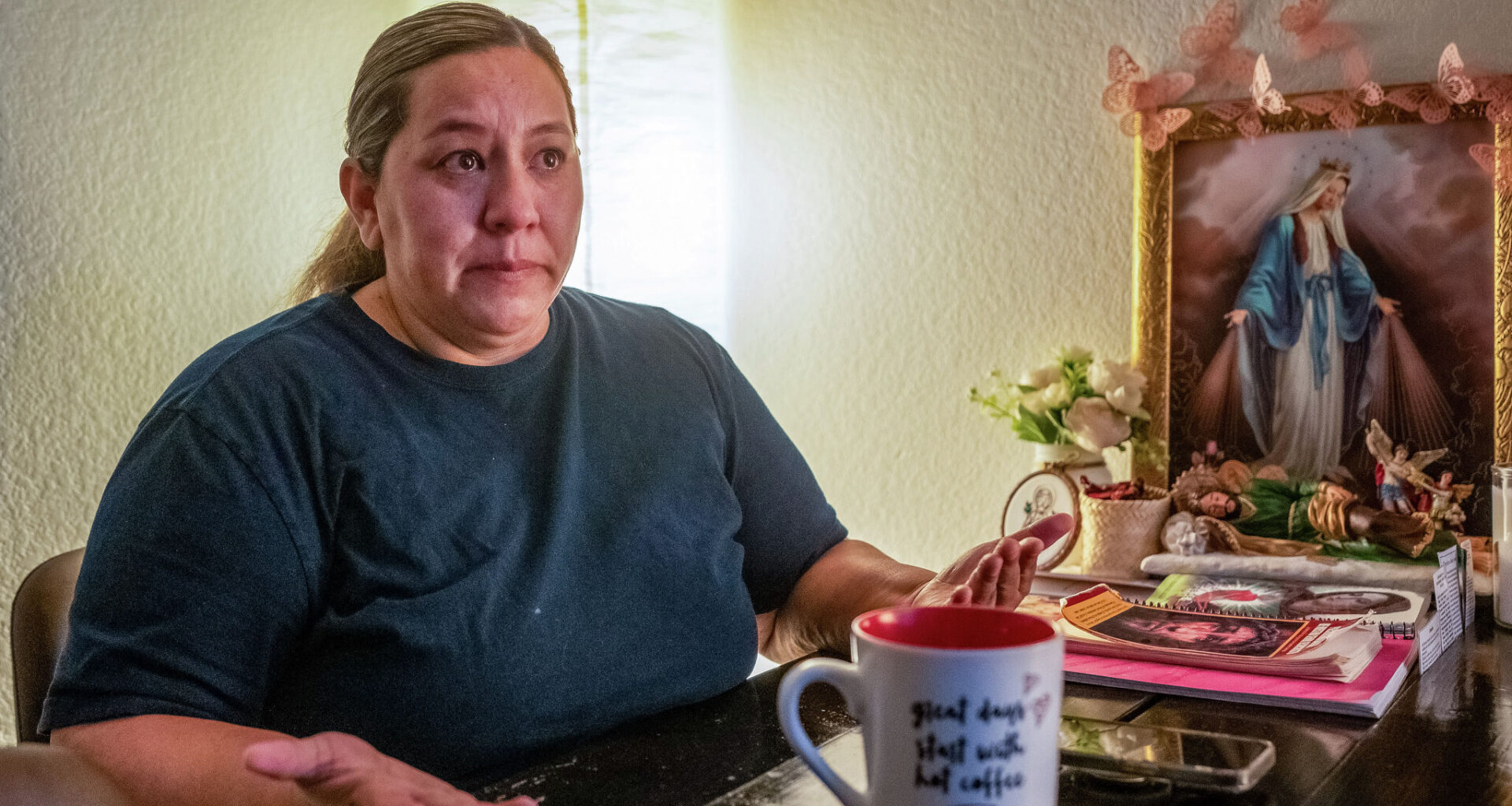
María Juárez discusses an incident from December when her husband was stopped by police and questioned about his immigration status as she sits at her home in Austin, Friday, May 15, 2026. Juárez, a 47-year old Mexican immigrant who has a work visa, and her husband, a U.S. citizen, avidly check Reporte Austin for news and ICE locations, sending to friends and family to warn them of locations to avoid.
Mikala Compton/Austin American-Statesman
On weekday mornings, Austin resident María Juárez pauses while making her children’s breakfast to anxiously pore over Facebook on her phone. She scrolls through Spanish-language pages tracking sightings of Texas state troopers and federal agents conducting immigration enforcement. Later, as she rides in the passenger seat of the family truck or helps her husband finish a plumbing job, she checks again. He does, too.

“My husband checks it three times an hour,” said Juárez, a 47-year-old Mexican immigrant who has a visa. “He has brothers who weren’t born here.”
Article continues below this ad
María Juárez watches Reporte Austin on her phone as she begins her day at her home in Austin, Friday, May 15, 2026. Juárez, a 47-year old Mexican immigrant who has a work visa, and her husband, a U.S. citizen, avidly check Reporte Austin for news and ICE locations, sending to friends and family to warn them of locations to avoid.
Mikala Compton/Austin American-Statesman
Mario Tapia, owner and reporter of Reporte Austin, has the largest following of a Spanish-language social media page that focuses on local news and information in Austin Tuesday, Feb. 24, 2026.
Mikala Compton/Austin American-Statesman
Mario Tapia, owner and reporter of Reporte Austin, has the largest following of a Spanish-language social media page that focuses on local news and information in Austin Tuesday, Feb. 24, 2026.
Mikala Compton/Austin American-Statesman
Limon Verde takes a video of a DPS vehicle after a suspected ICE-involved traffic stop in Mustang Ridge, outside Austin, Thursday, April 16, 2026.
Mikala Compton/Austin American-Statesman
Limon Verde stops at a gas station in Mustang Ridge, outside Austin, as he waits for tips from his social media followers about the location of ICE agents on Thursday, April 16, 2026.
Mikala Compton/Austin American-Statesman
An ICE agent makes an arrest following a traffic stop made by a Department of Public Safety officer in Mustang Ridge, outside Austin, Thursday, April 16, 2026.
Mikala Compton/Austin American-Statesman
This information, found on outlets like Reporte Austin, informs which roads Juárez and her husband warn family members to avoid — roads they also try not to use.
The constant demand for information about local immigration enforcement has fueled the growth of Spanish-language social media channels that track and amplify reports of U.S. Immigration and Customs Enforcement activity, as well as the state and local agencies that assist it.
Although news of the Trump administration’s immigration crackdown often leaves her feeling powerless, the small act of consuming and sharing information gives her a sense of agency and control.
Article continues below this ad
“You know you’re helping [those you love] stay here for one more day,” she said.
For immigrants without legal status, the social media channels have become critical sources of real-time information. But they’re also widely consumed by immigrants with legal status, like Juárez, who want to warn family members or avoid encounters in which they believe they could be racially profiled.
Of course, the information providers differ widely in structure and reliability. Pages, both established and emerging, are run by owners with different levels of journalistic training, producing content that varies in quality and verification standards. In Austin, popular Facebook and Instagram personalities include a former local Univision news anchor, a former history researcher and a social media influencer who spends his mornings and evenings chasing reports of immigration arrests.
Article continues below this ad
Together, they form an information ecosystem united by what Reporte Austin owner Mario Tapia describes as a “pro-migrant” mission.
News from the community
For 12 years, Reporte Austin has built a following through its daily morning newscast and regular updates about weather, traffic, local crime and missing persons. Immigration arrests during Trump’s first administration, followed by the pandemic, dramatically expanded its audience.
Yet nothing has made the outlet more central to followers’ daily lives than the current immigration crackdown, during which Tapia has taken on a unique local role: verifying and reposting videos or photographs purporting to show ICE, or a collaborating agency like the Texas Department of Public Safety, arresting immigrants.
Article continues below this ad
Reporte Austin has gained 70,000 followers on its largest platform, Facebook, since the start of the current Trump administration, boosting its audience to 240,000.
For Tapia, the stakes are high — and so is the pressure to share only the most thoroughly corroborated information. On an average day, he can receive up to 20 immigration-related tips.
“It’s helped that we’ve been cautious,” said Tapia, a former researcher. “I have followers who say, ‘Until we see it in Reporte Austin, we don’t know if it’s true or not.’”
That trust is essential. Tapia’s operation depends on constant, direct interaction with his followers. People who once sent him videos of crashes and traffic backups on Interstate 35 now commonly send footage of suspected immigration arrests.
Article continues below this ad
To decide which videos to post, Tapia usually reviews footage from multiple angles sent by different users, searching for clues that distinguish ICE agents from the numerous other agencies operating in the area, including federal marshals and local SWAT teams. He studies agents’ clothing and vehicles, which are often unmarked or use temporary or changing license plates. Often, he also consults activists and immigration lawyers tracking enforcement trends across the region.
Today, Tapia said he posts about three-quarters of the tips he receives, a significantly higher rate than a year ago, because immigrants have become better at identifying enforcement activity.
Delivery driver Yahira Chávez is one source who provides Tapia videos. Though last year she initially doubted widespread immigration arrests were occurring in Austin, she changed her mind after witnessing her first immigration arrest in February. She has since spotted three more along her delivery route on North Lamar Boulevard, an area with a large immigrant population. She sent videos of each detention to Tapia.
“It’s an ugly feeling that you can’t do anything for the person,” said Chávez, who has family members living in the country without legal status.
Article continues below this ad
Those who send videos hope the footage will help family and friends who lack lawful status avoid detention. But people with legal status, like Juárez, rely on the information too. Fearful of mistreatment or of being wrongly pulled into the immigration detention system because they are perceived to be in the country illegally, they also seek to avoid encounters with DPS.
Juárez said she believes police are increasingly assuming Spanish-speaking people are illegally in the country, pointing to a December traffic stop in which she said an officer asked her husband, who is a U.S. citizen, whether he was legally in the country after he spoke Spanish during the interaction. Since then, the couple has become consistent consumers of Reporte Austin’s immigration clips.
“Personally, if I know they’re there, I’m not going around there,” Juárez said of DPS. “They’re not respecting anything.”
DPS has touted its cooperation with ICE, saying its officers are instructed to assist with immigration enforcement. Immigration advocates have argued that the agency’s concentration of stops in immigrant-heavy neighborhoods suggests state troopers are targeting immigrants for enforcement scrutiny. Texas law, however, gives police broad authority to conduct traffic stops, including for minor violations, making racial profiling claims difficult to prove.
Article continues below this ad
In a statement responding to American-Statesman questions about racial profiling allegations, DPS spokeswoman Sheridan Nolen repeated a previous agency statement saying officers target only criminal activity and “any person who breaks the law.”
She also said the agency’s Inspector General found no instances of racial profiling last year.
“Not a single racial profiling complaint was sustained,” she said.
‘I’ll be right there’
In an era when information about ICE and DPS activity is in such high demand, much of it is produced and shared outside the more traditional, professionalized model attempted by outlets like Reporte Austin.
Article continues below this ad
One prominent example is Limon Verde, the alias of a 5-foot-5, goateed man in his 30s who patrols the Austin metro hidden in a ski mask and cowboy hat, searching for immigration arrests. (Limon asked the Statesman to withhold his legal name, saying he has received death threats and fears retaliation from law enforcement.)
Early on a Sunday morning, Limon wove through traffic on Decker Lane in East Austin in his silver Tesla, bouncing between phone calls as he waited for a lead. After several calls, a tipster alerted him to a DPS stop a few blocks away, where the caller believed an ICE agent had arrived.
“I’ll be right there,” Limon said in Spanish. “Hold on. Hold on.”
Limon arrived and began to film, pointing his phone at the state troopers sitting in their cars and the empty white Honda CRV whose driver was no longer at the scene. He warned his viewers to avoid the nearby roads. “Be very careful, my people. Let your family members know.”
Article continues below this ad
Limon posts similar recordings almost daily and has become embedded in many immigrants’ daily routines. The son of immigrants began his “patrols” six months ago, motivated by what he believes is racial profiling by DPS officers targeting Hispanics. His willingness to race to rumored enforcement hotspots has helped him amass more than 85,000 followers. In return, supporters flood his livestreams with praise and occasional donations.
But Limon’s relative inexperience — and more confrontational style — also shows. Critics have accused him of amplifying rumored ICE sightings that never occurred. Limon said he has apologized when he has erred and has become more careful over time about what he posts, arguing that he quickly shares information because he can’t have it on his conscience if someone is detained after he delayed posting.
Some immigrants who spoke to the Statesman, including Juárez and Chávez, said they are wary of Limon because of his willingness to confront officers during arrests, which they believe can escalate tensions between immigrants and police.
Limon has filmed himself cursing at ICE agents entering and leaving the Pflugerville detention processing center and berating a Hispanic state trooper over DPS’ role in the immigration crackdown.
Article continues below this ad
Yet those confrontations are central to Limon’s appeal for many followers, who cannot personally chase down reports of enforcement activity or openly vent their anger.
“He’s the daring one,” said Arturo Baldit, a Mexican immigrant deliveryman who relies on both Reporte Austin and Limon Verde for information.
A changing landscape
The rise of information providers like Tapia and Limon reflects broader shifts in the media industry: the rise of individuals as brands, the fragmentation of audiences and the decline of large legacy outlets.
In Austin, Spanish-language TV stations that once served as the dominant local news sources for Hispanic audiences have sharply contracted. Immigrants like Juárez and Baldit said they have noticed the decline, particularly at what was once the region’s largest Spanish-language broadcaster, Univision 62.
Article continues below this ad
The station, which a decade ago rivaled Austin’s most popular English-language broadcasters in ratings, has significantly reduced the size of its editorial staff since the pandemic, shrinking from about a dozen employees at its peak to just five, according to former Univision 62 employees. Of those five staffers, only three are Austin-based reporters, the former employees told the Statesman. The station has also shifted most of its operations to San Antonio and now primarily airs pre-recorded newscasts.
“Everyone notices that Univision has shrunk here, and that you get less Austin news and more about San Antonio,” Baldit said. “That’s why I think we go a lot on social media, especially for stuff that’s at the moment and live.”
The station’s longtime anchor, Hugo Chavez Montes, who left in 2023, now publishes on social media as an independent journalist. He publishes interviews with individuals detained by ICE and explainers about changes to the immigration court system.
Univision 62 declined to comment.
Article continues below this ad
Clemencia Rodríguez, a Temple University professor who studies immigrant and community media, characterized today’s social media reporters and personalities as a modern version of the immigrant press that has long served communities in languages other than English.
Yet, Rodríguez said the decline of traditional media institutions doing this work creates a significant risk of misinformation and reputational collapse. Social media reporters often lack the manpower to verify all the information they want to share. Nor do they have institutional legacies that can help preserve credibility if they publish incorrect information.
“It takes one second and a wrong move to lose that trust,” Rodríguez said.
Keeping on
As immigration arrests continue, the consistent work takes its toll on many information producers like Tapia and Limon, who feel an emotional attachment to the communities they seek to inform.
Article continues below this ad
There are times, amid the daily repetition of reviewing detention videos, that Tapia wishes he was reporting on something else — something that caused less sadness or anxiety. But he continues because he knows the work matters to the people watching.
Family members of people shown handcuffed in the videos he publishes often call him after seeing his posts.
“That was my dad,” they tell him.
Article continues below this ad
If immigration detention can sometimes become abstract — a tally, a statistic — those interactions remind him otherwise. People will know how it happened.