
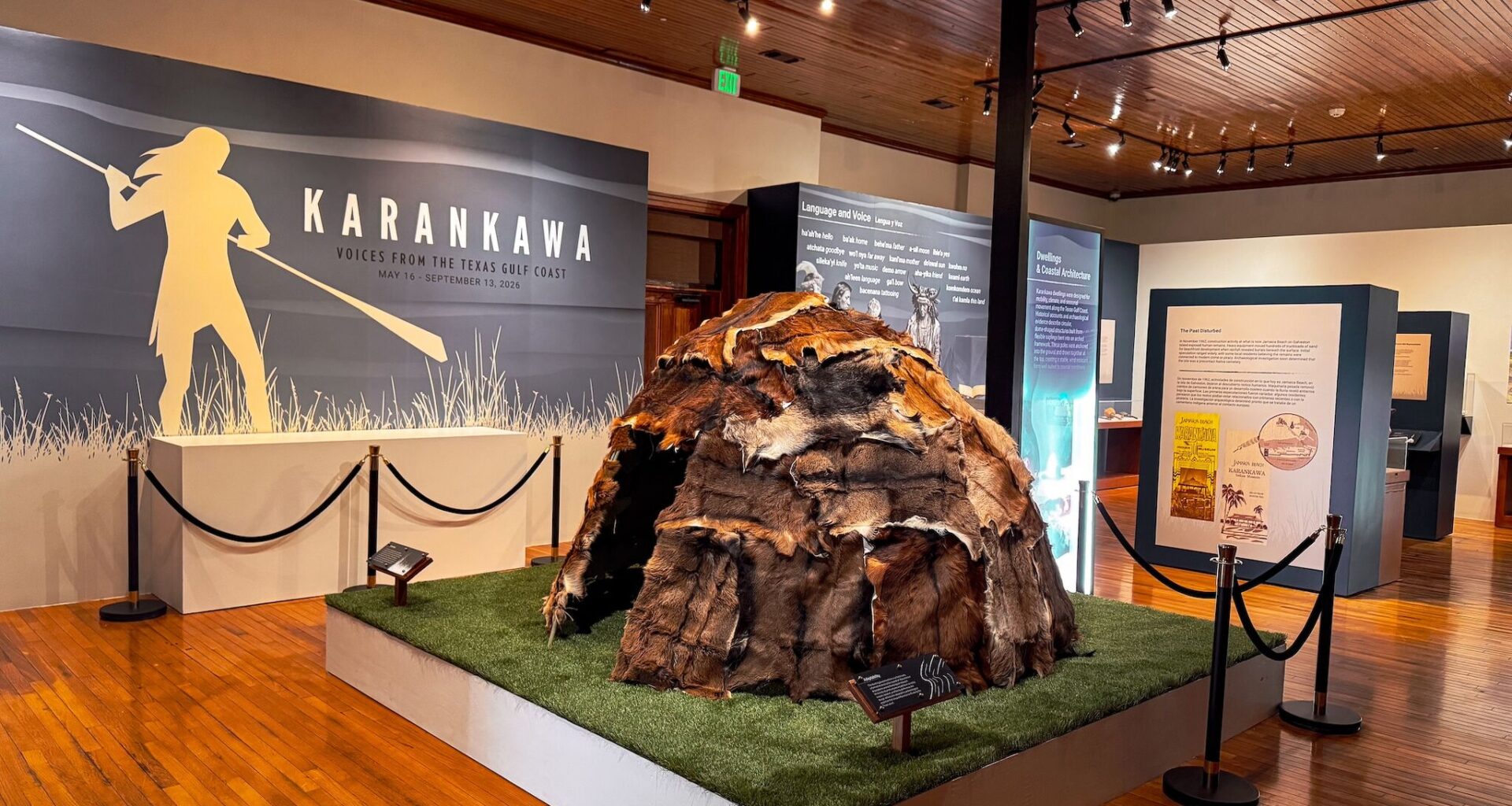
The Bryan Museum’s new exhibit “Karankawa: Voices From the Texas Gulf Coast” includes a trove of information dispelling some persistent myths about perhaps the state’s most misunderstood indigenous people.
Bryan Museum
It will take far more than a new museum exhibit to clear up the misconceptions, tall tales, half-truths, and outright lies surrounding the Karankawa people. That said, there’s no time like the present.

For two years, Galveston’s Bryan Museum has been planning and preparing “Karankawa: Voices From the Texas Gulf Coast,” an exhibit engineered to dispel a host of myths, whether relatively innocuous—they were not ‘aimless nomads,’ for example—or the significantly more damaging canards that the Karankawa practiced cannibalism and, perhaps most stubbornly, are in fact extinct.
Article continues below this ad
After Friday’s members-only preview, “Karankawa” opens Saturday and runs through Sept. 13.
“We love telling Texas history, obviously, but specifically the Texas history that is just constantly gotten wrong,” Bryan curator Eric Broussard told Chron.
Scholars believe the five neighboring tribes that collectively came to be known as the Karankawa had settled the area roughly between Freeport and Corpus Christi by the 1400s.
Chris Gray/Chron
Broussard and his colleagues had their work cut out for them here. The museum’s advisors on the exhibit include Texas historian Tim Seiter, whose book on the Karankawa is due next year, as well as members of the Karankawa Tribe of Texas and language keeper Alex Perez, author of the 2021 book Karankawa Kadla—Mixed Tongue: Medicine for the Land & Our Peoples.
Article continues below this ad
To Broussard, it was a “no-brainer.”
“This story needs to be told, and it needs to be told right,” Broussard said. “And the thing to remember is we’re not going to have all the answers in this exhibit, but anything that we do have in here is provable by primary source material or firsthand accounts.”
Located in the upstairs Special Exhibits Gallery, the exhibit provides a trove of information on Karankawa history, culture, lodging, language, weapons, tools, and musical instruments. (All faithful reproductions, Broussard said, save the artwork and jewelry created by Karankawa descendants.) However, the organizing principle is, without a doubt, correcting the historical record.
Article continues below this ad
For starters, the Karankawa was not a single tribe, but an association of five neighboring, linguistically connected smaller tribes thought to have settled along the Texas coast, roughly between Freeport and Corpus Christi, in the 1400s. As we now know, early encounters with the Spanish and other European explorers were catastrophic on many levels, from decimating native populations with exotic diseases to displacing them from generations-old hunting and fishing grounds.
The exhibit includes detailed information about how the Karankawa tongue managed to survive after the then-Republic of Texas banned indigenous languages in the late 1840s.
Bryan Museum
Given the circumstances, it’s easy to see how some of these myths got started.
“When you’re a Spanish sailor who’s 5’4″ and malnourished, and you get to the Texas coast and there’s a six-foot-tall Karankawa guy, yeah, he looks like a giant to you,” Broussard said. “But these people were eating fish and seafood and bison, and they were healthy. And what better way to justify the attempted genocide of somebody than to paint them as scary?”
Article continues below this ad
No less an esteemed historical figure than Stephen F. Austin, the so-called Father of Texas, reportedly said the Karankawas would “frequently feast on the bodies of their victims,” according to a 2022 Texas Highways article. Perez calls the policies that sprang from such attitudes “kill the Indian to save the man”; by the late 1840s, the then-Republic of Texas had banned indigenous languages outright, an action Perez likened to “the final straw for the native population.”
“And so then it was just systematic assimilation,” Perez told Chron. “Tribal identity and tribal ties were severed, beginning especially then. It became [where] anyone of Native origin, well, you were referred to as Mexican because you most resembled the Mexican people.”
And so the Karankawa passed into history… almost. In 1891, the Swiss linguist Albert Gatschet published The Karankawa Indians: The Coast People of Texas, a copy of which will be on display in the Bryan exhibit. More than a century later, Perez’s research into his own ancestry—born on Galveston Island, he moved to the West Coast in his teens and studied Lakota culture for years—led him to establish the Karankawa Kadla in the mid-2010s.
This photo of a “Karankawa” float in League City’s Texas sesquicentennial parade in 1986 would probably not fly in 2026, suffice to say.
Albert Kiecke/Helen Hall Library/University of North Texas Libraries
“Kadla” means “calico” and, in this case, also denotes a person claiming Karankawa ancestry. Over the next several years, more and more Kadla members found one another, reconnecting both online and at regular social gatherings. The old myths finally began to dissolve, slowly. Perez’s political differences with the Karankawa Tribe of Texas have since led to a falling out, he said, but his research went a long way toward reintroducing the modern Kadla to the wider public, including through a 2024 Texas Monthly cover story.
Article continues below this ad
Meanwhile, generations of Texas schoolchildren learned the most distorted and frankly racist version of Karankawa history imaginable. A photo of a League City parade honoring the state’s sesquicentennial in 1986 depicts several white boys in outrageously stereotypical indigenous costumes, including one in what looks like blackface.
A generation or so earlier, during the construction of the town of Jamaica Beach in the early 1960s, excavation uncovered several sets of human remains, initially thought to be Karankawa but later identified as Tonkawa or Atakapa, according to Broussard. Shortly thereafter, he added, officials invited the public to the site and encouraged them to keep whatever they found.
Karankawa tattooing tools could be sourced from plant thorns or animal bones, but in later years French sewing needles were preferred.
Bryan Museum
“And so you had like Girl Scout troops going out there and bringing home pottery shards from a mass burial site,” Broussard said.
Article continues below this ad
Even the Karankawa historical marker erected at Jamaica Beach around this time referred to the people as “giants” and “cannibals.” Thanks to Seiter petitioning the state, Broussard said the Texas Historical Commission has at last agreed to update the marker; Seider helped to write the new text.
“I think they’re waiting for it to go to the foundry and be poured, and then it will be replaced,” Broussard said. “We’re thinking that will happen while this exhibit’s open, which is pretty great. We may turn that into an opportunity to take our lifetime members on a field trip to Jamaica Beach and let them see the site, and just clear the air and tell the right story.
“That’s all we really want to do,” he continued. “I think the Karankawa story definitely is overdue for some edits and corrections, and just to let people know that they’re not extinct. And all of these horrible things that history has said about them, it just isn’t true.”
Article continues below this ad
Alex Perez, a member of Spider clan, wrote the 2021 book Karankawa Kadla—Mixed Tongue: Medicine for the Land & Our Peoples.
Absolem Yetzirah/Five Rivers Council
As the cliche goes, history is written by the winners, but it might be helpful to stop treating history like a prizefight or other sporting contest. As this exhibit makes clear, history is rarely simplistic enough where it can easily be sorted into “winners” and “losers.” And who decides whose truth gets told in the first place is a question that, obviously, goes far beyond the museum.
Still, “it’s important for people like myself to have a voice, to educate people on the true history of it from this perspective of someone who’s actually spent their entire life in Native culture,” Perez said. “The only thing that other people have is their textbooks, which are often inaccurate.”