
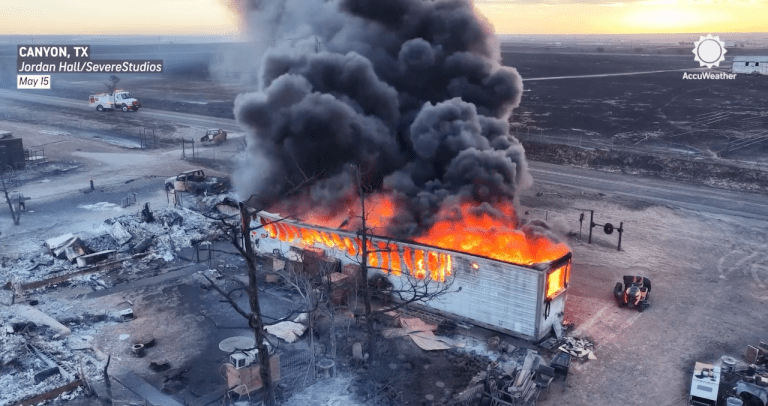
The Hunggate Fire in the Texas Panhandle spread quickly on Thursday after dry lightning and strong winds sparked a series of wildfires in the region.
Published May 15, 2026 1:17 PM CDT
|
Updated May 15, 2026 2:16 PM CDT
This drone video from storm chaser Jordan Hall shows a railroad going up in flames during a wildfire in Canyon, Texas, in the early morning of May 15.
A lightning-sparked wildfire fanned by strong winds has destroyed several buildings and badly damaged a railroad in Canyon, Texas.
The Hunggate Fire started Thursday afternoon in the Texas Panhandle and had burned 14,000 acres by Friday morning. It was 40% contained, according to InciWeb.
“At approximately 4:30 p.m., a storm cell came over the area of Randall County, creating dry [lightning] which started a series of wildfires throughout the area,” the agency said on its website. InciWeb also said gusts from the thunderstorm created “erratic” fire behavior.
More than 300 lightning strikes were recorded within a 25-mile radius of Canyon on Thursday afternoon and evening around the time that the Hunggate Fire was reported, according to the AccuWeather Lightning Network. This included 187 cloud-to-ground lightning strikes.
A map showing lightning strikes around Canyon, Texas, on May 14, 2026, around the time that the Hunggate Fire started. (AccuWeather Lightning Network)
Evacuation orders were initially issued for the area but have since been lifted.
Video from the scene on Friday morning showed the immediate devastation, including damage to nearby buildings and a railroad that had been set on fire.
A building that was destroyed by the Hunggate Fire in Canyon, Texas. (Jordan Hall/SevereStudios)
Heavy equipment is being used to build containment lines while fire crews are working to protect structures and knock down hot spots.
Other lightning-sparked wildfires in the region include the Line Fire, which has burned 23,000 acres; the Shifty Fire, which has burned 5,000 acres; and the Crooked Cook Fire, which has burned 1,500 acres.