
The Clean Energy Technology Association Inc. claimed it could sell revolutionary carbon capture technology, seen here in images from court documents. It was found by federal regulators to be the basis of a Ponzi scheme.
Court Records
Victims of an alleged Ponzi scheme run through dozens of Austin-based investment funds are in federal court going after the institutions, including Wells Fargo Bank, and people they say made it possible.

Regulators have already shut down Clean Energy Technology Association Inc. and Freedom Impact Consulting LLC for selling fraudulent investments based on carbon capture technology for the oil and gas industry.
Article continues below this ad
They said they had patented technology that would capture drillers’ hydrocarbon spill-off and inject it back into the ground, providing a green return for energy-industry clients. They falsely told investors they had contracts with ExxonMobil Corp. and other oil companies for hundreds of its carbon capture units and promised a 10% quarterly return.
The two Texas companies, run by former Fairfield Mayor Roy Hill and Pennsylvania dentist Eric Shelly, raised more than $300 million from more than 500 investors before the U.S. Securities and Exchange Commission shut them down in 2023.
Roy Hill, an attorney and former mayor of Fairfield, is seen in a 2013 file photo. He’s a defendant in two federal cases alleging his clean-energy company — already shut down by federal regulators — ran a Ponzi scheme.
G.J. McCarthy/The Dallas Morning News
Now, a lawsuit filed in U.S. District Court in Austin by a group of investors who put up more than $6 million is seeking damages from those it says assisted the companies. The suit’s targets are the companies’ accountant, their lawyer, his former firm and one of the banks.
Article continues below this ad
Mauricio J. Rauld of Premier Law Group, Timothy Gertz and his company ProVision Wealth Strategist, and Wells Fargo Bank all are alleged to have had a role in the scam since 2019.
“They were links in the chain of selling the limited partnership units that were actually a Ponzi scheme,” the investors say.
Wells Fargo denies the allegations.
Article continues below this ad
“It is unfortunate that the investors lost funds as alleged in the complaint, but Wells Fargo is not responsible for their losses and intends to defend against this litigation,” said Shea Leordeanu, a Wells Fargo spokesperson.
The same defendants were sued in 2024 in a similar lawsuit by a separate group of investors in federal court in Waco. The lawsuit failed to gain class certification, which would have allowed it to take on additional investors as clients in a class action. Court documents suggest the suit has been settled or is in the process of settling with Gertz, ProVision and Wells Fargo.
Rauld and Premier Law Group of San Clemente, Calif., appear to be the remaining defendants in that case. Rauld and his attorneys did not respond to emails or phone calls seeking comment. Premier Law Group also did not respond to requests for comment.
While Wells Fargo has committed to fighting the new lawsuit, it isn’t clear what Gertz and ProVision will do. Neither responded to requests for comment.
Article continues below this ad
Rauld, who no longer works for Premier Law Group, markets himself online as an expert in securities law for real estate syndication deals — investment groups that pool money to buy large multifamily units.
“Raising Money?” his LinkedIn profile asks. “I help you stay compliant and out of jail!”
Lawsuit alleges professionals enabled fraud
Plaintiffs in the new Austin lawsuit say Rauld and Premier Law went beyond basic legal work. They prepared offering documents, business plans and presented themselves on the advisory teams for several of the limited partnerships. Sixty-three of the investment vehicles were registered in Austin.
Article continues below this ad
“Rauld and Premier promoted both themselves and the FIC Partnerships by participating in and speaking at in-person conferences, webinars and podcasts directed at potential investors misrepresenting the Ponzi scheme as a legitimate investment,” the suit says.
Gertz and ProVision prepared tax documents for the investments and allegedly pushed the tax advantages of the investments.
Both Gertz and Rauld allegedly solicited investors for the funds with false information. Those investors include William Bryant, Elisabeth Embry, Matthew Fackrell, Christopher Gaarlandt, Kevin and Joyce Hoover, Richard and Jill Parker, Alex Petkas, Peter Petkas, Chad and Elizabeth Raynor, Joe Saures, Michael Sauers, Stephanie Sauers-Boyd and Avi Weisfogel.
The investors, collectively suing as TRC Master Trust, say Wells Fargo should have been able to detect the fraud through the pattern of money transfers through the various actors’ accounts that were unrelated to legitimate business revenue.
Article continues below this ad
They allege the bank saw the growth of the wire transfers balloon to $225 million between 2019 and 2023 and that those funds flowed to trusts and entities Hill controlled in a way they say should have clearly shown they were divorced from legitimate business activity.
“Wells Fargo tracked the account activity of (Clean Energy Technology Association) and the Hill Trusts and saw that the accounts were being used to operate an improper scheme,” the suit says.
SEC found companies operated Ponzi scheme
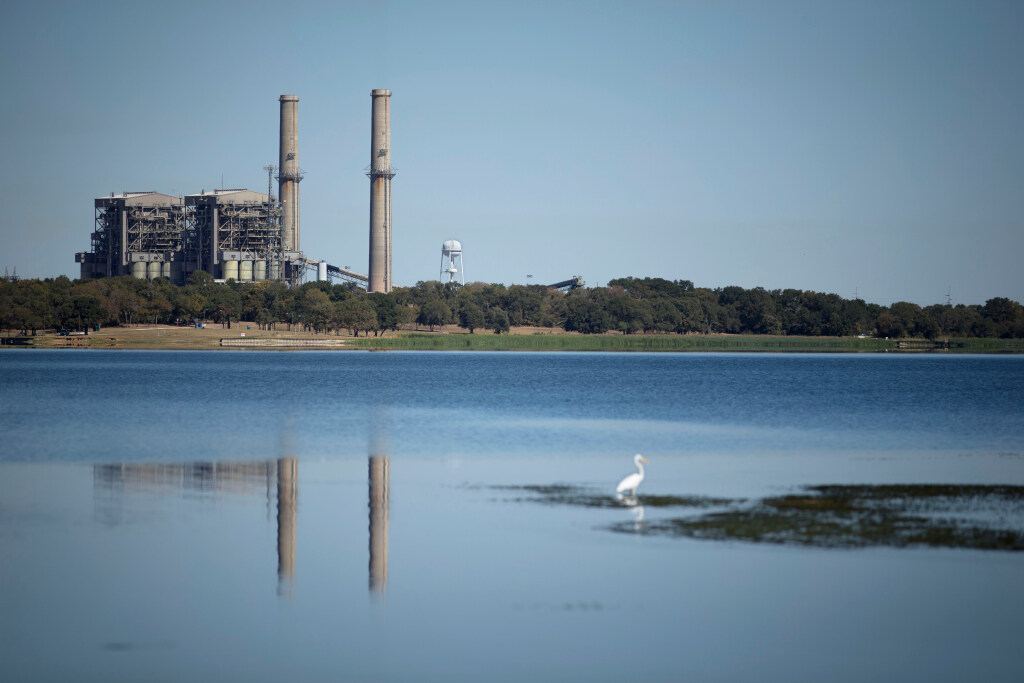
Clean Energy Technology Association began in 2009 as Hill’s attempt to find a way of propping up a power plant know as Big Brown in Fairfield, where he had been mayor. The Luminant-owned plant had been on the brink of closure for some time and Hill wanted to create a cleaner coal fuel to keep it viable. It ultimately was shuttered in 2018 and its demolition began in 2021.
Article continues below this ad
The ycoal-fired Big Brown Power Plant in Fairfield is seen in a 2015 file photo. It was shut down in 2018.
G.J. McCarthy/The Dallas Morning News
The company raised funds in 2009 and there were signs, according to court documents, that it attempted to create lab-scale equipment. It raised money to create some larger demonstration units for the plant, according to a receiver’s report. Many of the units went unbuilt and, according to court records, others were largely unused and many were never tested.
The company pivoted to carbon capture technology with mobile machines it said could clean up natural gas at a well site and help drillers get more oil and gas out of the ground.
In 2019, Hill began working with Shelly and his Freedom Impact Consulting, which was to pay investors returns from carbon capture revenue. That was when the scale of the fraud expanded rapidly, according to the SEC. Shelly worked with Premier and ProVision to create 66 investment funds, selling stakes in deployment of the technology for a couple of hundred thousand dollars at a time. The money poured in, according to court records.
Article continues below this ad
Hill and Shelly claimed to have 150 of the patented machines leased to oil and gas companies, but in reality had manufactured components only for a few dozen and had no substantive customers. An engineer later found the technology did not work, according to court documents.
Clean Energy Technology Association “was never commercially successful in any respect,” according to court documents.
Rather than building their green machines, the money went to fund Hill’s lifestyle and prop up the pyramid scheme, paying earlier investors with new investor money.
Article continues below this ad
Ultimately, neither denied the SEC’s allegations that the operation was a Ponzi scheme and agreed to judgments barring them from selling securities.
The total amount the men will be forced to pay is unclear but the case was put under court-appointed receiver Albert C. Black III, who has recovered $66 million of the more than $200 million in investments that hadn’t been paid back to investors.
An egret perches on tall grass in Fairfield Lake State Park near the coal-fired Big Brown Power Plant in 2015. The plant played a role in former Fairfield Mayor Roy Hill’s creation of a company now being sued in federal court in Austin.
G.J. McCarthy/The Dallas Morning News