
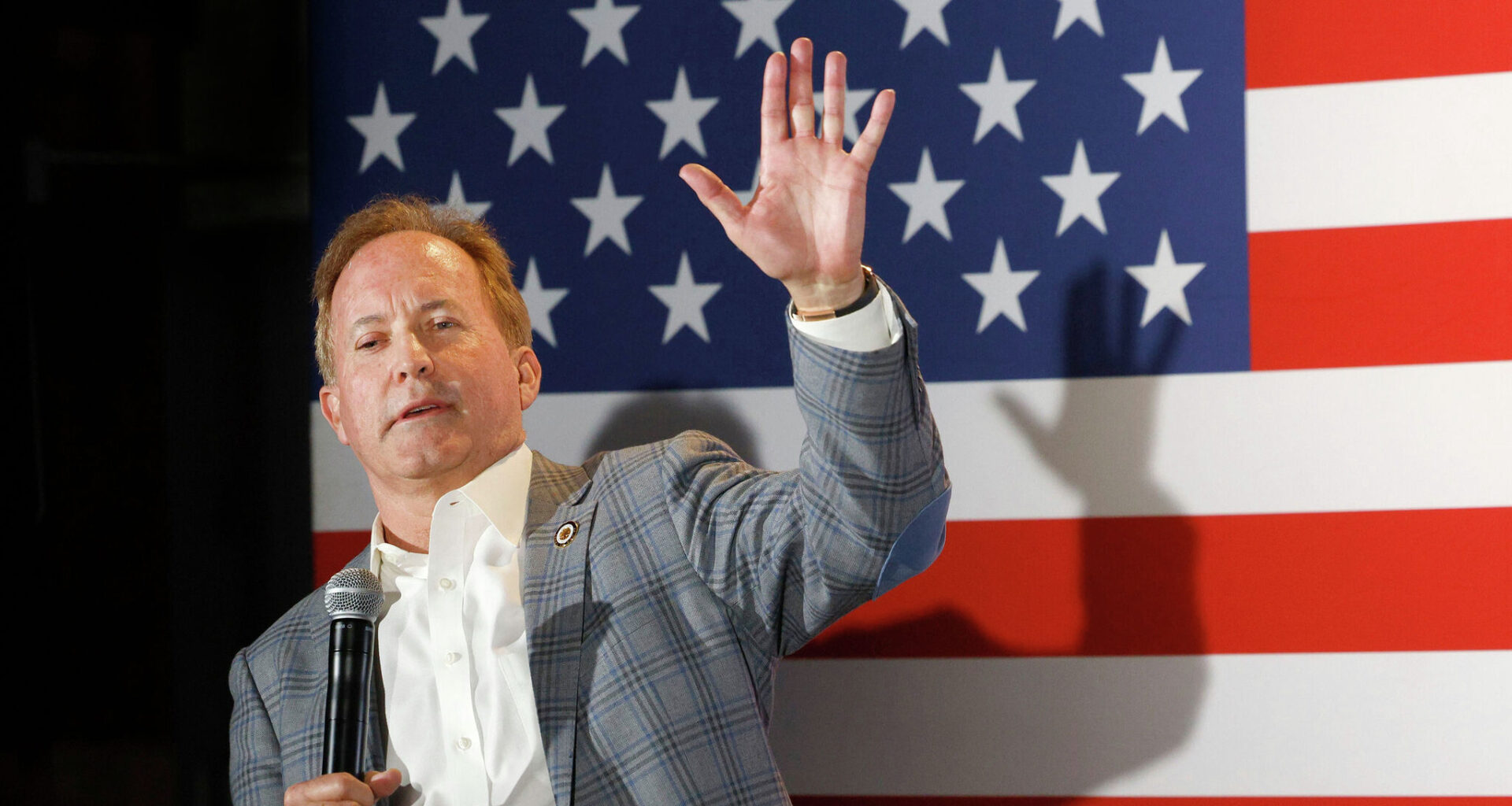
Texas Attorney General Ken Paxton is suing the Texas American Muslim University at Dallas, arguing the Richardson school has been illegally offering academic degrees.
Chitose Suzuki/TNS
Texas Attorney General Ken Paxton is suing the Texas American Muslim University at Dallas, arguing the Richardson school has been illegally offering academic degrees and “deceiving students.”

On Monday, Paxton’s office announced the lawsuit, marking the latest legal challenge for the school, which advertised itself as the first university in the country to offer STEM degree programs with mandatory courses in Islamic studies. The school made headlines earlier this month after Gov. Greg Abbott said it was violating state law by operating without proper authorization.
Article continues below this ad
“TexAM has repeatedly disregarded Texas law, misrepresented its authority to grant degrees, and risked deceiving students about its legitimacy,” Paxton said in a statement. “My office will not allow illegal, unaccredited degree mills to operate in Texas.”
The school’s founder told The Dallas Morning News on Monday that it stopped offering classes and ceased all operations last week.
At Abbott’s directive, the Texas Higher Education Coordinating Board ordered the school to cease advertising its programs and enrolling students earlier this month. The agency did not authorize the school to grant degrees, as required under state law.
Make Dallas News a preferred source so your search results prioritize writing by actual people, not AI.
Add Preferred Source
Related: Gov. Abbott, higher ed agency order North Texas Muslim school to stop operations
Article continues below this ad
Shahid Bajwa, the school’s founder and one of the plaintiffs in the suit, said officials complied with the coordinating board’s May 6 order to halt operations last week. The school’s website and social media accounts have been deactivated.
“We are not operating as a university and not offering degree courses,” he said in a message Monday. “The THECB should have made the required announcement and … informed the attorney general’s office.”
Texas Higher Education Coordinating Board spokesperson RJ DeSilva confirmed Bajwa sent a letter to the agency on May 11, which said the school had “ceased operations and use of protected terms.”
Texas A&M University System officials also recently threatened legal action against the school, which branded itself as “TexAM University,” over alleged trademark infringement. University officials argued the school’s similar branding could mislead the public into thinking there is a connection between the two institutions.
Article continues below this ad
Related: Texas A&M System sends cease-and-desist to North Texas Muslim school over trademark concerns
Officials from the Texas A&M University System did not immediately respond to a request for comment on the lawsuit Monday.
Paxton’s lawsuit, filed in Collin County District Court, asks the school to stop operating as a private postsecondary institution or using any logos similar to that of Texas A&M University. He is also asking for more than $1 million in civil penalties for violating the Texas Deceptive Trade Practices-Consumer Act and the Texas Education Code.
Private universities must be authorized by the Texas Higher Education Coordinating Board to grant degrees in Texas under state law. The law, which aims to “prevent deception of the public” based on “fraudulent or substandard college and university degrees,” requires institutions that are already accredited or working toward accreditation to apply for authorization.
Article continues below this ad
For schools that are not accredited, agency officials review several factors, such as the institutions’ mission, governance and financial resources and stability. A site visit is also part of the application.
TexAM University does not appear in the U.S. Department of Education’s database of accredited postsecondary institutions and programs.
The legal challenges come as state leaders have increasingly scrutinized Islamic schools and sought to curtail activities hosted by Muslim groups. The state comptroller’s office initially held up dozens of Islamic K-12 schools from enrolling in Texas’ new voucher-like program, with Abbott deeming the schools sites of “radical Islamic indoctrination.”
TexAM University, which started its first semester in October 2025, promoted several STEM degree programs and classes on its website, which has since been taken down.
Article continues below this ad
For example, students could enroll in what the website described as an online Master’s in Artificial Intelligence program, which consisted of 40 credits. Another class, called Introduction to Cybersecurity, promised to provide a “comprehensive introduction to cybersecurity fundamentals.”
Overseas students were charged $99 for a 3-credit course, while U.S. students were charged “$99 X 3 for a 3-credit course,” according to the website.
Bajwa previously told The News that Islamic studies make up about 30% of the school’s coursework, and the requirement is “transparent” to prospective students.
“Our goal is to showcase the positive contributions of Muslim scholars to science and knowledge, enriching the academic experience for all students,” he said.
Article continues below this ad
The school had not granted degrees, certificates or credentials, he said, and it was primarily funded through donations.
The DMN Education Lab deepens the coverage and conversation about urgent education issues critical to the future of North Texas.
The DMN Education Lab is a community-funded journalism initiative, with support from Bobby and Lottye Lyle, Communities Foundation of Texas, The Dallas Foundation, Dallas Regional Chamber, Deedie Rose, Garrett and Cecilia Boone, Judy and Jim Gibbs, The Meadows Foundation, The Murrell Foundation, Ron Steinhart, Solutions Journalism Network, Southern Methodist University, Sydney Smith Hicks, and the University of Texas at Dallas. The Dallas Morning News retains full editorial control of the Education Lab’s journalism.