
Houston World Cup organizers say the city’s soccer culture has existed for decades and the “Grow the Game” initiative aims to expand access long term.
Thomas B. Shea/MLS via Getty Images
Soccer was already woven into Houston long before the World Cup was announced. However with FIFA now fewer than two months away, city leaders are trying to make that passion permanent.

For organizers behind Houston’s “Grow the Game” initiative, the goal isn’t just to capitalize on World Cup excitement—it’s to use the moment to expand access to the sport in communities that historically haven’t had it. In other words, the initiative is less about building new fans and more about removing “pay to play” barriers that have historically prevented some communities from participating in organized soccer.
Article continues below this ad
“Houston is, as you know, a very international and diverse city,” Chris Canetti, president of the Houston 2026 World Cup host committee, told Chron. “And as you also know, soccer is the world’s game. So for most of the international folks that live in the city, soccer is their game.”
That reality has existed for years even if it hasn’t always been as visible as Houston’s football, baseball or basketball culture, he said.
“I think we have a rich history and tradition and heritage and culture for soccer in this city that maybe doesn’t come out and shine as clear as the Texans, the Astros and the Rockets,” Canetti said. “But it is here, and it’ll be on full display this summer during the World Cup.”
Part of that disconnect, Canetti suggested, comes from how soccer culture in Houston has historically existed more at the community and youth levels than through major professional fandom.
Article continues below this ad
“If you’re defining soccer by the Major League Soccer (MLS) team and the National Women’s Soccer League (NWSL) team, that’s one way; if you’re talking about soccer in general, I think that’s a completely different conversation,” he explained.
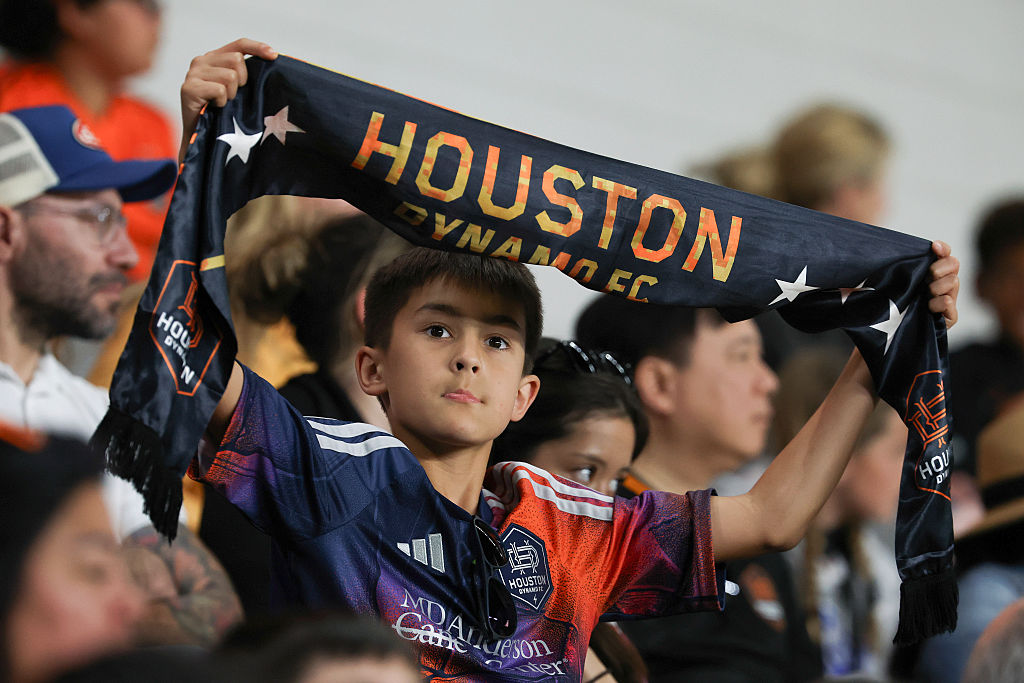
HOUSTON, TEXAS – MAY 02: A Houston Dynamo FC fan displays a scarf during second half against the Colorado Rapids at Shell Energy Stadium on May 02, 2026 in Houston, Texas. (Photo by Jack Gorman/Getty Images)
Jack Gorman/Getty Images
While Houston has supported the Dynamo since the team arrived in 2006, Canetti, who served as club president for years, said soccer in Houston has long been embedded in immigrant communities, local leagues and neighborhood parks rather than concentrated around one singular franchise or fan identity.
“That’s when Major League Soccer was only 10 years old then Houston got its first major league soccer franchise, and that gave Houstonians a team of their own to root for,” he said. “I was, of course, with that organization for its first 13 years, and I watched a lot of people become fans of the Houston Dynamo and of the sport of soccer as a result of there being a pro team that they could follow with.”
Article continues below this ad
Part of that continued visibility comes through its FREEKICKS Soccer program under the “Grow the Game” initiative, which focuses on refurbishing 23 soccer fields across six Harris County parks—including: Blue Ridge, George Bush, Moody, Alabonson, Baytown Soccer Complex and Keith-Wiess Park. The initiative also partners with five local youth soccer clubs, collectively investing an estimated $1.5 million and providing more than 1,200 annual scholarships for underserved children.
Additionally, the World Cup gave Harris County commissioners, the City of Houston, local youth soccer clubs and nonprofit partners youth soccer organizations a rare reason to align around the same long-term project.
“We were able to leverage the power of the World Cup to bring lots of different groups together that may not have come together without the World Cup being here,” Canetti explained.
The long-term plan stretches beyond the tournament itself, which is why organizers have repeatedly framed the project as part of the World Cup’s long-term legacy in Houston.
Article continues below this ad
Canetti said Blue Ridge Park, for example, is already hosting youth clinics designed to identify children who can join clubs through scholarship opportunities.
“Spring youth soccer seasons have wrapped up, and many of the expanded FREEKICKS-related activities connected to these park improvements are expected to ramp up beginning in Fall 2026 and continue as additional parks and facilities come online over time,” he said.
More importantly, Canetti insists the project is designed to outlast the temporary excitement surrounding FIFA.
Article continues below this ad
“The World Cup was the reason why this program came to Houston and why it exists,” he concluded. “We’re going to make sure that these things are put into play and last many years from now.”