
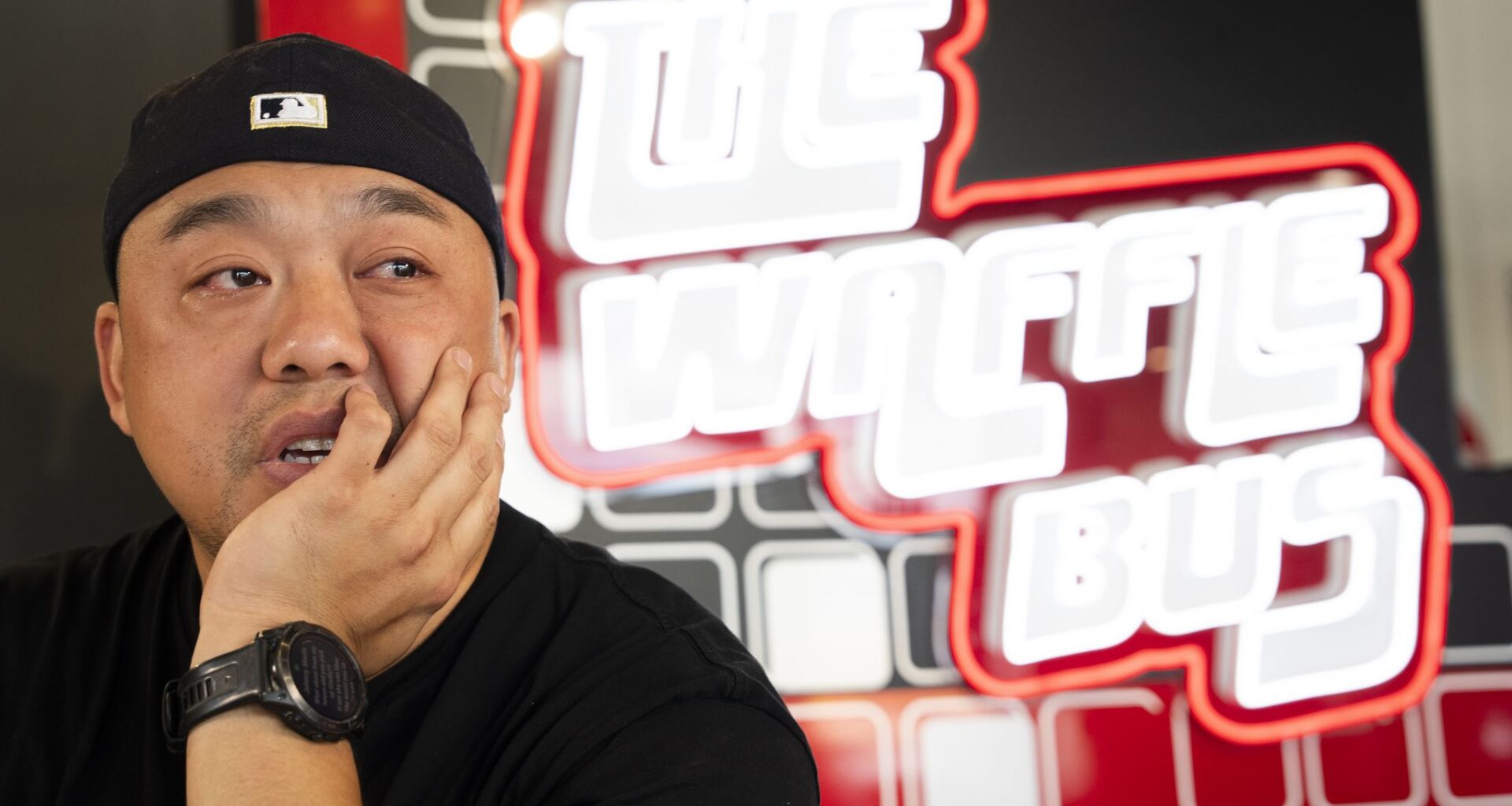
Phi Nguyen, owner of The Waffle Bus, becomes emotional as he describes why his 14-year-old restaurant is vulnerable to closing. Nguyen is hopeful the World Cup and the summer season will help build a bridge out of the building stress and mounting debt taken on to keep the doors open.
Jason Fochtman/Houston Chronicle
The Waffle Bus owner Phi Nguyen has spent months trying to lure customers back to the Houston-born restaurant with value deals: $5 chicken sandwiches on Tuesdays, $5 smashburgers on Wednesdays and now a $10 bone-in fried chicken box.
Still, the 14-year-old business is barely hanging on.
In October 2025, Nguyen took out his first loan just to make rent and payroll. He’s borrowed more money since — including another loan last week — leaving him buried in debt. Two business partners have left. He’s cut staff by more than half. He’s spent $5,000 on influencer marketing trying to bring customers back.
Article continues below this ad
“I’ll try to do whatever I can not to close this down,” Nguyen said.
RESTAURANT INFLATION: The economics behind a $32 pasta in Houston
Nguyen’s struggle reflects a broader problem facing Houston’s dining scene, where many middle-tier restaurants are getting squeezed between fast food chains and high-end dining. Customers remain cautious about spending, while restaurants continue to battle rising food, labor and utility costs, according to a recent survey from the Texas Restaurant Association.
“Of the (restaurant owners) I’ve talked to, everyone’s down across the board,” Nguyen said. “We’re not the only ones — the mid-tier are down more.”
Article continues below this ad
Phi Nguyen, owner of The Waffle Bus, prepares waffles on May 12.
Jason Fochtman/Houston Chronicle
Houston’s middle-tier restaurants are getting squeezed
Restaurant closures have continued across Houston in 2026, including Paulie’s, Superica and Be More Pacific. Many of the restaurants featured on the Houston Chronicle’s defining restaurant closings of 2025 fell into the same category: neighborhood restaurants that are neither mega-cheap nor luxury dining destinations.
Mid-tier restaurants — often operating with limited financial backing — face mounting pressure in Houston’s shifting dining economy. They can’t compete with the low prices and convenience of fast food chains, but they also don’t offer the kind of splurge-worthy experience diners seek for special occasions. Customers expect a certain price point from their neighborhood restaurant, but inflated costs have forced owners into an increasingly difficult choice: raise menu prices and risk driving customers away, or absorb the higher costs and struggle to pay the bills. Fifty-one percent of Texas Restaurant Association survey respondents increased menu prices slightly in the first quarter of 2026.
“The problem is,” said Ford Fry, the chef-owner behind Superica turned Star Rover, “when you do these mid-level restaurants and you start raising your prices according to what you need to raise them to, then the customers say they’re charging too much for that.”
Article continues below this ad
The latest loan Nguyen took out is meant to keep Waffle Bus alive through Houston’s expected World Cup surge this summer. The restaurant will operate as a vendor at the FIFA Fan Festival in EaDo. Nguyen hopes it will be one last opportunity to stabilize the business.
Waffle Bus went from food truck hit to survival mode
He launched Waffle Bus as a food truck in 2012, when Houston’s food truck scene was booming and fried chicken sandwiches were trending nationally. Wherever the food truck went, customers showed up.
Customers wait in line for The Waffle Bus to open up at the Temple Sinai West Houston Food Truck Festival in April 2017 in Houston.
Wilf Thorne/For The Chronicle
He opened his first brick-and-mortar in the Heights in 2019. Even after the pandemic shut down the dining room months later, the business thrived through delivery apps like DoorDash, Nguyen said. Its success led to a second brick-and-mortar in Montrose in 2021. He had the food truck parked at the University of Houston. The restaurants were profitable, Nguyen said. In early 2024, he started planning for a Cypress location.
Article continues below this ad
Then came Hurricane Beryl in July 2024. The Heights Waffle Bus, along with many other Houston restaurants, closed for two weeks. Insurance didn’t pay out, Nguyen said. Like many restaurant owners, the storm drained cash at the same time customer spending across the city began softening.
From then on, he was playing catch-up on that lost revenue. The Cypress restaurant was already in motion, so he was also pouring money into that. Business at Waffle Bus locations in the Heights and Montrose never returned to normal.
“It feels like we’re starting all over. It’s like, what happened to all the people?” said Nguyen. “People just aren’t dining out like they used to.”
Diners are still pulling back on discretionary spending. Residents in Harris, Fort Bend and Montgomery counties identified the economy as the biggest issue facing the Houston area, according to a recent survey by Rice University’s Kinder Institute for Urban Research.
Nguyen doesn’t know what’s next if his business fails. This was his life dream.
Article continues below this ad
“It’s just hard to think it can be shut down at any moment now,” Nguyen said through tears. “Everyone looks at the Waffle Bus like it’s a huge brand, a Houston staple.”
Phi Nguyen, owner of The Waffle Bus, becomes emotional as he thinks about the possibility of closing his restaurant after a rough year.
Jason Fochtman/Houston Chronicle
Phi Nguyen, owner of The Waffle Bus, works at the Heights location of the 14-year-old business that started as a food truck on May 12.
Jason Fochtman/Houston Chronicle
Phi Nguyen, owner of The Waffle Bus, becomes emotional as he thinks about the possibility of closing his restaurant after a rough year.
Jason Fochtman/Houston Chronicle
Denise Kellison with First Vision Financial, a local finance company that works with restaurants, said she’s seen an uptick of existing clients borrowing money in the past six months.
“Our financing conversations often reveal restaurants are trying to borrow money earlier when they notice slow periods and more competition affecting them, rather than waiting. The last time we saw this was mid pandemic,” Kellison said.
Restaurants are reinventing to survive
Restaurants are finding different ways to weather the storm as this challenging time becomes the new normal. Some have relied on events, BYOB or opening a business within an existing one.
Stacey Shin, owner of MDK Noodles, talked to the landlord of the restaurant’s Asiatown location about possibly closing in the summer of 2025. Costs were climbing and business was becoming unsustainable in its fifth year. She had one last idea to try out: break up the large dining room in two and open a new concept in the second space.
The landlord agreed to delay rent payments during construction. Ramen Alley opened in the fall of 2025 as a DIY ramen bar modeled after casual dining experiences in Korea.
“It was kind of our Hail Mary,” Shin said.
Customers, many of them younger diners, spend about $10 for a bowl of ramen and a drink. So far, the gamble is paying off. MDK is doing better with the added business, Shin said.
The Waffle Bus opened its first brick-and-mortar in the Heights in 2019. Now, it’s vulnerable to closing as costs continue to rise and fewer customers visit.
Jason Fochtman/Houston Chronicle
In the Heights, Fry decided to replace his Tex-Mex restaurant Superica earlier this year. It wasn’t losing money, but it wasn’t making much either, he said. Star Rover, the affordable steakhouse that replaced it, has doubled Superica’s sales.
People thought Fry was crazy for closing Superica, a popular Tex-Mex brand that built a strong following in Houston after expanding from Atlanta. But for many mid-tier restaurant owners, surviving in Houston’s changing dining economy increasingly means reinventing themselves… or risking closure altogether.
For Nguyen, the hope is simply that Waffle Bus can hold on long enough for customers to return.