
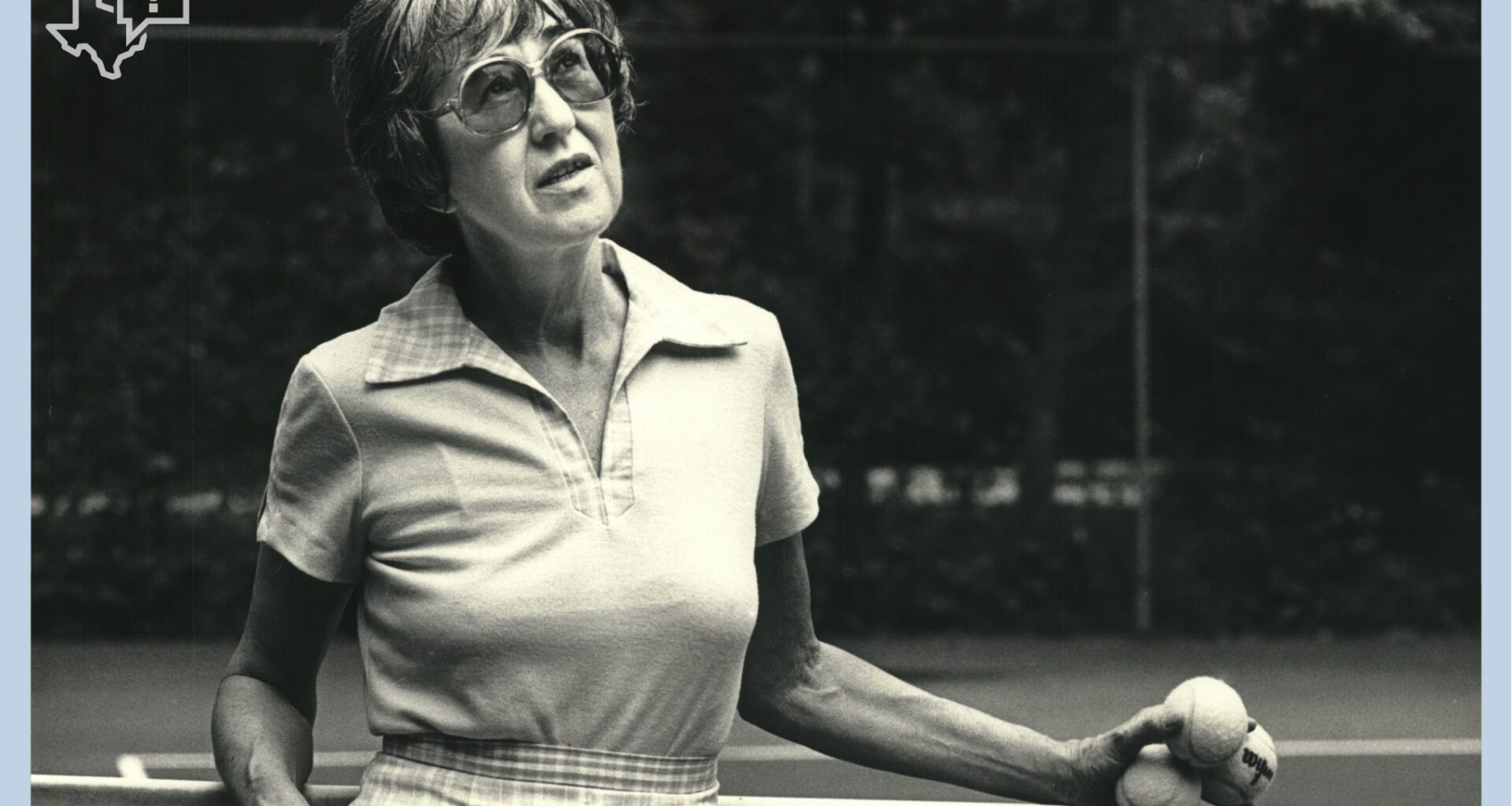
Gladys Heldman, the women’s tennis pioneer, in May 1982.
Betty Tichich/Houston Post
Join us on a journey to better understand Houston, one question at a time. Sign up to get the Houston Explained newsletter in your inbox every Tuesday and Friday.
Women’s professional tennis was born in Houston. And the woman who made it happen, a tennis-enthusiast-turned-magazine-publisher-turned-sporting-pioneer named Gladys Heldman, who would have turned 104 this month, doesn’t get nearly enough credit from our city.
In September 1970, Heldman gathered nine of the world’s best women tennis players here in Houston, handed them each a contract worth exactly one dollar and started a revolution that became the Women’s Tennis Association and everything that followed: equal prize money for male and female athletes, nine-figure careers, the sport as we know it.
Article continues below this ad
Icon Billie Jean King has put it simply: “Without Gladys Heldman, there wouldn’t be women’s professional tennis.”
But Heldman’s story starts far from Houston, in New York City more than a century ago.
Who was Gladys Heldman?
She was born in New York on May 13, 1922, into a life whose trajectory pointed toward academia and not athletics or activism. Her education brought her to California, where she graduated top of her class from Stanford in 1942 and later pursued a master’s degree in medieval studies at UC Berkeley.
Article continues below this ad
Her husband’s career eventually brought the family (he and Heldman had two daughters) to Houston, where he, of course, took a job at one of the many oil companies based here.
And it was here in Houston that her obsession with tennis and with fixing its glaring issues flourished.
She picked up the racquet, and within a few years, she was one of the top players in Texas, had won the Texas State Championships and even competed at Wimbledon. But she quickly understood that the game she loved, or rather the men who governed it, treated its female players like an afterthought.
Her response was to start writing.
Article continues below this ad
She first published a one-page newsletter called Houston Tennis, which eventually grew, in 1953, into World Tennis Magazine, one of the sport’s most prominent publications for decades.
Those pages became her platform, where she documented the discrimination and, for years, made the case that it didn’t have to be this way.
How Houston helped change women’s tennis forever
By 1970, the gap between what men and women tennis players earned in prize money had grown obscene. And until then, all women’s tournaments had been held alongside men’s events.
Article continues below this ad
It all came to a head when Jack Kramer, the former player and promoter of that year’s Pacific Southwest Championships, offered female competitors an 8:1 split in the tournament’s winnings.
Heldman made the call: If the men wouldn’t treat women fairly, the women would stop playing in their shadows.
So Heldman organized her own protest tournament for women only right here in Houston in 1970, a one-off at the Houston Racquet Club that brought together the Original Nine: Billie Jean King, Rosie Casals (who won the tournament), Nancy Richey, Peaches Bartkowicz, Valerie Ziegenfuss, Kristy Pigeon, Judy Dalton, Kerry Melville and Julie Heldman, Heldman’s own daughter.
Risking suspensions and sanctions by the United States Tennis Association, they all signed symbolic $1 contracts and posed with their dollar bills in a now-iconic photo. The event, thanks to a sponsorship deal, became known as the Virginia Slims Invitation and gave way to the first organized women’s tennis circuit, and, eventually, the WTA.
Article continues below this ad
Heldman was inducted into the International Tennis Hall of Fame in 1979 and died in 2003 at 81.
But the movement she started here in Houston has since paid out billions to female tennis players and made stars of athletes like Serena and Venus Williams, Steffi Graf, Naomi Osaka and many more.

What is your Houston question?
Top female tennis players hold up their $1 bills which will make them contract pros and eligible to play for money instead of trophies in the Virginia Slims tournament at the Houston Racquet Club in defiance of the USLTA. The players are (standing, L-R) Valerie Ziegenfuss, Billie Jean King, Nancy Richey, Peaches Bartkowicz; (seated, L-R) Judy Tegart Dalton, Kerry Melville, Rosie Casals, manager Gladys Heldman, and Kristy Pigeon.
Bela Ugrin/Houston Chronicle