
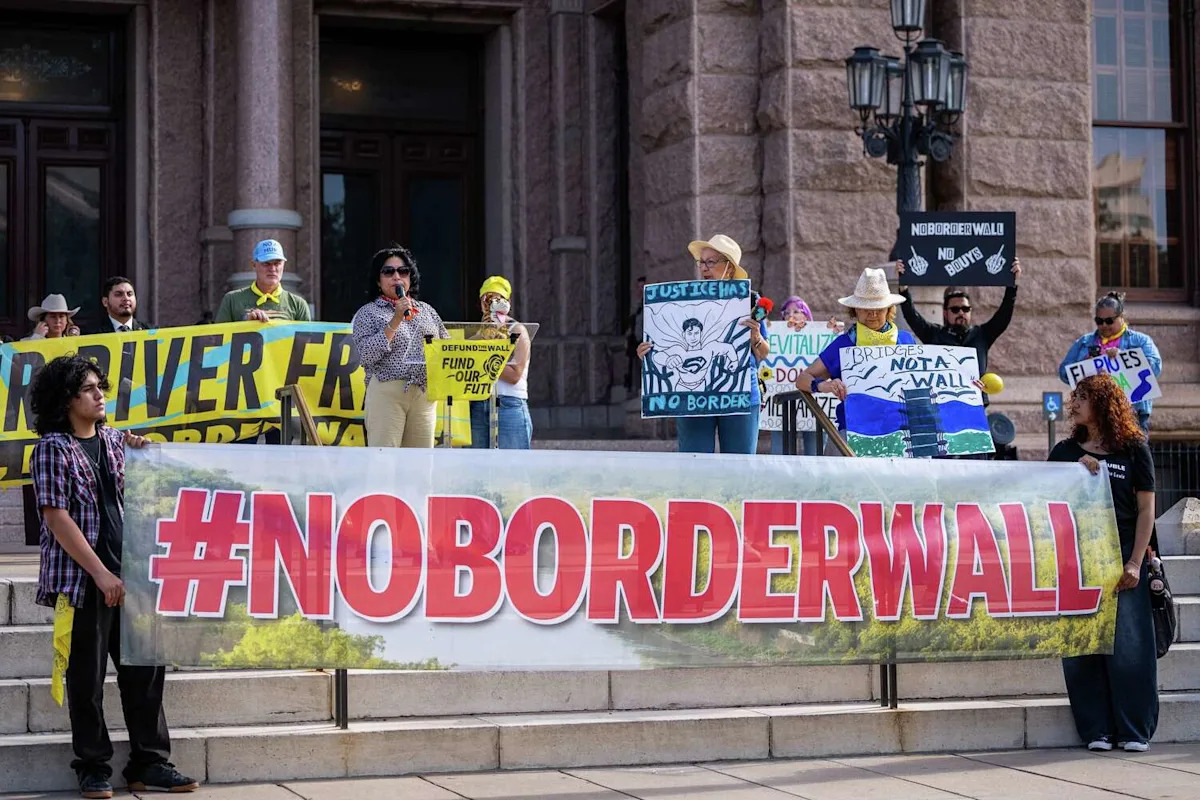
A few dozen border residents, riverfront landowners and environmental advocates gathered outside the Texas Capitol on Tuesday to urge state and federal officials to stop building walls and other barriers along the Rio Grande, saying the money should instead be spent on water systems, public infrastructure and environmental protections in border communities.
The rally, organized by the Texas Says No Border Wall coalition, brought speakers from Laredo, Eagle Pass, Zapata County, the Rio Grande Valley and Big Bend to Austin as new federal border wall plans have renewed fears about flooding, land access, wildlife habitat and the future of communities built along the river.
The Capitol event came days after the Department of Homeland Security published a waiver allowing federal officials to bypass environmental, historic preservation, public lands and other laws to speed construction of barriers and roads in the Big Bend Sector. The notice described the sector as an “area of high illegal entry” and said there was an “acute and immediate need” for additional physical barriers and roads.
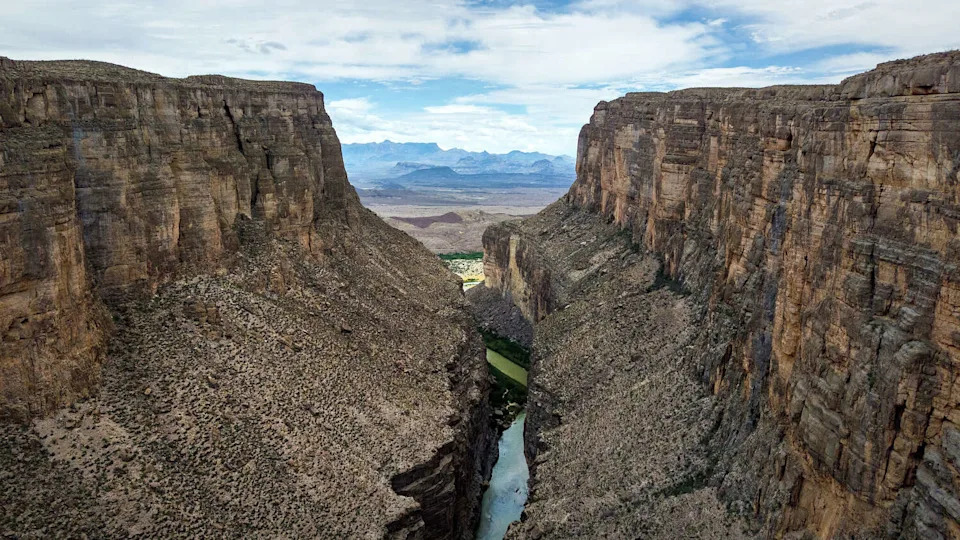
BIG BEND NATIONAL PARK, TEXAS – APRIL 11: From an aerial view, the Rio Grande flows through the Santa Elena Canon on April 11, 2026 in Big Bend National Park, Texas. The U.S.-Mexico border is demarcated in the center of the river. Trump Administration plans to extend the U.S.-Mexico border wall into the region have sparked rare bi-partisan unity among Texans against construction through one of the most rugged and pristine parts of the United States. Critics of the construction say there is no need for a wall there, citing the low number of immigrants who attempt to cross through the forbidding terrain. (Photo by John Moore/Getty Images) (John Moore/Getty Images)
The waiver came after U.S. Customs and Border Protection awarded a $1.7 billion contract listed in federal spending records as being for “border wall in Big Bend Texas.” The award added to confusion among opponents because CBP’s commissioner had recently said no wall would be built at Big Bend National Park, and the agency had indicated it would instead rely on roads and digital surveillance equipment there.
Speakers Tuesday said that uncertainty is part of the problem.
Border residents say they want answers
Several speakers said communities along the Rio Grande have been left trying to decipher federal plans that appear to be moving faster than public information.
Anna Claire Beasley, a Big Bend business owner with No Big Bend Wall, said residents have struggled to get clear answers about what could be built near their homes, businesses and public lands as new federal waivers and contracts move forward. Cary Dupuy, regional director for the National Parks Conservation Association, said that uncertainty has extended to Big Bend National Park and nearby protected areas, where roads, lighting or barriers could affect the Rio Grande Wild and Scenic River and Amistad National Recreation Area.
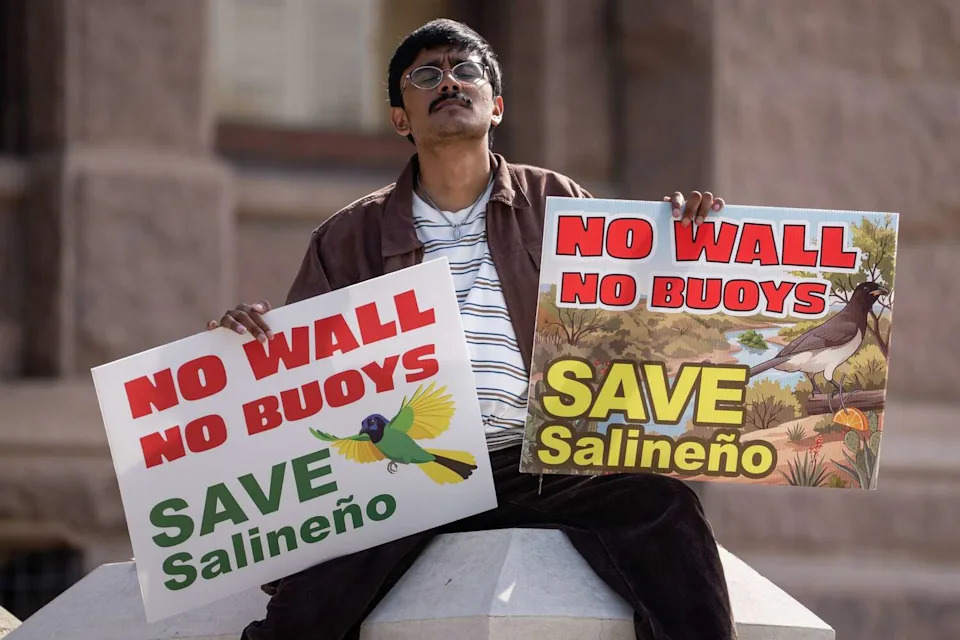
Alexis Esparza holds signs as he listens to speakers at a rally against continued border wall expansion in the Big Bend region, hosted by the Texas Says No Border Wall coalition at the Texas State Capitol, May 19, 2026. (Sara Diggins/Austin American-Statesman)
Dupuy called for Congress to pause construction and work with Texans on an approach shaped around the region, not a one-size-fits-all wall.
The Department of Homeland Security and U.S. Customs and Border Protection did not immediately answer questions about their plans.
Speakers warn wall could worsen river problems
Speakers framed the fight over border barriers as a question of flooding, water access and local control as much as immigration enforcement.
Beasley warned that concertina wire and other barriers near the Rio Grande could be swept away during heavy rains, sending debris into parks, wildlife habitat and recreation areas. Elsa Hull, a Zapata County landowner near San Ignacio, said walls and buoys could trap debris, raise water levels and push floodwaters toward neighborhoods built close to the river. She pointed to flooding from Hurricane Alex in 2010 and said residents still have not seen enough flood modeling or impact studies.
Others said border communities are being asked to absorb those risks while basic needs go unmet. Amerika Garcia Grewal, with Frontera Federation, said communities from Brownsville to El Paso are dealing with razor wire, walls, buoys and other enforcement measures while still needing investments in education, health care, parks and public infrastructure.
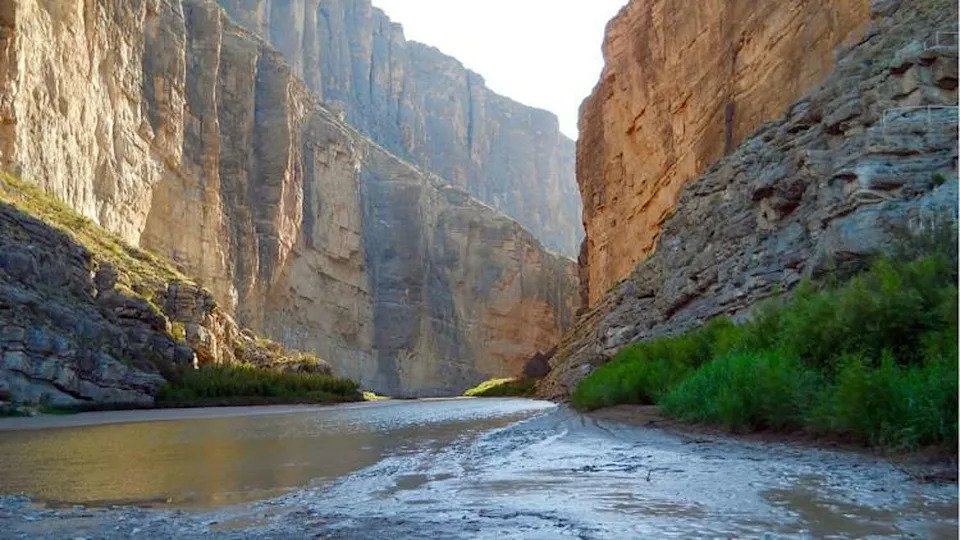
The Rio Grande slices the 1,500-foot-high walls of the Santa Elena Canyon in Big Bend National Park. (Contributed by Ann Wildemuth, Austin American-Statesman)
“This is not metaphor,” Grewal said. “These are our backyards. These are our homes.”
Jasmin Vega, a Laredo homeowner, said her family’s land has been along the river for generations, but her neighborhood still struggles with poor water quality, sewage problems and other infrastructure needs.
Several speakers said they were not arguing that border security should be ignored. Billy Bartko, with Big Bend Far Flung Outdoors, said border residents are not political talking points and deserve policies shaped by the people who live along the Rio Grande.