
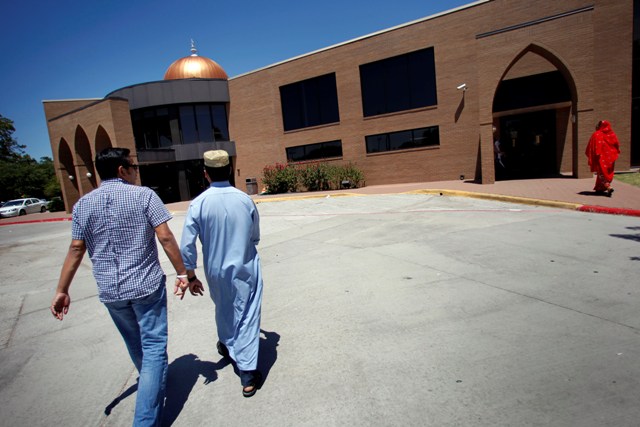
The Islamic Association of North Texas has a mosque and a school in Richardson. (DMN file photo)
Dr. Asif Hirani was preparing for midday prayer when he heard news of a deadly shooting at a mosque in San Diego Monday, where a number of children were also in school.

Though he was across the country at a mosque in Richardson, Hirani, resident scholar at the Islamic Association of North Texas, said it was a difficult day, as his own young children were in class at the time. At the mosque’s evening and night prayers, he and other faith leaders spoke about the virtues of resilience and protecting the vulnerable.
Article continues below this ad
Since the attack, Hirani said he has received a number of calls from his community expressing support and messages of solidarity from neighboring Christian and Jewish residents of Richardson. Other faith leaders have said they are increasing security measures after the attack, but also finding strength in faith and coming together as a community.
“This reminds us that, despite political divisions, our faith-based communities remain united in the standing against hatred and violence and marginalization,” Hirani said. “We’ll confront hate with love and solidarity and mutual respect.”
Related: North Texas houses of worship lock doors, tighten security amid surge in targeted violence
Make Dallas News a preferred source so your search results prioritize writing by actual people, not AI.
Add Preferred Source
Two teenagers shot and killed three men at a San Diego mosque Monday, including a security guard who is being hailed as a hero, the Associated Press reported. Officials said Tuesday the teenagers shared white supremacist views and authored writings that included hateful rhetoric against Muslims and Islam, Jewish people, the LGBTQ community, Black people, women and others, the Associated Press reported.
Article continues below this ad
The crime is the latest attack on U.S. houses of worship, following a recent attack on a synagogue in Michigan and a deadly attack on a Church of Jesus Christ of Latter-day Saints in Michigan. As a result, North Texas faith leaders of mosques, churches, synagogues and temples have invested in increased, and costly, security.
Related: D-FW Jewish leaders say Michigan synagogue attack highlights importance of preparation
North Texas Muslim leaders noted anti-Muslim rhetoric has been on the rise, across the U.S. and in Texas.
Hirani is urging members of the Muslim community to be vigilant in the wake of the San Diego attack.
Article continues below this ad
Khalid Hamideh, a spokesperson for the IANT, said the community is praying for the families in San Diego, particularly for those died.
“As people of faith, we find our solace and put our faith in the Lord,” Hamideh said.
Khalid Ishaq, a former board member with the East Plano Islamic Center, said his first concern after he heard of the attack was a “copycat” crime.
The EPIC mosque also serves as a kind of community center, with education for children, adults and recreational spaces. As a result, it’s bustling with activity and visitors.
Article continues below this ad
Ishaq immediately contacted the mosque’s head of security, who increased the presence of security that night for prayer.
“This is what happens when you have these kinds of statements and rhetoric of hate,” Ishaq said.
Dr. Amir Malik, public affairs director at the Ahmadiyya Muslim Community Dallas, said, “The moment you start hearing the details, you know your heart starts sinking.”
Muslims traditionally pray five times a day, and Malik said that prayer brings the community together.
Article continues below this ad
“Being one in faith also goes a long way in ensuring solidarity, not only to the ones who’ve gone through this, but amongst our own congregants,” he said.
Malik urged local civic and faith leaders to attend an upcoming tour of the Baitul Ikram Mosque in Allen May 27 in order to learn more about their organization and religion.
“The sacred spaces, which include the churches, the synagogues, the temples, need to be protected,” he said. “Every person should be able to worship in peace.”