
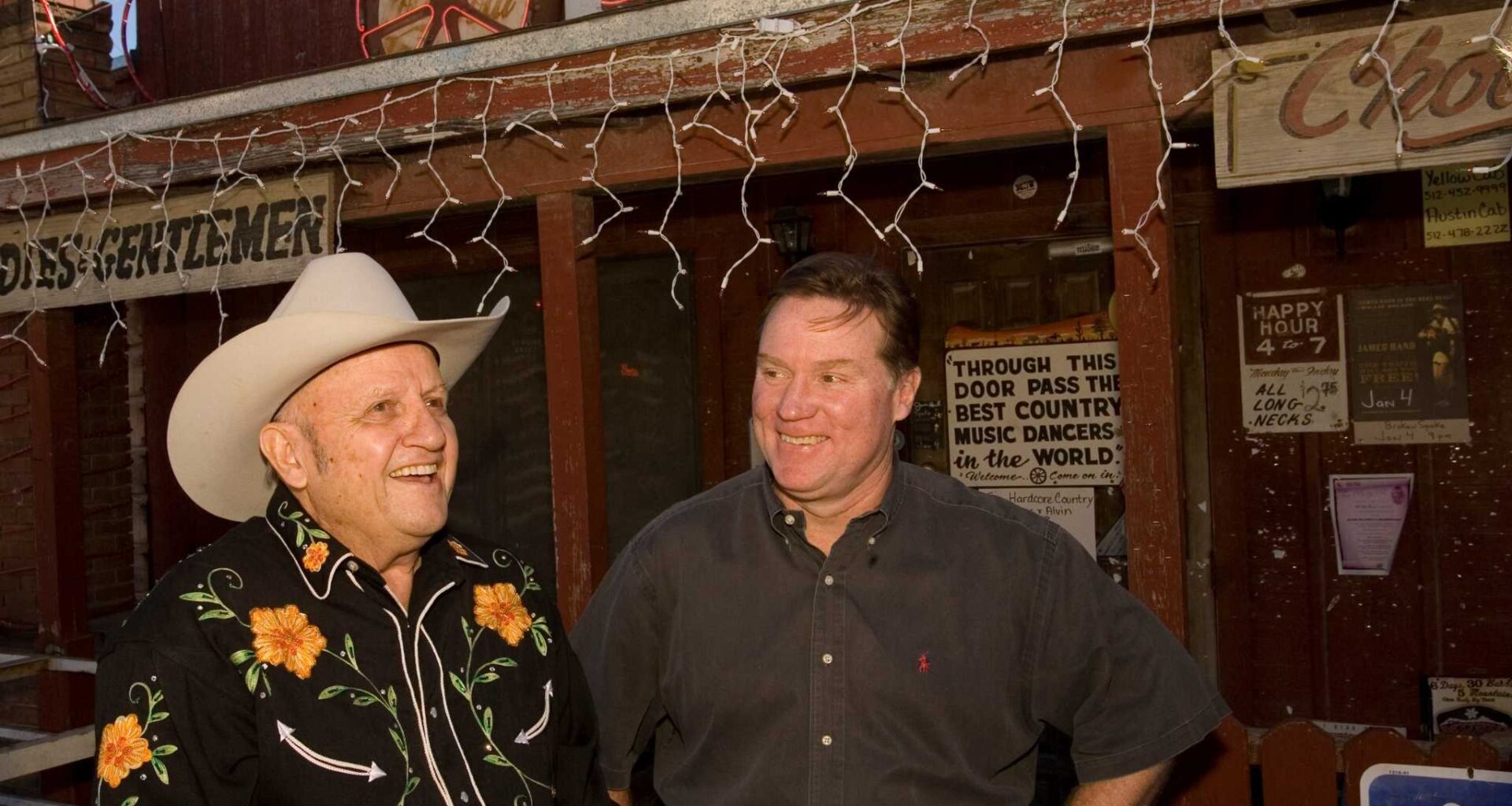
The past two weeks in “Jim Duncan’s Austin,” we adapted not one, but two sets of business histories of the city’s dive bars. This week, we turn to Austin honky tonks, which Duncan says are all about country music culture. “Always has a live band and a dance floor,” Duncan says. “People go specifically to two-step and dance.” — Michael Barnes

1964: Broken Spoke
The Broken Spoke, Austin Texas.
American-Statesman file, Austin American-Statesman
If there is a honky-tonk Heaven, then its address has to be 3201 South Lamar Boulevard.
Article continues below this ad
Founded by James Morris White in 1964, the Broken Spoke has kept country and western music alive and well for six decades. Under his watch, it became the go-to place in Austin where people can listen or dance to live music, linger over a longneck, and chill out with chicken-fried steak.
In addition to regularly showcasing local favorites such as Alvin Crow, Jerry Jeff Walker, Gary P. Nunn, Dale Watson and Asleep at the Wheel, the Spoke has hosted countless country legends, including Bob Wills, Kitty Wells, Ernest Tubb, Ray Price, Garth Brooks, Dolly Parton and Kris Kristofferson. Willie Nelson started playing there when he had short hair and wore a turtleneck and sports coat, and George Strait got his start there in 1975 and featured the Spoke on one of his albums.
Texas Highways voted the Spoke the “Best Dancehall in Texas,” and USA Today named it “one of the nation’s ten best nightclubs.” Even contemporary pop singers, such as Dua Lipa, enjoy boot-scooting at the Spoke when in town.
When the landowners sold the property in 2010, they considered only developers that would preserve the Spoke — and provide valet parking. Now flanked by 385 apartments, the Spoke is two-stepping on. White died in 2021.
Article continues below this ad
1972: Donn’s Depot
Bartenders Michelle Beebe (left) and Tammi Schissler fill Donn’s Depot with warmth.
MIKALA COMPTON/AMERICAN-STATESMAN
Before Austin was the “live music capital of the world,” Robert Lee Ogden, a local restaurant and real estate entrepreneur, wanted a place with a piano bar where he could hang out with his buddies, listen to live music and dance with his wife, Mary Jean.
So he purchased the old McNeil train depot, acquired a refrigerator car, wooden caboose and parlor car and hired a tire salesman named Donn Leigh Adelman to play the piano. He brought them all downtown to Fifth and West Lynn streets in 1972, and named it the McNeil Depot Saloon.
Article continues below this ad
Adelman took over the business in 1978 and renamed it Donn’s Depot. It is a dance hall. It is a honky tonk — even a wedding chapel. It is a cross-section of the kind of town Austin was and is.
Adelman likes to say, “We are not trying to keep Austin weird, we are keeping Austin Austin.”
The Depot has been described as a “honky tonk famous for country crooning, elaborate holiday décor and an ageless owner,” and as a “living, breathing time capsule of old values, and a place for up and comers to test their metal, wood and wire.”
Article continues below this ad
1981: Sam’s Town Point
Herb Steiner plays Steel Mondays at Sam’s Town Point in 2019.
Austin American Statesman file photo
Tucked away in the woods near the intersection of Slaughter and Menchaca exists a honky tonk that serves as the south pole of Austin’s live music axis.
Founded by Georgia Lois “Penny” Grossman in 1981, Sam’s Town Point shares a four-acre site with several homes. The compound has a dual address: 2115 Allred Drive and 2112 Oak Valley Road.
Article continues below this ad
Aging beer signs, mirrors and flyers for weekly two-step lessons adorn the walls of the bar. Comfy couches, club chairs and old theater-style seats are arranged to face the dance floor and bandstand.
Over the past four decades, countless musicians have taken Sam’s stage, including Shinyribs, Guy Forsyth and Dale Watson, who reminisced, “I first played there in the late ’80s. It’s special because it’s really unchanged. Rootsy Austin musicians, old veterans and new beginners of the scene still enjoy its unpretentious Old Austin vibe.”
When Grossman decided to slow down in 2017, she turned the reins over to singer-songwriter Ramsay Midwood, who had started playing there in 2002. As for Grossman, she can still be found sitting at the bar, enjoying the music and talking with customers.
Midwood foresees the creation of a cluster of music venues in the neighborhood — sort of a rural Rainey Street without the high-rises.
Article continues below this ad
1995: Poodie’s Hilltop Roadhouse
Poodie’s Hilltop Roadhouse opened on Texas 71 in the Austin suburb of Spicewood three decades ago. Its founder, James Randall “Poodie” Locke, was the tour stage manager for Willie Nelson, whose ranch was located nearby.
Known in the music industry as the “King of the Roadies,” he traveled the world with Willie for 34 years. The location gave him and the rest of his road crew a place to hang out when not on tour.
Willie himself has played Poodie’s many times. Legends such as Merle Haggard, Guy Clark and Johnny Gimble all played there, often unannounced.
Article continues below this ad
Locke died in 2009 at the age of 60. A celebration of his life brought together a crowd of 2,000, with performers including Joe Ely, Ray Wylie Hubbard and Billy Joe Shaver.
After his death, Sharon Burke took over and gave the bar a makeover with a new sound system, bar top, flooring and kitchen. She also started a “Songwriters Showcase” during which patrons can watch local artists share original material.
The walls of the bar are adorned with old photos of Willie and Locke together, alongside other famous country and blues artists who have played there over the years. Sidebar: The nickname “Poodie” is derived from “purty” — a younger sister couldn’t pronounce the word “pretty” when describing him.
Three more stories in this series
Article continues below this ad
Please send tips and questions to mbarnes@statesman.com.