
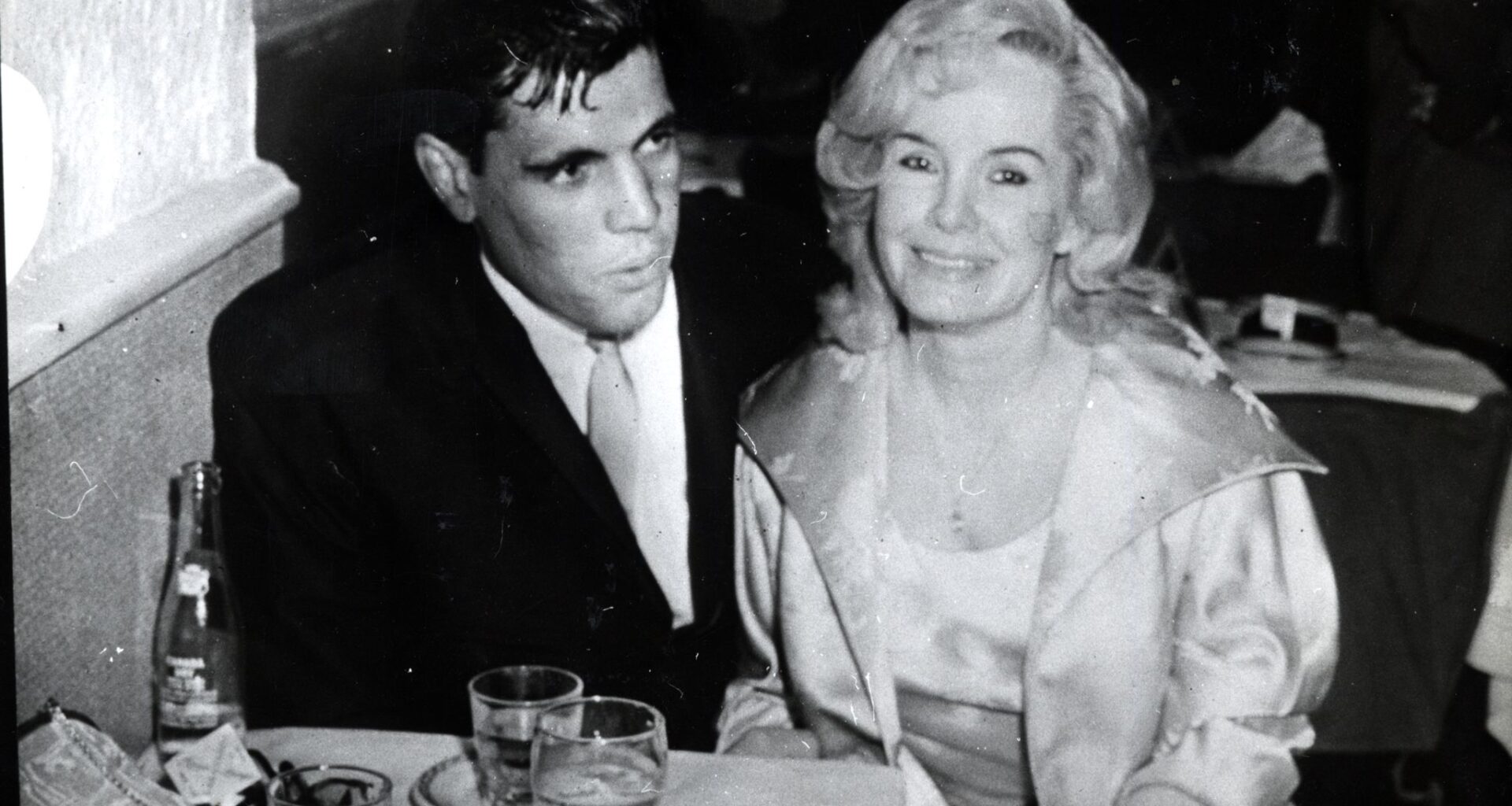
Melvin Powers and his aunt Candace Mossler were tried for the murder of her husband.
Houston Chronicle files
Joan Robinson Hill plays with her dog, Scooter, at her River Oaks home in 1959.
Bob Verlin / Houston Post/Houston Chronicle
Joan Robinson Hill, shown here in 1959, died of an infection, and her husband, Dr. John Hill, was tried for her murder.
Keith Hawkins/Houston Chronicle
William Marsh Rice was murdered in his sleep.
HOUSTON CHRONICLE
The “crooked E” stood in front of Enron’s headquarters on Smith Street downtown.
Ben DeSoto/Houston Chronicle
It’s hard to shock the average Houstonian. As a group, we’ve been dragged into more than our fair share of scams and scandals — crimes that read like fiction except they are true.
The very founding of Houston in August 1836 was based on lies or at least gross exaggerations. Two New York land speculators, brothers Augustus and John Allen, purchased roughly 6,600 acres of hot, swampy land on Buffalo Bayou and advertised the barely-there community as a prosperous new city with “beautiful elevation” and “fresh sea breezes.”
The location was so convenient, they said, sailing ships could travel from the Gulf of Mexico up Buffalo Bayou to Houston’s back door.
Not exactly.
Article continues below this ad
The bayou was clogged with tree limbs, and, in its natural form, too narrow for ships to turn around. Also, the tadpole of a town was known for brawling, prostitution and bugs, particularly infected mosquitos that spread yellow fever.
The Allen brothers named their new settlement for statesman and military hero Sam Houston. But even he was known to rumble. He made the news when he pummeled an Ohio politician with a hickory cane. During times of turmoil in his younger years, Houston would leave his white world and join neighboring Cherokees, whom he described as his second family. The Native Americans loved him but also tagged him, “Big Drunk.”
As the years sped by and the chaotic community on the bayou grew exponentially, its reputation for mayhem and scandal persisted — a faint, rank odor.
In the late 1800s, businessman and philanthropist William Marsh Rice decided to use the bulk of his fortune to create a tuition-free institute of higher learning in Houston. What is today’s Rice University was to come to life upon his death.
Article continues below this ad
But his careful planning was almost foiled by a nefarious lawyer and a scheming valet.
What exactly happened has been told many times and with slight variations, but this much is generally agreed upon:
On the night of Sept. 23, 1900, Rice went to bed in his New York City apartment. Once he was asleep, secretary and valet Charles Jones killed him by putting a sponge soaked with chloroform over his face.
The next day, Jones’ partner in crime, Albert Patrick, tried to get a large forged check cashed — supposedly to him from financier Rice.
The crooked lawyer also produced an equally fraudulent will that benefited him, not the proposed institute or even his accomplice, Jones.
Alert bank officials were suspicious of the enormous check — and an error in the spelling of Patrick’s first name. They contacted Rice’s Houston lawyer and friend, Captain James Addison Baker Jr. A criminal investigation and trial followed.
Patrick was found guilty of murder and sentenced to death. As it turned out, he was down but not out. After years in New York’s Sing Sing Correctional Facility and intense legal wrangling, his death sentence was commuted to life in prison in 1906, and he was pardoned in 1912.
(Speculation was that family money and connections helped him greatly.)
Article continues below this ad
Patrick, then 46, spent most of the next three decades in Oklahoma, practicing law without a license and selling cars and air conditioners.
He died in 1940.
Jones, the secretary valet, escaped punishment because he testified against Patrick. In 1954 in Baytown, he committed suicide.
High society scandals
If old Houston had been a magnet for crimes that involved blood and money, scandals in the 1960s and ’70s added another ingredient — sex.
Just one example: Financier Jacques Mossler, 69, was stabbed 39 times and bludgeoned with a glass bowl one sultry June night in his Key Biscayne, Fla. apartment. The year was 1964.
Article continues below this ad
Prime murder suspects were his wife, Candace Mossler, who lived in the couple’s Houston mansion, and Melvin Powers, her troubled nephew who also lived in the River Oaks manse.
Allegedly the aunt and her nephew were lovers. Gossips and law enforcement officials thought the murder was a convenient way to get rid of Jacques and snare his fortune.
This is another Houston tale that has been told and re-told, with details slightly different each time. But the end of the story is always the same: Candace Mossler and Powers were tried for murder in Florida in 1966, and they were acquitted. After the not-guilty verdicts were announced, Candace sought out the 12 jurors in a back hall of the courthouse and kissed them all.
That was, perhaps, vintage Candace. In her early 50s, she was still the beautiful society hostess with the little girl voice, and most people found her charming, even mesmerizing. Some found her frightening as well.
In time Candace and her nephew ended whatever type of relationship they had, and she married Barnett Garrison, an electrical contractor, in 1971.
He was 33. She was, by then, 57.
Article continues below this ad
One day Garrison came home to River Oaks, found himself locked out and fell while trying to climb to Candace’s third floor bedroom.
He survived but suffered life-altering injuries.
Candace died of what was believed to be an accidental overdose of prescribed medicine in 1976. Powers, a real estate developer in and out of bankruptcy, died in 2010.
Houstonians were still talking about Jacques Mossler’s society murder when another prominent River Oaks couple died mysteriously.
Joan Robinson Hill, a celebrated equestrian and the wife of plastic surgeon John Hill, died of a massive infection in 1969. She was 38.
Her grieving father, Houston oilman Ash Robinson, was convinced that her husband had murdered her, and police apparently thought so, too.
Dr. John Hill, plastic surgeon and noted classical music aficionado, was charged and tried in 1971. Prosecutors tried to prove Hill deliberately withheld medical care to hasten his wife’s death.
Ann Fairchild Kurth, Hill’s second wife, testified against him. She said Hill told her that he killed Joan “with a needle.” She also said that she and Hill were lovers before Joan’s death, and that they married less than three months after Joan’s passing.
Once again, the themes of sex, money and betrayal were swirling on the front pages of Houston’s newspapers. Jurors in the 1971 trial failed to reach a verdict. Before Hill could be retried, he himself was slain in September 1972.
In his book, “Blood and Money,” author Tommy Thompson implied that the contract killing was arranged by Joan’s father. Ash Robinson, however, was never charged.
Kurth also wrote a book, “Prescription Murder,” about the whole sordid episode. Her book was the basis for a 1981 TV movie, “Murder in Texas.”
She claimed Hill killed Joan by feeding her pastries injected with human fecal bacteria. Kurth also said that Hill tried to kill her, too. They were married only briefly before they divorced and Hill moved on to wife No. 3.
After the Hills, other high profile scandals followed. Long-time Houstonians talked about the cases as if they were titillating sporting events, and they could do the play-by-play.
The business of scandal
But a different kind of scandal dominated the news with the dawning of the 21st century. Suddenly everyone was talking about the energy giant, Enron Corp., and Robert Allen Stanford, the mastermind behind Stanford Financial Group.
The crimes committed by the leaders of those corporations were bloodless, but they still went to prison if they didn’t die first.
In the case of Enron, investigators and juries found that company executives pushed shady deals, manipulated accounting, overvalued assets and misled investors and analysts.
The result was a $49.8 billion bankruptcy filing that was at the time the largest in American history — and a tangle of civil and criminal litigation. Enron’s stock traded around $80-per-share at the beginning of 2001, and was practically worthless a year later.
Houstonians may never forget the photos of of laid-off Enron employees, about 4,000 in all. They streamed out of their building — an elegant downtown skyscraper — balancing a box or two of their personal belongings — a coffee cup, a picture of their kids, a phone directory that seemed important at the time.
For those everyday Houstonians, the shift from gainfully employed to broken was a long, painful fall. Some saw retirement nest eggs heavily invested in Enron stock turn into pocket change.
One mid-level Enron executive committed suicide. Three others faced a world of trouble. Kenneth Lay, who started Enron in the 1980s, claimed he hadn’t known what was going on in his own company. Chronicle business columnist Loren Steffy called that “the doofus defense.”
In 2006 a federal court jury convicted Lay and CEO Jeffrey Skilling on multiple counts of fraud and conspiracy.
Lay, 64, died just six weeks later while vacationing in Colorado. Because he had not yet been sentenced and hadn’t yet appealed, a court vacated his conviction. He died legally innocent.
Skilling served exactly half of what was originally a 24-year sentence. He was released from federal custody in 2019 and has lived mostly outside the public eye since then.
Andrew Fastow, then Enron’s chief financial officer, cooperated with prosecutors and received a considerably lighter sentence — five years in federal prison and one year in a halfway house. Today he is a public speaker, among other things, and talks about ethics and accounting integrity.
Stanford, founder of the financial group he named after himself, lives in a Florida prison. He is only able to dream about the jet-setting lifestyle he enjoyed while ripping off thousands of Houstonians and others for at least $7 billion.
Stanford, a Mexia native, once was a celebrity in the Caribbean island nation of Antigua and Barbuda. He even was knighted for civic involvement there.
Then, in 2009, federal agents raided his offices in Houston’s Uptown district and obtained court orders freezing his companies’ assets.
Prosecutors accused Stanford of masterminding a years-long fraud, promising high returns to investors in certificates of deposit at his Stanford International Bank in the Antiguan capital of St. John’s.
The feds alleged — and a Houston jury agreed in 2012 — that Stanford used investors’ money to finance other businesses and personal luxuries, including a yacht and private airplanes. A federal judge sentenced him to 110 years in prison. Appeals courts upheld the sentence.
Other defendants linked to the fraud received prison sentences, and banks accused of aiding the scheme settled with regulators for millions. A court-appointed receiver recovered some of Stanford’s ill-gotten gains, and as of April 2026, was still distributing reimbursement checks to thousands of claimants.
Few if any were made whole. It’s unlikely that they took much comfort in the Antiguan government’s 2009 revocation of Stanford’s knighthood.