
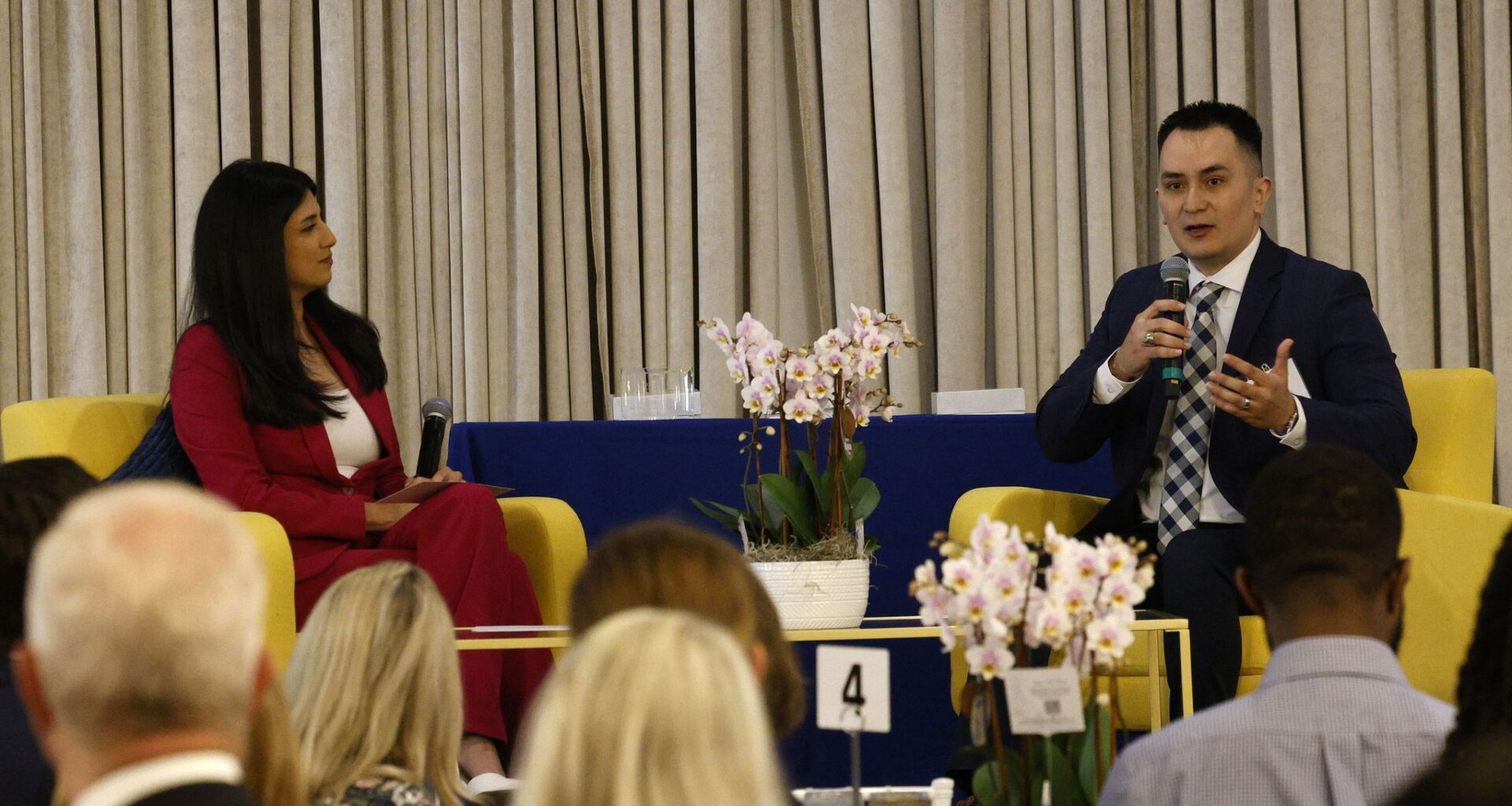
Cayro Bustos grew up hearing the same refrain from his father, a Mexican immigrant who spent his life doing landscaping and tree trimming. If Bustos stayed in school and became a lawyer, he could work in an air-conditioned office instead of under the Texas sun.
By the time Bustos arrived at the University of Texas at Austin, he was navigating a campus his parents had never experienced, surrounded by classmates whose parents were already lawyers and doctors.
“Attending college, I knew at the time without ScholarShot it was like going to a major city that you’ve never been before without a navigation system,” Bustos said Monday during ScholarShot’s graduate luncheon in Dallas.
“ScholarShot acted as that GPS system, where they were able to help me navigate the waters of the application system, what it’s like to apply to financial aid and get that reviewed every year.”
ScholarShot, a Dallas nonprofit, celebrated 34 new first-generation college graduates Monday, bringing its total number of graduates to 278 since its founding in 2009, while also making a broader argument that too many low-income students are left to navigate college admissions, financial aid and career decisions with little guidance.
The nonprofit provides first-generation students with that financial aid and academic mentorship. Citing state higher education data, the organization said roughly 74% of Texas public high school graduates fail to earn a postsecondary credential even as employers increasingly demand degrees, certificates and technical training.
Founder and executive director Dan Hooper told the audience to imagine being an 18-year-old student accepting thousands of dollars in grants and loans to attend a four-year university without understanding the full cost.
“You’re 18, you’re all on your own. What are you going to do? Of course, you accept it all,” Hooper said. “In fact, you’re $10,000 short after grants and loans, and no one has told you that.”
ScholarShot attempts to intervene earlier. The nonprofit pairs students with academic managers who help them navigate financial aid, course schedules, career planning and personal setbacks while also providing up to $6,000 a year in “last dollar” support for tuition, books and fees.
Hooper said the nonprofit’s degree completion rate exceeds 90%.
David Perez, a recent UT Austin graduate and the luncheon’s student speaker, said that support helped transform what once felt impossible into something tangible.
Perez, who graduated with degrees in international relations and global studies and Asian cultures and languages, told the audience he grew up as the son of immigrant parents and worked two jobs during college while struggling with mental health challenges and financial pressure.
“Although I received multiple scholarships, I still faced significant out-of-pocket costs,” Perez said. “That’s when ScholarShot stepped in, helping me graduate debt-free and most importantly helped me believe in my capacity.”
Perez later told The Dallas Morning News that seeing his family watch him walk across the graduation stage in Austin was very emotional.
“It meant a lot that I was the first person in my family to complete a bachelor’s degree. It still feels surreal,” he said.
Another graduate, Ebube Ezennaya, said ScholarShot helped him stay afloat after knee surgery left him on crutches and struggling through college classes at Texas A&M University.
“Having those conversations with Dalia, just telling her about my situation, being able to talk to her … really helped me get through that challenging time,” Ezennaya said of his academic manager, Dalia Trejo.
Trejo understands that role personally. A graduate of Sunset High School in Oak Cliff, she joined ScholarShot as a first-generation student, graduated from the University of North Texas at Dallas and returned to the nonprofit as a senior academic manager.
“I realized how much I didn’t know,” Trejo said of entering college. “Financial aid, I had no idea what that was. ScholarShot came in and filled in those gaps for me, which was life-changing.”
Now, she works with roughly 50 students at a time, helping guide them through the same transition.
“Whenever [people] are considering making a donation [to ScholarShot], they need to know that they’re changing generations, not just one student’s life,” Trejo said.
Bustos, now a third-year technology transactions and privacy attorney at Perkins Coie, told supporters he still answers emails and phone calls from current ScholarShot students because he understands the power of paying it forward.
“I am the product of ScholarShot,” Bustos said. “It’s what allows students like me to break that cycle and raise the baseline for their families.”
This reporting is part of the Future of North Texas, a community-funded journalism initiative supported by the Commit Partnership, Communities Foundation of Texas, The Dallas Foundation, the Dallas Mavericks, the Dallas Regional Chamber, Deedie Rose, Lisa and Charles Siegel, the McCune-Losinger Family Fund, The Meadows Foundation, the Perot Foundation, the United Way of Metropolitan Dallas and the University of Texas at Dallas. The News retains full editorial control of this coverage.