
The SpaceX Starship rocket is prepared for a flight test from Starbase, Texas, on Monday, Oct. 13, 2025. (AP Photo/Eric Gay)
Eric Gay/Associated Press
The SpaceX Starship rocket is seen ahead of a flight test from Starbase in Boca Chica, Texas, on Monday, Nov. 18, 2024. (AP Photo/Eric Gay, File)
Eric Gay/Associated Press
Construction is seen north of the Tesla Giga Texas factory in Austin on Wednesday, March 25, 2026. Elon Musk said he would build an advanced technology fabrication plant in Austin as he looks for a larger site to build his “Terafab” chip manufacturing plant that would eventually produce enough chips for 1 trillion watts, or 1 terawatt, of compute each year.
Jay Janner/Austin American-Statesman
A SpaceX facility where the company builds its Starship rocket is seen in Starbase, Texas, on Saturday, Aug. 23, 2025.
Andrea Leinfelder/Staff
The exterior of the Starlink manufacturing facility, a subsidiary of SpaceX founded by Elon Musk, on Friday, Sept. 20, 2024, in Bastrop, Texas.
Christopher Lee / Staff Photogra
Temporary SpaceX housing in the form of airstreams sit in the shadow of the newly expanded SpaceX complex showing a slowly developing company town for SpaceX on Wed, Jan 16, 2025, in Brownsville, Texas. Local residents who own property and were hold outs on offers by SpaceX officials to buy their property to transform it into their signature employee housing have complained that they are often left out of the conversation when continuing or new developments take place in the neighborhood.
Christopher Lee/Staff Photographer
A mural depicting the Starship rocket on Mars is seen on the side of a SpaceX facility in Starbase, Texas, on Saturday, Aug. 23, 2025.
Andrea Leinfelder/Staff
SpaceX’s production facility Starbase is pictured behind Boca Chica Village houses along St. Jude Street on Tuesday evening, June 18, 2024. Over the years SpaceX has offered buyouts to all the homeowners in Boca Chica Village and only a handful of property owners have held out.
Sam Owens/San Antonio Express-News
The SpaceX Starship rocket launches on its 11th flight test from Starbase, Texas, Monday, Oct. 13, 2025. (AP Photo/Eric Gay)
Eric Gay/Associated Press
The SpaceX Starship rocket makes a flight test from Starbase, Texas, on Tuesday, Aug. 26, 2025. (AP Photo/Eric Gay)
Eric Gay/Associated Press
SpaceX is seeking to sell stocks on Nasdaq and Nasdaq Texas in what could be the world’s largest IPO, unlocking cash that could generate more jobs, home sales, startup companies and tax revenues in Texas.
The rocket giant, headquartered outside of Brownsville in a company town dubbed Starbase, ended months of speculation on Wednesday by officially filing its registration statement with the U.S. Securities and Exchange Commission.
SpaceX did not say how many shares it would sell or list its price per share, though media outlets have previously suggested it could be a record-breaking initial public offering.
Article continues below this ad
TEXAS: New maps show Elon Musk’s expanding Texas empire, property by property
“More money for SpaceX will drive more investment into Texas,” Goran Calic, a professor of strategy at McMaster University in Canada, said in an email.
And listing it on Nasdaq Texas, which launched earlier this year with a handful of companies, also sends “a huge signal about the quality of Nasdaq Texas in a way that no other IPO could,” Calic added. “That’s a really big net positive for Nasdaq Texas.”
SpaceX has operations across the Lone Star State. It’s developing the Starship rocket in South Texas, testing Falcon 9 rocket engines in McGregor and manufacturing kits for its Starlink broadband internet satellites in Bastrop.
Article continues below this ad
WEALTH MILESTONE: Elon Musk reaches new wealth milestone, now halfway to being a trillionaire, Forbes says
In coordination with Tesla — Musk’s electric automaker — SpaceX is building an advanced technology fabrication plant in Austin that will design chips for data centers launched into space. It’s also considering a location outside of College Station for a larger “Terafab” chip-making facility.
These communities — particularly those in South Texas where the company is headquartered — are poised for growth. But the relationship won’t be one-sided.
A suite of relatively new state laws will protect Musk, SpaceX and its board of directors from certain shareholder lawsuits.
“It is a significant protection in Texas,” said James Spindler, a corporate and securities law professor in the University of Texas law and business schools. “A lot of it has Elon Musk in mind.”
Article continues below this ad
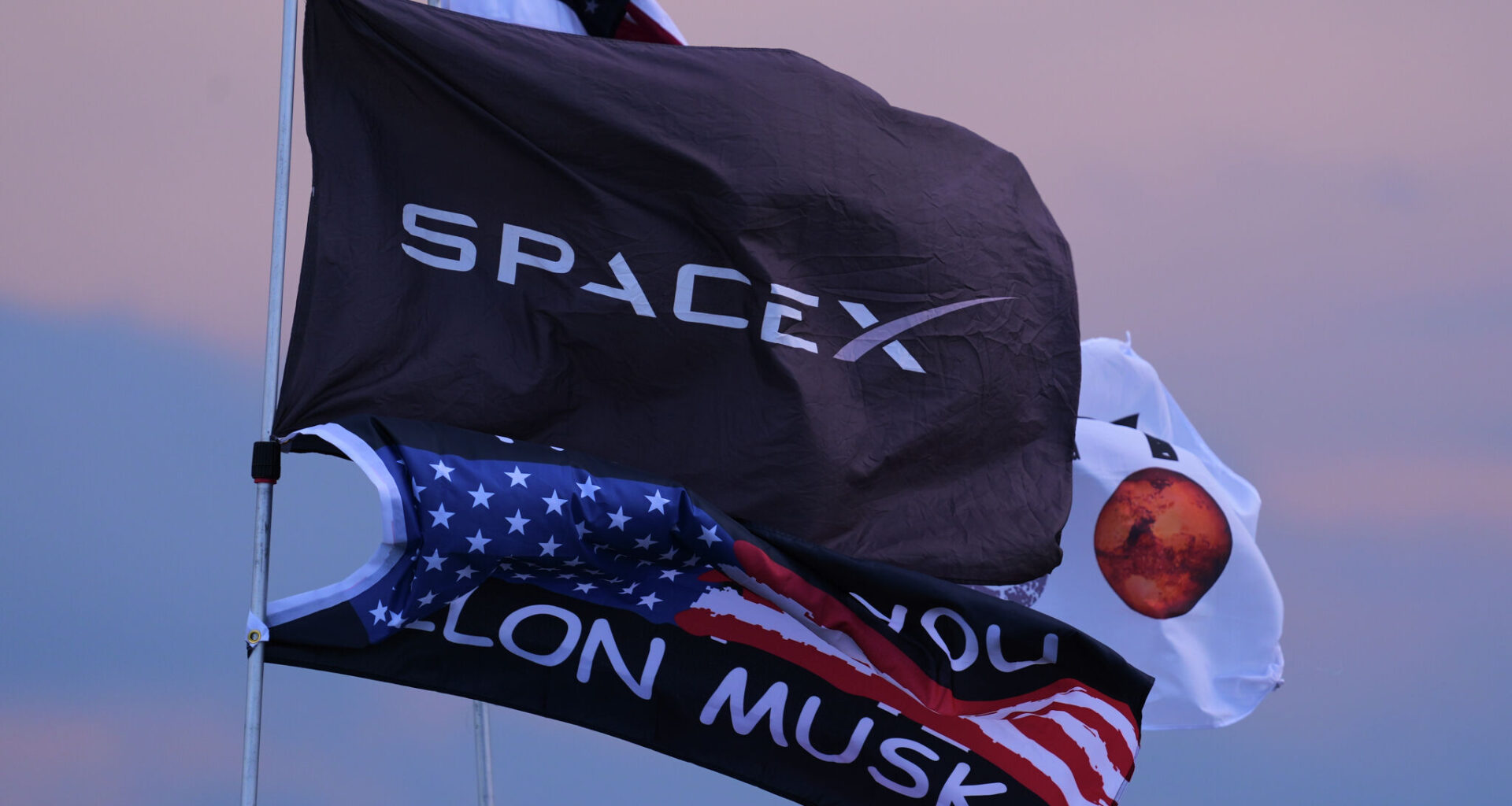
Flags are posted near the site where SpaceX’s mega rocket Starship will make a test flight from Starbase, Texas, Sunday, Aug. 24, 2025. (AP Photo/Eric Gay)
Eric Gay/Associated Press
Spillover effect for Texans
Initial Public Offerings often have spillover effects for the community where the company is headquartered.
Each additional $10 million raised through an IPO creates roughly 35 to 47 local jobs and between 0.6 and 0.8 new businesses in the county. The price of expensive homes within two miles of the headquarters is estimated to increase by $3,900, according to a research study published in the Journal of Financial and Quantitative Analysis in 2019.
The record-breaking SpaceX IPO probably won’t follow that exact formula. But it will still have a positive impact, said Ioannis Spyridopoulos, co-author of the study and an associate professor of finance at American University.
Article continues below this ad
He said much of the spillover occurs as early investors and employees sell their stocks. They use this new wealth to buy local goods and homes.
This effect tends to be strongest around a company’s headquarters. But Starbase — the company town built around the SpaceX headquarters — is remote, so the effect will likely expand into Brownsville and other South Texas communities.
GROWTH: SpaceX receives federal approval to develop acres of wetlands for launch pad expansion
SpaceX operations in Austin, Bastrop and McGregor could also experience some uplift, though not as large as South Texas, as SpaceX invests more money into these locations and its employees boost their local spending.
“The closer you are to the headquarters, the bigger the impact,” Spyridopoulos said. “But it does naturally create spillovers for those who live farther away.”
Article continues below this ad
Calic said the SpaceX IPO could pull other aerospace and tech firms — plus bankers, lawyers and accountants — to Texas. It could also lead to new startups as successful IPOs can prompt some high-wage employees to join or start other businesses, said Spyridopoulos, citing a study he did not write.
It’s hard to gauge the magnitude of these effects across Texas because SpaceX is vertically integrated, building many of its own components rather than relying on subcontractors. It’s also unclear how many of its early stockholders live in Texas compared with California where the company was previously headquartered, and some stockholders may have sold their shares on private markets.
Rising home prices can have negative consequences, too, if they make the surrounding area unaffordable for renters and lower-income households. But Spyridopoulos believes the SpaceX IPO will likely be an overall boon for the local economy.
“There’s going to be a positive impact,” Spyridopoulos said. “The extent to which that’s going to happen is quite uncertain.”
Elon Musk delivers a speech during the World Economic Forum Annual Meeting in Davos, Switzerland, on January 22, 2026.
Anadolu/Anadolu via Getty Images
‘More protection to company management’
SpaceX will also benefit from Texas as lawmakers have approved new corporate protections over the past several years.
The state has made it harder for shareholders to challenge corporate decisions and to file derivative lawsuits, where a shareholder alleges the company’s directors or officers are harming the organization, said Spindler, with the University of Texas.
These new laws were likely inspired by a derivative lawsuit filed against Tesla in Delaware, Spindler said. That lawsuit tied up Musk’s compensation package and ultimately went to the Delaware Supreme Court, which reinstated the pay package and reversed the lower court decision in part.
LAWS: Elon Musk moved Tesla and SpaceX to Texas. They could test the state’s new business courts
“Texas has been aiming to provide more protection to company management, particularly the sorts of companies like Tesla that have dominant managers,” Spindler said. “This was largely seen as an opportunity to put one over on Delaware.”
SpaceX could still be sued at the federal level in a securities class action lawsuit, but Spindler said these lawsuits require a higher burden of proof. A derivative lawsuit can be filed if a shareholder argues that something was unfair. A securities class action lawsuit can often require proving that fraud occurred and affected the company’s stock price.
“It’s going to be very, very hard to challenge decisions that Elon Musk makes within the company,” Spindler said.
Expensive priorities — and an AI race
Musk has long resisted taking SpaceX public, prompting speculation as to why he’s pursuing this IPO.
The company may need more money to fulfill its ambitions and keep competitors at bay. It has raised nearly $12 billion from the private markets, according to Crunchbase, but could access even more money as a publicly traded company.
“They need it to grow,” said Phil Smith, a space industry analyst at BryceTech. “SpaceX itself has created a competitive environment where they have to consider an IPO. There are a bunch of companies that are right behind them, in many ways, inspired by SpaceX.”
VINE RELAUNCH: Elon Musk shares new details on Vine relaunch with Grok Imagine, says he found video archive
The funding is expected to benefit its three main priorities: Starship, Starlink and orbital data centers.
Starship will be the world’s most powerful rocket — and it could play a crucial role in NASA’s endeavor to beat China to the moon. Starlink satellites connect homes, businesses and mobile devices to broadband internet. And SpaceX acquired Musk’s artificial intelligence company, xAI, earlier this year to create a constellation of satellites that will operate as data centers.
“Global electricity demand for AI simply cannot be met with terrestrial solutions, even in the near term, without imposing hardship on communities and the environment,” Musk wrote earlier this year in a SpaceX update.
CHIPS: Elon Musk plans chip fabrication plant in Austin as he pushes toward space-based data centers
Musk also believes humans are entering singularity, which could be another reason he’s taking SpaceX public and focusing on data centers, said Philip Metzger, director of the Stephen W. Hawking Center for Microgravity Research and Education at the University of Central Florida.
Singularity is a term coined by science fiction writer and computer scientist Vernor Vinge. It represents a time when artificial intelligence creates even better artificial intelligence. It’s an era where technology changes so quickly that it becomes hard to predict the future.
“It’s like emergency mode addressing the singularity,” Metzger said. “He feels like the most important thing he could do right now is getting ahead of that.”
AI competitors Anthropic and OpenAI are also reportedly considering IPOs, which is creating a “high-stakes race,” Patrick Boyle, a hedge fund manager and visiting professor at King’s College London, said in a YouTube video. Musk co-founded OpenAI but left after disagreeing with the other co-founders, who he later sued.
“Bankers are quietly warning that there might not be enough spare change in the public markets to support three massive, capital-intensive AI listings at the same time,” Boyle said, “and the first mover might get the biggest slice of the pie.”
Sending data centers to space
But there is a debate around whether Musk’s data centers are technologically or economically feasible.
“There’s a little bit of a ‘space being the solution for all your problems’ kind of attitude,” said Smith, with BryceTech. “But there are a myriad of terrestrial- and sea-based data center options being explored, too.”
For starters, solar arrays are not very efficient at generating power and will have to be massive to keep up with a data center’s needs. SpaceX’s initial plan is to build satellites with solar arrays longer than its 400-foot Starship rocket.
This raises concerns around light pollution and orbital debris, Smith said. And forces created by solar radiation could cause small movements that need to be dampened, Metzger added.
Cooling may also be difficult. On Earth, many systems use airflow to prevent overheating. But there isn’t air in space.
So spacecraft use thermal radiation. With the help of radiators and large panels exposed to space, their heat dissipates as invisible electromagnetic waves, like how the sun warms the Earth.
Bigger solar panels will create more heat, which means they’ll need larger radiators. Some people have expressed concerns around the cost and feasibility of these systems.
Metzger said fluids, which carry heat away from computers to the panels where the heat radiates out into space, might not flow as smoothly when pushed over larger distances. But he believes some normal technology development will address this and other orbital data center concerns. He does not believe the technological hurdles for orbital data centers are insurmountable.
“For some reason, there’s been a bizarre debate about radiators in space,” Musk said during an event earlier this year. “It’s safe to say SpaceX knows how to do heat rejection in space. With 10,000 satellites in orbit, (we) might know a thing or two.”
As for the economics, Metzger created a model that shows data centers will be cheaper to put in space — compared with building on Earth — in just 10 to 20 years.
Metzger considered the rate at which technology is advancing, the decreasing costs of building satellites inside a factory, and the heightened regulatory delays and public backlash on Earth. The latter was especially important as the value of AI is “increasing exponentially,” he said, and delays could cost a company $20 billion a year in revenues. Building data centers on Earth requires more regulatory approval than launching them into space.
“I do think it’s going to go to space because the economic, environmental and political pressures are going to push it off the planet,” Metzger said. “We’ve been predicting for a long time that eventually industry will be pushed into space because we’re outgrowing the planet. When AI burst on the scene, it accelerated that a lot.”