
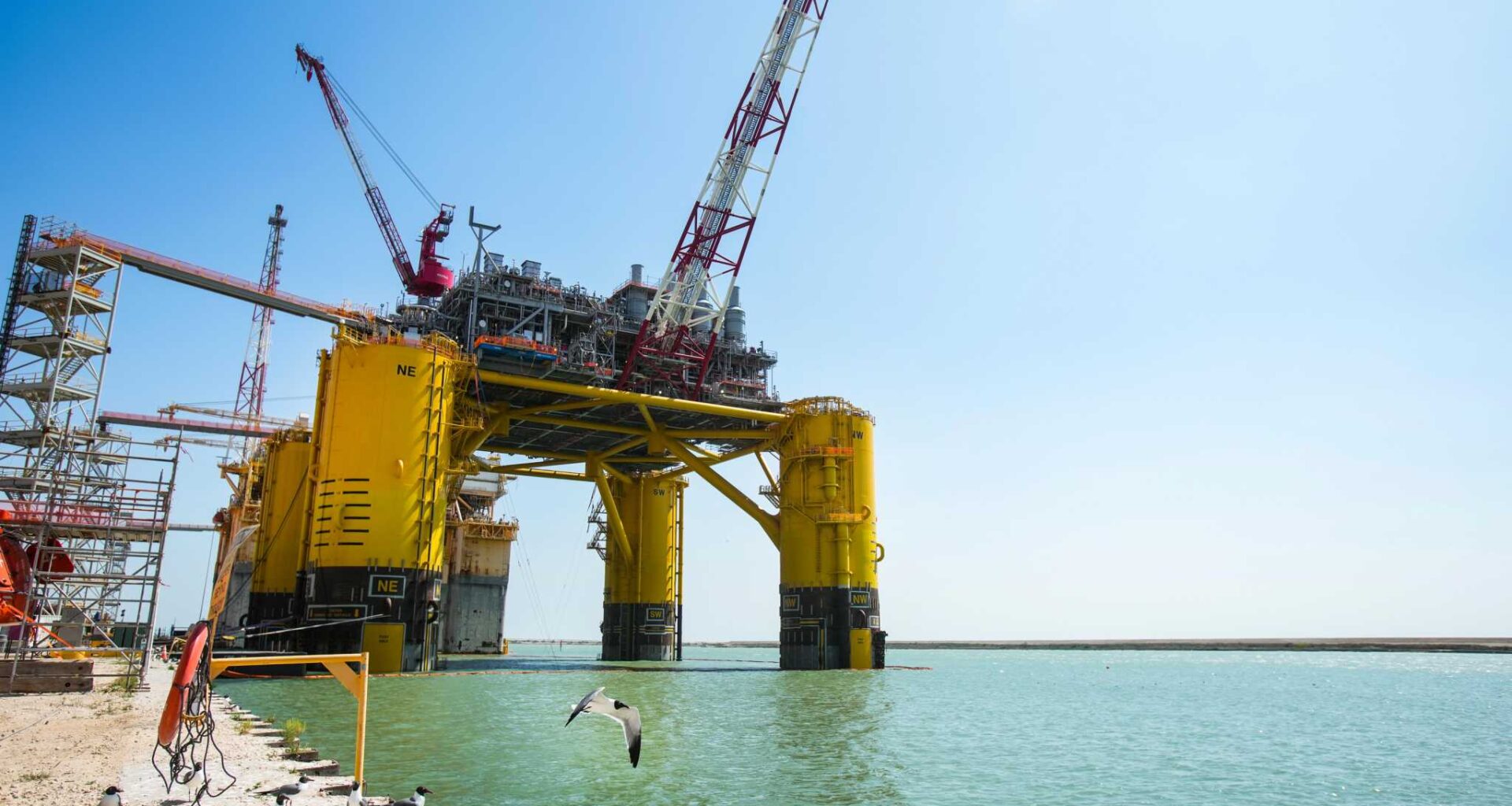
A seagull takes flight near Shellís Vito platform, as construction continued on the project at the Kiewit Offshore Services in Ingleside. The Gulf of Mexico Gulf in symbolizes the changes that both the offshore sector and broader energy industry have gone through
Brett Coomer, Houston Chronicle / Staff photographer
The offshore oil industry is making a comeback in the Gulf of Mexico, thanks, in part, to regulatory changes from the Trump administration.
As part of President Donald Trump’s push for energy dominance, the administration has taken steps to boost offshore operations by making leases more available, easing regulations and unwinding permitting processes. As a result, new deepwater and high-pressure projects in the Gulf of Mexico and contested platforms offshore oil-averse states such as California have been given the green light.
Offshore drilling, unlike its land-based counterpart, has added more rigs since last year, according to the latest counts from Baker Hughes. Onshore oil rig counts for the U.S. have dropped by 32, while the offshore count is up by 6.
Article continues below this ad
Many of the administration’s moves offshore have been met with dismay and legal challenges from environmental groups, and some state leaders. The latest major lawsuit brought in April challenged the administration’s approval of BP’s Kaskida project, arguing the project was approved without proper oversight and testing of the newer deepwater and high-pressure technology.
Here are the biggest moves the Trump administration has made in favor of offshore drilling:
1. Trump uses wartime powers to streamline projects.
The Defense Production Act is a Cold War-era law that lets the federal government direct companies to increase industrial production or fulfill contracts. It also enables the government to invest in private businesses and waive regulations, in the name of national security.
Since the start of the Iran war at the end of February, the administration has used these emergency wartime powers to speed up, waive or bypass state and federal regulations and jurisdictions.
Article continues below this ad
On March 13, the administration invoked the act and ordered embattled Houston company Sable Offshore to start production at its coastal California platform system. The company’s operations had been stalled for over a year in the state’s permitting and judicial review system as California regulators and environmentalists pushed back against the pipeline responsible in 2015 for one of the state’s worst oil spills.
COMMONWEALTH LNG: A massive $13 billion LNG is finally moving forward on the Gulf Coast
The administration followed that move by issuing five separate presidential determinations – official and legally binding policy stances – all in one day, one of which directly pushed for the development of more crude production and energy infrastructure.
Also in the name of wartime security, the administration waived the Jones Act on March 17 and extended the waiver this week. The Jones Act allows foreign-flagged vessels to transport specific commodities, such as oil and liquefied natural gas, between U.S. ports. This has opened up the flow of crude, refined products and LNG from Gulf Coast ports to the East and West Coasts of the U.S.
2. Trump releases Gulf of Mexico from ‘the God Squad’s’ rule.
The Endangered Species Committee convened in March in response to national security concerns raised as the Iran war disrupted global oil and gas supplies. The leaders of the six federal agencies and a federal appointee, dubbed the ‘God Squad’, voted that federal endangered species protections will no longer apply to oil and gas drilling along the Gulf Coast.
Article continues below this ad
The area now has a blanket exemption from previous restrictions, meaning that projects once inhibited by their potential threats to endangered sea turtles, whales and struggling coral reefs, among other living ecosystem concerns, are free to proceed full steam ahead.
It was the first time in more than three decades that the committee had convened. Speaking at the meeting, defense secretary Pete Hegseth said the Gulf was “a cornerstone of our security.”
“Disruptions to Gulf oil production doesn’t hurt just us, it benefits our adversaries,” Hegseth said.
The move was met by a swift wave of lawsuits attempting to block the waiver, many of which are ongoing in federal court in Washington D.C.
In this April 21, 2010 file aerial photo taken in the Gulf of Mexico more than 50 miles southeast of Venice, La., the Deepwater Horizon oil rig is seen burning. Tests performed before the deadly blowout of BP’s oil well in the Gulf of Mexico should have raised doubts about the cement used to seal the well, but the company and its cementing contractor used it anyway, U.S. investigators with the president’s oil spill commission said Thursday, Oct. 28, 2010.
Gerald Herbert/AP
3. Oversight now falls under a consolidated agency.
When the Deepwater Horizon platform exploded in 2010, it killed 11 people, countless marine animals and birds, and dumped an estimated 134 million gallons of oil into the Gulf of Mexico. The federal government investigated the disaster and as a result, split its offshore industry oversight agency, called the Minerals Management Service, into three separate entities.
Article continues below this ad
Those entities were the Bureau of Ocean Energy Management, the Bureau of Safety and Environmental Enforcement, and the Office of Natural Resources Revenue. Each was responsible for different facets of managing offshore energy industries and ensuring environmental, safety and resource protections were upheld.
The administration announced in April that it will re-consolidate those agencies, creating the Marine Minerals Administration. The decision stemmed from a desire to speed up permitting processes and has also eased well blowout and control rules.
The newly merged agency’s budget will be slashed by more than 30%, the administration said. The cuts mostly target the staffing and programs that manage operations and environmental safeguards.
4. Previously protected areas are now fair game.
Before it was consolidated into the Marine Minerals Administration, the Bureau of Ocean Energy Management released its agenda for upcoming lease sales.
Article continues below this ad
Documents exclusively reviewed at the time by the Houston Chronicle revealed that the administration had planned to open up areas that former presidents Joe Biden and Barack Obama withdrew from consideration. This included the entire Atlantic coast, the eastern Gulf of Mexico and the Outer Continental Shelf offshore Washington, Oregon and California and portions of Alaska’s Northern Bering Sea.
CHRONICLE EXCLUSIVE: Leaked documents detail Trump’s plans to open East and West coasts to offshore oil drilling
Those plans were amended following some political pushback by some of the administration’s biggest supporters – including Florida Gov. Ron DeSantis, who said offshore drilling would crush the state’s tourism industry.
Under the new proposal for the 2026 to 2031 leasing program, total proposed lease sales consist of more than 1.27 billion acres offered across the Gulf of Mexico, offshore California and Alaska, far surpassing the few hundreds of millions offered under previous administrations.
The proposal also includes the creation of a new administrative planning area, referred to as the South-Central Gulf of America.
5. Lease sales will be more frequent and have lower royalty rates.
In addition to opening up previously restricted waters, the administration has promised up to 34 lease sales over a five year period. As part of the One Big Beautiful Act, at least six offshore lease sales are required in Alaska and 30 within the Gulf of Mexico.
During the first Trump presidency, there were 7 sales held, according to BOEM records.
By comparison, the previous administration held just one sale for offshore oil and gas drilling, in 2023. The Biden administration’s most recent lease program had proposed three sales be held through 2029, all in the Gulf of Mexico.
To further incentivize bidding on lease sales, especially in the Gulf of Mexico, the administration also lowered the royalty rates companies would pay for deepwater leases. Previous royalty rates for deepwater leases were around 18%. They have since been dropped to match the shallow water rates, which hover around 12.5%.