
Water supply levels as of May 19, 2026
A new projected Level 1 water emergency trigger date has been revealed.
During a Corpus Christi City Council meeting on Tuesday, May 19, Corpus Christi Water (CCW) Chief Operating Officer Nick Winkelmann revealed a new projection model, which considers recent rain in the region and new groundwater sources coming online.
That new projected date is in December of this year, pushing three months from the previous estimated trigger date of September.
A Level 1 water emergency is when water supply is projected to be 180 days away from meeting demand.
“We are pleased to share the positive news with the community,” Winkelmann said. “CCW remains committed to the development of a diversified water supply portfolio that will ensure customers have reliable access to safe, quality water.”
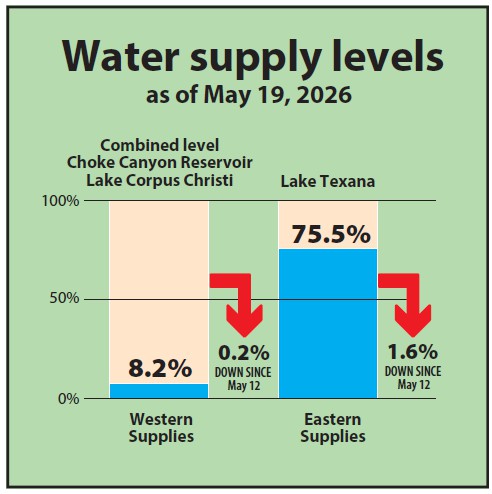
The news comes as Corpus Christi’s western water supplies (which include Lake Corpus Christi and the Choke Canyon Reservoir system) was at 8.2% as of Tuesday, May 19, down 0.2% since last week. Lake Texana, which provides most of the city’s eastern water supplies, sat at 77.5%, down 1.6% since a week ago.
At the same time, Corpus Christi City Council pushed a final vote on updates to the Corpus Christi drought contingency plan (DCP), regarding a Level 1 water emergency, to the next meeting on Tuesday, June 2.
Curtailment
As previously reported, the new amendments would use a “residential first” approach, according to CCW, to protect homeowners pending future water shortages, according to city officials.
The most significant update would be an increase in the residential monthly water baseline from 7,000 gallons per month (GPM) to 8,000 GPM, asking residents to curtail water use by 25%, resulting in a monthly allocation of 6,000 gallons.
The new policies would also allow residents to wash cars and boats with buckets of non-potable water under a Level 1 water emergency.
Also being weighed by the city council is a surcharge structure for customers who exceed their allocations or baselines. However, those surcharges would require separate resolution approval by the city council before taking effect.
When asked when the Nueces County Water Control and Improvement District (WCID) No. 4, which provides most of the water for Port Aransas, will vote to update its DCP to reflect Corpus Christi’s potential new policies, Nueces County WCID No. 4 Manager Scott Mack said it would be soon after Corpus Christi’s vote.
“We will review and make recommendations to the district Board of Directors, then call a special meeting to adopt once changes are reviewed and understood,” Mack said.
Also on Friday, May 15, CCW launched an online water usage portal, where Corpus Christi residents can log on and check their own usage to help curb the water crisis.
Mack said that the WCID No. 4 would look into doing the same, if the need arose.
“We have not experienced any complaints, and our system is small enough that our office staff is able to keep a closer eye on usage and see problems much quicker,” Mack said.
Water rates
During a water media briefing at Corpus Christi City Hall on Friday, May 15, City Manager Peter Zanoni responded to the question of whether Corpus Christi will raise its rates due to the new more than $1 billion of new supplies gradually being brought online.
Zanoni signaled that residents should expect a rate hike later this year.
As a wholesale customer of CCW, this affects the Nueces County WCID No. 4 and Port Aransas.
In response, Mack signaled the water district here will have to do the same.
“(As a wholesale customer) there is a cap on the size of the increase, but (our) customers will have to absorb at least a portion of whatever increases we encounter,” Mack said.
Evangeline
An administrative law judge ruled on Friday, May 15, that opponents of Corpus Christi’s Evangeline Groundwater Project have legal standing to have their concerns heard in court.
On Thursday, April 28, Judge Alicia Franklin York held a preliminary hearing on the matter.
Critics say that the project, which is on a massive 22,000- acre tract of land located on a historic ranch in San Patricio County, could impact local wells, land and the long-term health of the Evangeline Aquifer.
These concerns have led the City of Sinton and the St. Paul Water Supply Corporation to hold up the process of obtaining the drilling and transportation permits needed for the project.
In a letter following the ruling, Zanoni said that the decision does not mean that the project will not get the permits it needs. It is, however, the next step in the process.
Follow up dates or next steps have yet to be announced.
Desal update
U.S. Rep. Michael Cloud announced in a news release on Thursday, May 14, that President Trump’s administration had lifted a $30 million federal funding cap for desalination projects, opening the opportunity for large-scale funding for the Coastal Bend’s many ongoing desalination efforts.
The biggest is the Inner Harbor desalination plant, estimated to cost some $978 million dollars.
During Friday’s media briefing, Zanoni said that the city had asked for $500 million in federal funding, adding that the lifting of the funding cap is a good sign for the project.
Cloud shared that sentiment in the news release, adding that he had asked for an update on federal funding for the region from Andrea Travnicek, assistant secretary for water and science in the U.S. Department of Interior.
In the news release, Cloud said that Travnicek confirmed they had been closely tracking Corpus Christi’s application.
“It is no secret that the Coastal Bend is in need of long-term water solutions, and this is the first step into making things like desalination a reality for the region,” Cloud said. “It was my privilege to work alongside President Trump and the Bureau of Reclamation in making this a reality through countless conversations, legislative requests and President Trump’s recent visit to Corpus Christi.”