
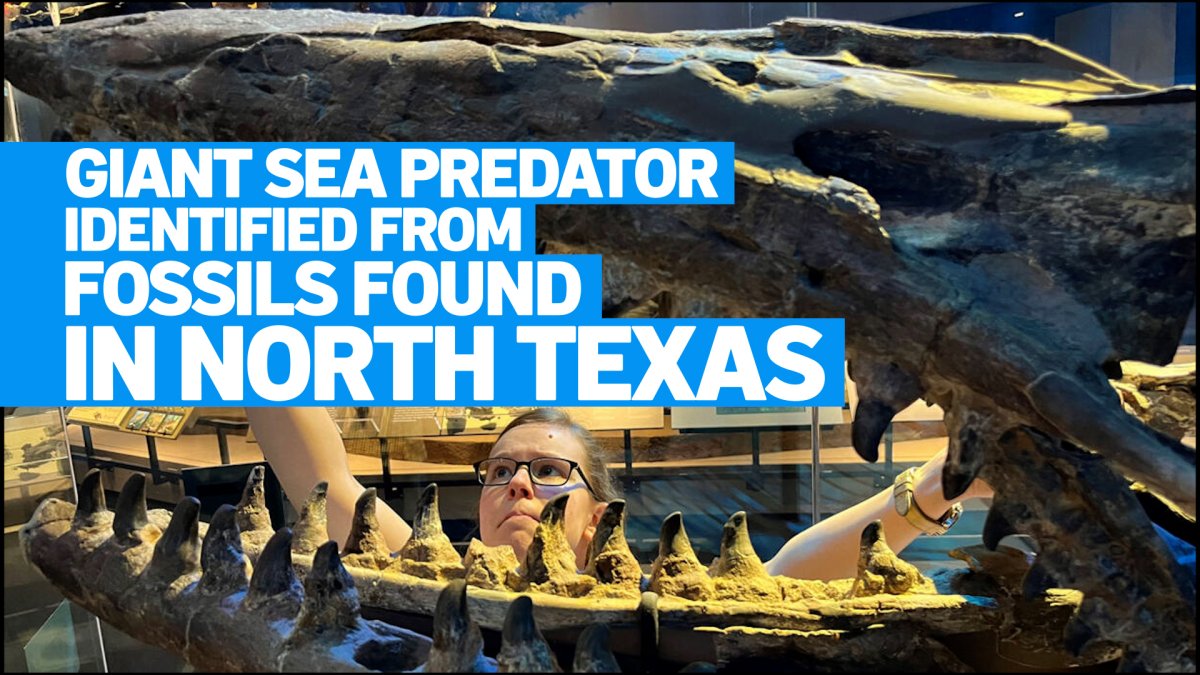
On Thursday, researchers at the American Museum of Natural History, the Perot Museum of Nature and Science, and Southern Methodist University announced they have identified a new T. rex in town, but this predator ruled the ancient seas.
The findings were part of a study published in the Bulletin of the American Museum of Natural History.
Researchers say the newly identified mosasaur species, a marine reptile that lived during the age of dinosaurs, is among the largest ever discovered.
The predator was identified using 80-million-year-old fossils found primarily in North Texas over several decades.
It was named Tylosaurus rex, or T. rex for short, meaning “king of the Tylosaurus.”
The holotype fossil, the specimen used to define the species, is on display at the Perot Museum.
“Everything is bigger in Texas, and that includes the mosasaurs, apparently,” said Amelia Zietlow, lead author of the new study.
Zietlow began her work as a Ph.D. student in the American Museum of Natural History after discovering a mosasaur fossil in the research collection that appeared to be misidentified.
She and her colleagues compared the fossil to other specimens and observed finely serrated teeth, a trait uncommon in mosasaurs.
Researchers say the serrated teeth, larger size, and evidence of powerful jaw and neck muscles helped distinguish the species.
Researchers said the name honors paleontologist John Thurmond, who first recognized that tylosaurs from north Texas were distinct.
The holotype specimen on display at the Perot Museum was discovered in 1979 near Lake Ray Hubbard, east of Dallas. Researchers say its anatomy suggests it was a powerful predator.
“Besides being huge, roughly twice the length of the largest great white sharks, T. rex appeared to be a much meaner animal than other mosasaurs,” said Dr. Ron Tykoski of the Perot Museum.
Researchers said they found evidence of violent injuries within the species at a level not previously documented in other Tylosaurus specimens.
An example of this fierceness is evident in a T. rex specimen in the Perot Museum’s collection, nicknamed The Black Knight. The specimen is missing the tip of its snout and has a fractured lower jaw, which researchers say could only have been inflicted by a member of its own species.
Researchers say this body of work also helps clarify mosasaur evolution, potentially reshaping our understanding of the species group.
“These findings reshape both the physical and evolutionary picture of mosasaurs, underscoring Texas as a key region for understanding ancient marine ecosystems and signaling a new era of research into the evolutionary history of these formidable predators,” said Dr. Michael Polcyn, an SMU paleontologist.
The study also highlights the role of amateur fossil hunters and citizen scientists in North Texas, many of whom helped discover and preserve fossils used in the research.