
Serious questions hang over next month’s World Cup. Will extortionate ticket prices keep out ordinary fans? Will America’s immigration crackdown deter international visitors? Will Iran’s national team participate in the tournament? For host cities Dallas and Houston, though, the problem is more basic: Will grass grow indoors?
To stage the world’s biggest sporting event, which will be played across North America, organizing committees in the two cities are spending millions to install natural playing surfaces at Dallas’s AT&T Stadium—which, as cynics like to point out, is actually in Arlington—and Houston’s NRG Stadium. The artificial turf at AT&T and NRG may be good enough for Dak Prescott and C. J. Stroud, but it will not do for the likes of Lionel Messi and Cristiano Ronaldo. Since the World Cup debuted in 1930, every men’s match has been played on a grass pitch. (FIFA adopted the same standard for the Women’s World Cup after being sued for gender discrimination in 2015.)
A quick primer: In soccer, known as football to everyone except Americans, a game is a match, a sideline is a touchline, a uniform is a kit, and a field is a pitch. FIFA, international soccer’s governing body, takes pitches very seriously. Its guidebook for playing surfaces is 120 pages long. In preparation for the World Cup, Dallas and Houston have upgraded their transportation networks, refined their security plans, retrofitted their stadiums, and organized massive fan festivals, but it will all be for nothing if they can’t build a proper, natural-grass pitch.
“It doesn’t matter how good the hospitality is or how nice the hotels are,” said John Coppins, vice president of operations for the Houston host committee. “None of that matters if the playing surface isn’t up to the standard.” Dallas cochair Dan Hunt has said that installing a new pitch will be the host committee’s single largest expense.
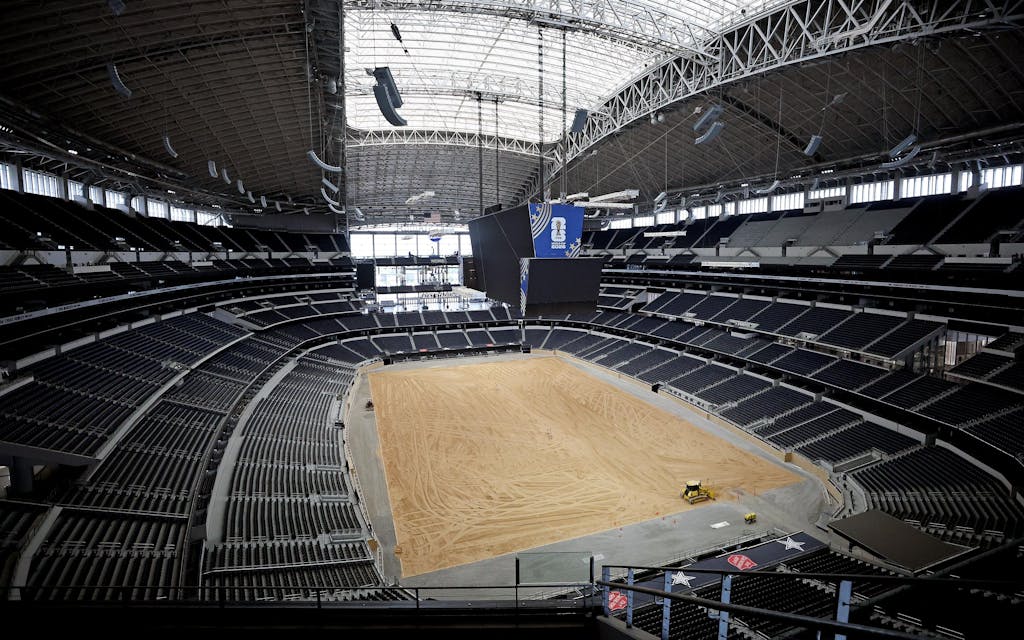 AT&T Stadium (in preparation for the World Cup) as of April 13.Stacy Revere/Getty
Previous attempts to grow grass indoors have been distinctly overwhelming. The Astrodome, the world’s first indoor stadium, opened in 1965 with a translucent roof that was supposed to make it possible to use a natural surface. But baseball players kept losing fly balls in the glare, and the roof had to be painted over, killing what remained of the patchy grass and necessitating the use of what came to be known as AstroTurf. Even with a retractable roof, NRG Stadium, home of the Houston Texans (which opened in 2002), had to use a grid of eight-foot-square grass sections that were grown outside the building and then installed directly over the stadium’s concrete floor. But that left seams between the grass sections, resulting in a rash of player injuries, and the Texans transitioned to artificial turf in 2015. AT&T Stadium, which also has a retractable roof, has used such turf since opening in 2009.
AT&T and NRG Stadiums have installed grass soccer pitches before, typically for international matches. For these one-night competitions, crews typically use the jigsaw puzzle system formerly used for Texans games. But that was never going to be acceptable for the sport’s most prestigious competition. “If we simply lay sod on the concrete floor, it looks like a natural-grass field,” Coppins said. “But to an elite soccer player, it just does not feel like they might want a soccer pitch to feel. The challenge is to have a surface that lasts for a reasonably long time indoors and to have that pitch play like a permanently installed pitch.”
In all, 104 World Cup matches will be played in sixteen stadiums—three in Mexico, two in Canada, and the rest in the United States. Half of those venues typically use artificial turf, and five, including AT&T and NRG, are domed. Almost four years ago, in preparation for the tournament, FIFA awarded a $5 million contract to researchers at Michigan State University and the University of Tennessee to develop a state of the art turfgrass that can survive indoors for the 39 days of the tournament—a sort of agronomical moon shot.
The FIFA-funded researchers tested a variety of grasses in greenhouses built to simulate the conditions in each host stadium. For the five indoor venues, they developed a proprietary turf consisting primarily of Kentucky bluegrass, which thrives in cool weather similar to that of an air-conditioned stadium, combined with faster-germinating ryegrass to produce stronger roots.
The sod set to be installed in Dallas and Houston was grown on a farm outside Denver, Colorado, where workers planted the grass in two inches of sand on long plastic trays. (Sand provides better drainage and stronger root development than soil.) Sometime this month, when the grass has reached exactly five centimeters in height, it will be cut into long strips—forty feet long by three-and-a-half feet wide—then rolled into dozens of one-ton bundles and placed on a fleet of air-conditioned trucks for the journey to AT&T and NRG stadiums. There, it becomes the responsibility of Dallas’s pitch consultant, Tom Jones, and his Houston counterpart, Dan Bergstrom.
The two have remarkably similar resumes. Jones oversees the grounds for FC Dallas, while Bergstrom does the same for the Houston Dynamo; each previously worked for their local Major League Baseball team; and each has dedicated his life to the cultivation of turf. “It’s a lifestyle, not a job,” Bergstrom once told an interviewer. According to a 2024 profile in The Dallas Morning News, “Jones always felt a passion for [the] nurture and upkeep of playing surfaces.”
Unsurprisingly, neither groundskeeper has much use for fake grass. “A well-maintained natural grass surface is, without question, the preferred choice across all major sports,” Bergstrom informed me in February, citing studies showing that athletes suffer more injuries on artificial turf. “Players feel safer on natural grass. They feel better the next day after playing on grass.” (Dallas’s World Cup host committee declined to make Jones available for an interview.)
Houston may not have been chosen as a host city at all if it weren’t for Bergstrom. FIFA was concerned that the Houston Livestock Show and Rodeo, which ran from March 2 to March 22 on a dirt floor in NRG Stadium, would make it impossible to install the grass pitch in time for the stadium’s first World Cup match on June 14, a David-and-Goliath contest between Germany and Curaçao. “FIFA said we have to move the rodeo,” Janis Burke, former CEO of the Harris County–Houston Sports Authority, told Houston television station ABC 13 in 2024 of the preliminary hosting discussions. “Well, that’s not going to happen. The rodeo is a very big deal in our city.”
An impassioned video presentation delivered by Bergstrom during the pandemic apparently persuaded FIFA officials that he could meet his deadline. “He’s not really Joe Personality,” recalled Chris Canetti, the president of the Houston organizing committee. “But we get on the Zoom, and he became a different man. It was like something from a movie . . . he wowed everybody.”
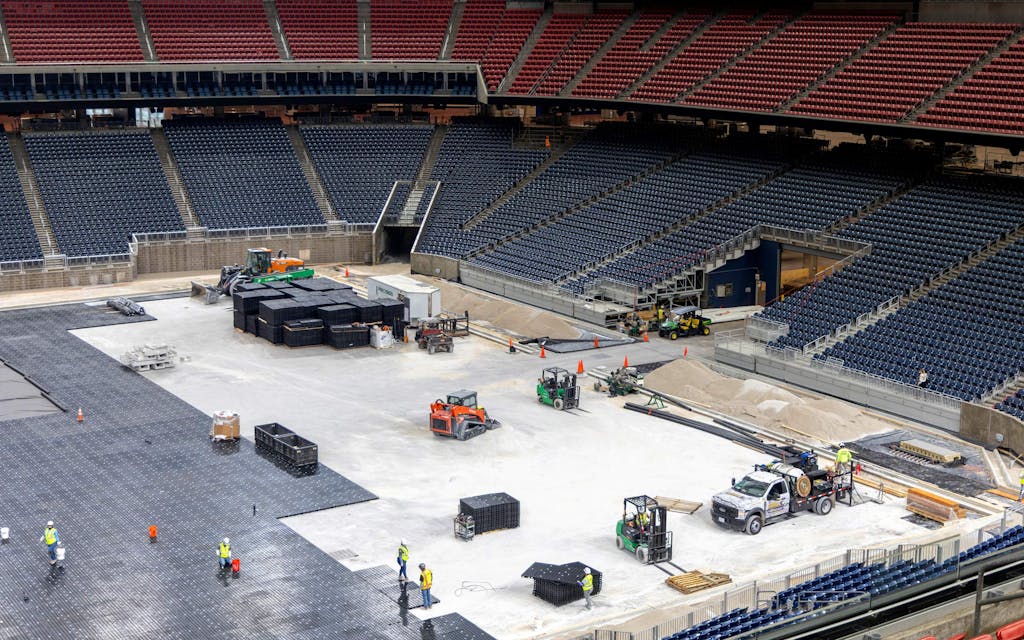 NRG Stadium on May 8.Rachel Drickamer/Harris County-Houston Sports Authority
During a media tour of NRG Stadium on May 8, a dozen yellow-vested groundskeepers were spread out across the vast concrete floor, assembling thousands of interlocking polypropylene pallets into the base of a five-layer, fully irrigated, natural-grass pitch. The strips of Colorado sod would later be placed atop a thick bed of laser-graded sand before being stitched together with polypropylene fiber.“There’s basically a big sewing machine on wheels that goes up and down the field,” Bergstrom explained.
In the weeks leading up to the tournament, the grass—helped along by grow lights, fans, sprinklers, and a fertilizer regimen—will take root and merge into a perfectly flat, perfectly seamless playing surface. The entire process should take about three and a half weeks.
Once the tournament gets under way, of course, the grass will endure torture by a thousand cleats. Players will kick it, jump on it, slide across it, and spit on it. In between matches, grounds crews will do their best to patch up its wounds. If all goes according to plan, the world’s focus will be on the action on the pitch rather than the pitch itself. “It’s assumed that, because it’s the World Cup, there will be no issues,” Coppins said. “If it’s talked about during the event, rarely is it in a positive light.”
Like referees, groundskeepers are typically only in the spotlight if something goes wrong. But the importance of Jones and Bergstrom’s work is not lost on anyone who’s part of the two host committees. Between the nine matches to be played in Dallas and the seven in Houston, the groundskeepers’ handiwork, for good or ill, will be visible to hundreds of millions of people around the world. Competing in the World Cup is the ultimate honor for a soccer player; building a World Cup pitch may be the ultimate honor for a groundskeeper.
But when the tournament ends, so will the pitches. The grass will be torn out, the sand carted away, and the artificial turf replaced in time for the start of the American football season. When I asked Bergstrom about the fate of his several-million-dollar masterpiece, he gave an appropriately practical response. “It doesn’t have much of a future,” he deadpanned. “It can’t survive in the Houston summer.”
And thus passes the glory of the World Cup.
Read Next