


EL PASO, Tx., May 22, 2026: As controversy over datacenters continues to intensify several communities are seeking to keep them out of their neighborhoods. El Paso is home to a META datacenter expected to go online in 2028, a proposed military artificial intelligence (AI) datacenter at Fort Bliss and another $165 billion AI datacenter being built in Santa Teresa.

The META datacenter was originally conceived as a $1.5 billion campus but recently ballooned to $10 billion after META pivoted towards including more AI tools in its offerings.
Concerns over electrical and water requirements have led to several grassroots efforts opposing datacenters across several communities in the country, including El Paso. In El Paso a coalition of several neighborhoods called the Sembrando Esperanza have organized to oppose the Northeast META datacenter citing electrical and water concerns. A lawsuit was filed against the Project Jupiter datacenter being built at Santa Teresa last October alleging that the government benefits offered to the project were “illegal.” In March, the judge in the case ruled that the lawsuit can continue after Santa Teresa county commissioners attempted to stop it.
Project Jupiter faces additional challenges including another lawsuit by the New Mexico State Ethics Commission alleging Elevate New Mexico, a secretive out of state company, is illegally lobbying state officials without registering as a lobbying group with state officials. In March, the New Mexico State Land Commissioner rejected the datacenter’s application to lay pipes for natural gas to fuel the proposed onsite electrical energy plant for the datacenter.
City Allocated $5 Million To Help Pay for META Datacenter
When signing the 380 Agreement with Wurldwide LLC, also known as META, which originally called for a $1.5 billion datacenter in the Northeast, the city council voted to allocate TED funds for the project. TED funds are grants from the Texas Economic Development Incentive Program (TED). Texas offers several economic development incentives to attract large capital investments in the state. TED helps to fund 380 Agreements.
On December 5th, 2023, the city council voted to approve a Development Agreement for Road Improvements to help pay to connect the datacenter with U.S. Highway 54. Although META was not required to connect to the 54 highway, the city allocated “up to $5,000,000” in TED funds to help the company defray the costs of designing and building the connection to the highway.
This was in addition to incentives provided to META in the 380 Agreement.
The roadwork does not include water or sewer improvements that may be required leaving any future construction of these to the PSB or the city council in the future.
Water Concerns
Chief among the concerns raised by opponents to datacenters is the stress on the water supplies that the centers place on local water resources. In El Paso, water is supplied by the El Paso Public Service Board (PSB), an agency that possesses the characteristics of a private company and a governmental body. The PSB manages the water supply in El Paso and surrounding areas and sets the rate water users pay. Although it is a quasi-governmental body run by a seven-member board who are not elected officials, the mayor of El Paso, Renard Johnson sits on the board. The rest of the board members are appointed by the city council.
The PSB was established in 1952 to insulate water policies from political pressure.
Nonetheless, Johnson and the city council have oversight of the water agency because they appoint the board members and the mayor sits in the meetings where water policies are made, including setting rates.
According to the PSB’s current annual budget report, El Paso water consumers used an average 108 million gallons of water a day last year, slightly less than the 108.6 million used the previous year. The report makes no mention of datacenters.
The 2023 META agreement between the city and the company building the datacenter states that the PSB “agrees to provide water and wastewater services” to the datacenter. In a December newsletter PSB CEO John Balliew wrote that “we are happy to say we can welcome the Meta to the Chihuahuan Desert while continuing to maintain a sustainable water supply.”
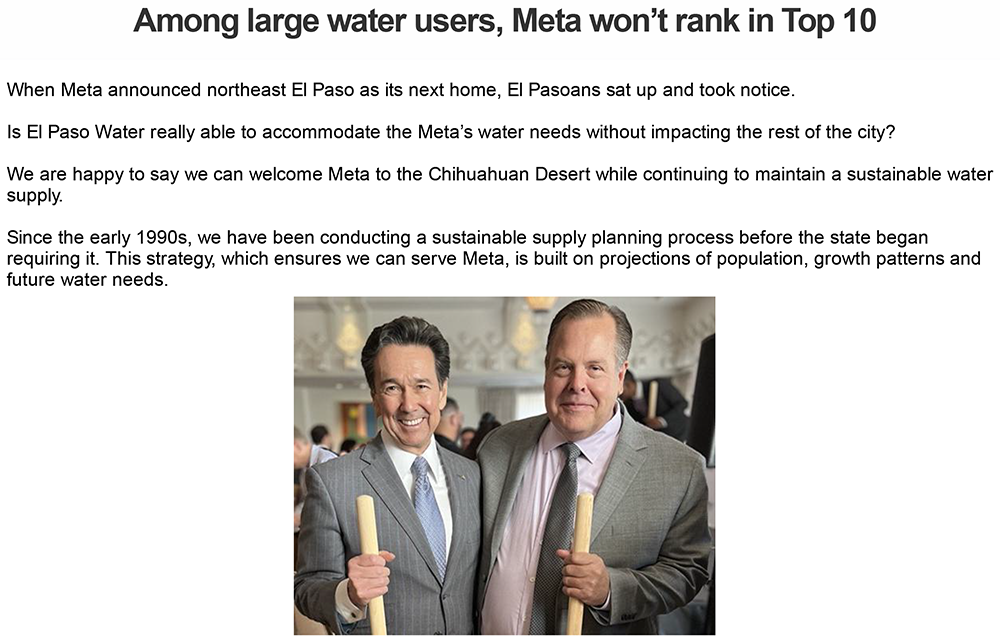 A section of the On the Water Front newsletter published by the PSB in December 2025, Martín Paredes/El Paso Herald Post.
According to Balliew, the META datacenter is expected to use around 400,000 gallons per day of water.
That was before META announced in March that it was expanding the project from $1.5 billion to $10 billion.
The sudden investment in El Paso’s datacenter is led by META’s efforts to deploy more AI computers so that it can compete better against Amazon, Google and Microsoft who have a larger AI infrastructure than META.
META’s larger investment will go towards heat generating equipment that will require more water to keep cool even with a closed-loop system and additional electricity to operate.
Neither META nor the PSB have released updated forecasts to the water usage requirements the larger datacenter will need but it will likely jump closer to 1 million daily gallons when the analysis is completed.
While META continues to invest in its datacenter footprint it continues to reduce its workforce to help fund the projects across the country. The company announced another round of layoffs of 8,000 Facebook employees this week.
Although the local water utility has not addressed the additional requirements the larger META datacenter will require, Texas officials have become concerned about water supplies in Texas. Texas water planners are estimating that around 25% of Texans may face water shortages by 2070.
The problem with water usage by datacenters is not only the water used directly to cool the equipment, but the water used by El Paso’s largely thermal electric plants that heavily rely on water to generate electricity.
The proposed close-loop colling system reduces water consumption by limiting evaporation but the added need for electricity to power the heat exchangers, pumps and other electrical equipment to pump the water leads to the higher consumption of electricity that requires water, in the case of El Paso, to generate.
City Council Will Seek to Limit Future Datacenters
The City of El Paso held community meetings in March to help the city council develop a Data Center Policy Framework.
On Tuesday, the city council will be discussing and possibly acting on an item put on the city agenda by Chris Canales. The item calls for the city to consider adopting “a general policy” that future “hyperscale data centers should not be actively recruited, pursued, or incentivized.”
Canales released a social media video on March 24 acknowledging that he voted for the META datacenter in 2023. However, in the video, Canales adds that he doesn’t “want data centers for generative AI here in El Paso.”
On Wednesday, Canales said on social media that his city council “proposal is about setting a clear direction for the future and recognizing that while these large data centers can generate substantial tax revenue to fund public services, they also come with very real tradeoffs that we have to take seriously as we decide what our future economy should look like.”
In his post, Canales pointed to the increasing public concern over “unusually high demands for electricity, water, and supporting infrastructure.”
Canales’ city council agenda does not seek to address META’s datacenter currently under construction. It only seeks to establish policies for future datacenters in the city.
City council has been advised that terminating the existing agreement with META could lead to penalties as high as $1 billion.
Texas Datacenter Developers Facing Greater Scrutiny
On May 18, over 100 Temple Texas, residents gathered at a town hall meeting to sign petitions calling for the recall of three council members after the Temple city council voted last month to move forward on another datacenter development in their community.
On the same day as recall organizers in Temple were organizing, Texas Agriculture Commissioner Sid Miller posted an editorial on the state’s official website calling for “a temporary moratorium” in Texas for datacenters to better understand the implications of energy and water the critics of the datacenters contend are costly to people across Texas.
Former Texas Governor Rick Perry’s AI startup, Fermi is now facing internal struggles for control of the datacenter company he co-founded after its stock collapsed by 80% after going public.
Perry is seeking to offer datacenter operators Texas land and power capabilities for their AI technologies. The first phase was slated to be completed by the end of the year. But in December, Amazon pulled out of a $150 million deal with Perry’s company leading to the collapse of the company’s share prices. Fermi has not named the company that pulled out but Business Insider revealed that it was Amazon.
Following the termination of the deal, CEO, Toby Neugebauer, was fired. Fermi has since announced that it is moving forward with a new plan called Fermi 2.0. Project Matador, the datacenter complex under construction near Amarillo, remains ongoing, says Fermi.
Nonetheless, growing concerns over the datacenters continue to grow in El Paso, Texas and across the nation.
Like Us and Follow Us On Our Social Media!
Visit this link for more details about the city’s plans for datacenters.
Visited 20 times, 20 visit(s) today