
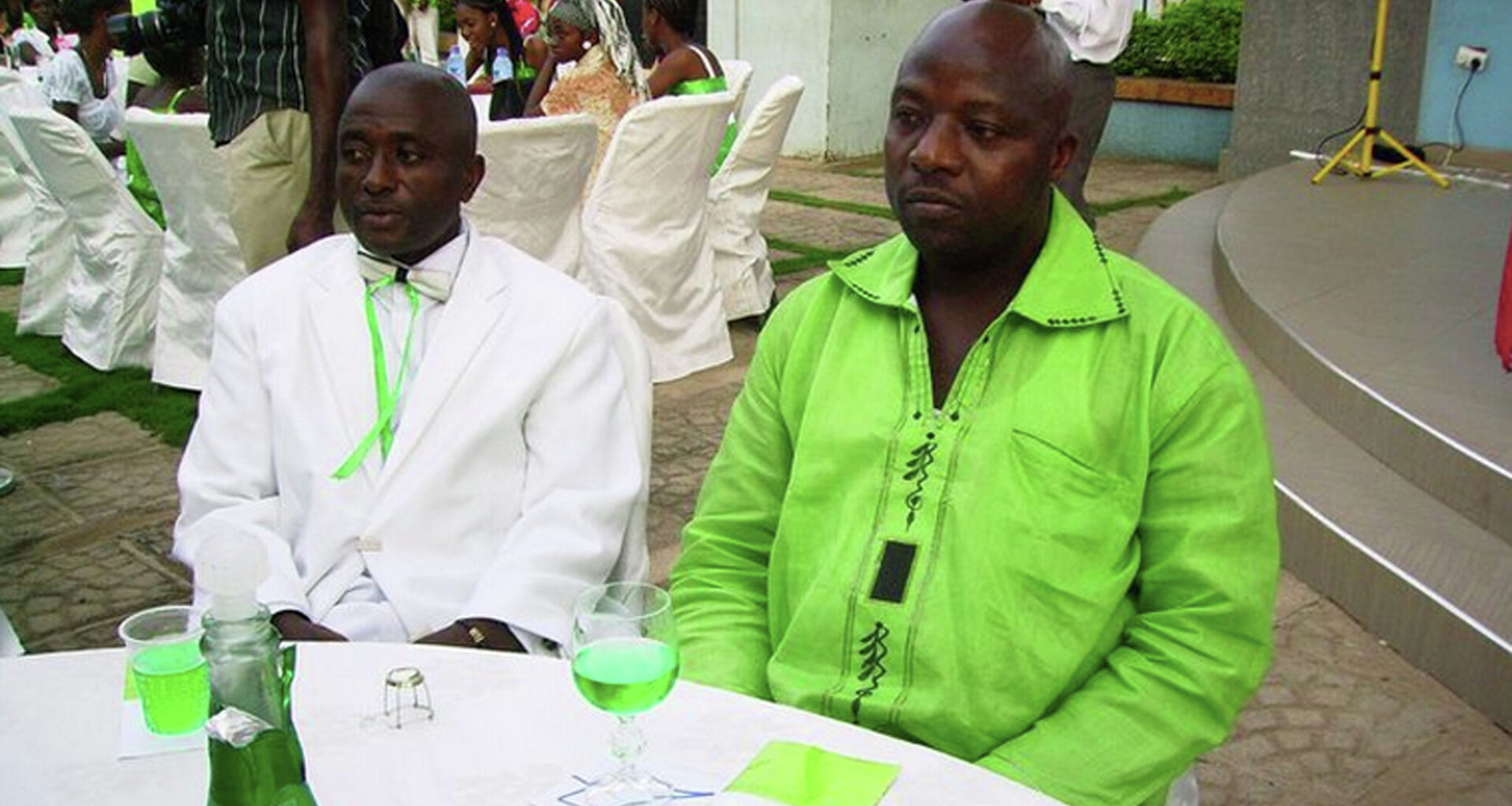
This 2011 photo provided by Wilmot Chayee shows Thomas Eric Duncan, right, with friend Wilmot Chayee at a wedding in Ghana. Duncan traveled to Dallas in 2014 after contracting Ebola in Liberia.
Wilmot Chayee/AP
On May 17, 2026, the World Health Organization declared the Ebola outbreak in the Democratic Republic of the Congo and Uganda a Public Health Emergency of International Concern. When news like this breaks, it’s hard not to wonder whether this deadly disease could reach us in Dallas. It already has once before.

The following account is based on news stories from The Dallas Morning News and The New York Times.
Article continues below this ad
In September 2014, Thomas Eric Duncan boarded a plane in Monrovia, Liberia, to reunite with family in Dallas and celebrate his son’s high school graduation.
Just a few days earlier, Duncan helped take a pregnant woman to the hospital, where she later died of Ebola. Despite his exposure, Duncan was asymptomatic when he was checked for fever at Monrovia’s airport.
Duncan arrived at Dallas-Fort Worth International Airport on Sept. 20 and traveled to an apartment in the Vickery Meadow neighborhood to meet his family. Symptoms including fever, abdominal pain and decreased urination began to appear four days later, leading Duncan to visit Texas Health Presbyterian Hospital Dallas. He reported severe pain, and doctors ordered tests to rule out appendicitis, stroke and other serious ailments. He was prescribed antibiotics, told to take Tylenol and released.
Make Dallas News a preferred source so your search results prioritize writing by actual people, not AI.
Add Preferred Source
Over the next few days, Duncan’s symptoms worsened. He returned to Texas Health Presbyterian on Sept. 28, transported by EMS. A doctor noted Duncan had just come from Liberia, where an Ebola epidemic was occurring, and that Duncan needed to be tested for the virus. He was placed in isolation, and federal health officials confirmed on Sept. 30 that he had contracted Ebola.
Article continues below this ad
With that announcement came some reassurance. There was no risk to anyone who traveled on the same planes as Duncan, since the disease only spreads through contact with bodily fluids of a symptomatic person, and he had no symptoms at the time of the flights. Federal officials also turned down calls for mandatory travel restrictions, saying the chances of an outbreak in the United States remained minimal.
On Oct. 1, Presbyterian Health said the nurse who treated Duncan during his first visit made a note about his recent trip from Liberia, but that information was not shared with the rest of the team. At the time of the first visit, obtaining a patient’s travel history was not part of standard triage protocol. Hospital officials initially said there was a flaw in their electronic health records system that led to separate physician and nurse workflows, meaning Duncan’s travel history was not passed on to physicians, but later retracted this statement and said the error was due to miscommunication.
Texas Health Presbyterian Hospital in Dallas, Texas on Friday, Oct. 3, 2014, when Thomas Eric Duncan was in isolation at the hospital.
David Woo
Presbyterian Health announced on Oct. 6 that Duncan had started receiving an experimental treatment and that about 70 hospital staff were working to save him. He died two days later, at the age of 42.
Article continues below this ad
Two of the nurses who treated him, Nina Pham and Amber Joy Vinson, were diagnosed with Ebola within a week of Duncan’s death. They both recovered from the disease in the following weeks.
What to know about the current outbreak
The current Ebola outbreak in Central Africa has caused nearly 600 suspected cases, 51 confirmed cases and 150 suspected deaths as of Thursday, according to the Centers for Disease Control and Prevention. Those numbers include two confirmed cases and one death in Uganda. It is the 17th Ebola outbreak to occur in DRC since the virus was first identified in 1976, and the third to be caused by the Bundibugyo Ebola strain, which has previously led to outbreaks in Uganda in 2007 and DRC in 2012.
The Bundibugyo strain has historically been associated with lower mortality rates compared to other strains, with previous outbreaks having mortality rates ranging from 25%-50%. Early symptoms of the Bundibugyo strain include fever, fatigue and aches, which later progress into diarrhea, vomiting and unexplained bleeding. Ebola is spread through direct contact with bodily fluids and cannot be spread through the air.
Article continues below this ad
Lessons learned from the 2014 Ebola cases in Dallas
The 2014 Ebola cases in Dallas led to changes in triage protocol, said Dr. Philip Huang, director of Dallas County Health and Human Services. “Making sure that you take that travel history and that everyone knows about it, those are definitely lessons learned,” Huang said. “I know whenever I go for a medical visit, they always ask if I’ve traveled.”
Some diseases such as COVID-19 are easily transmitted, Huang said, while others — like Ebola — are harder to spread. Public health officials take these factors into consideration during risk assessments to decide on a response. Huang emphasized that Ebola can only be transmitted after symptoms occur, making it easier to identify and contain.
In a statement published Thursday, the CDC said no Ebola cases associated with the current outbreak have been reported in the U.S. and that the risk to the public remains low.
Article continues below this ad
Thirteen health systems across the U.S. are specially equipped and trained to treat patients with Ebola, including the University of Texas Medical Branch in Galveston. Public health entry screening measures, designed to detect symptomatic arriving travelers, are in place to help prevent the spread of disease into the U.S.
Niamh Ordner is a science reporting fellow at The Dallas Morning News. Her fellowship is supported by the University of Texas at Dallas. The News makes all editorial decisions.