
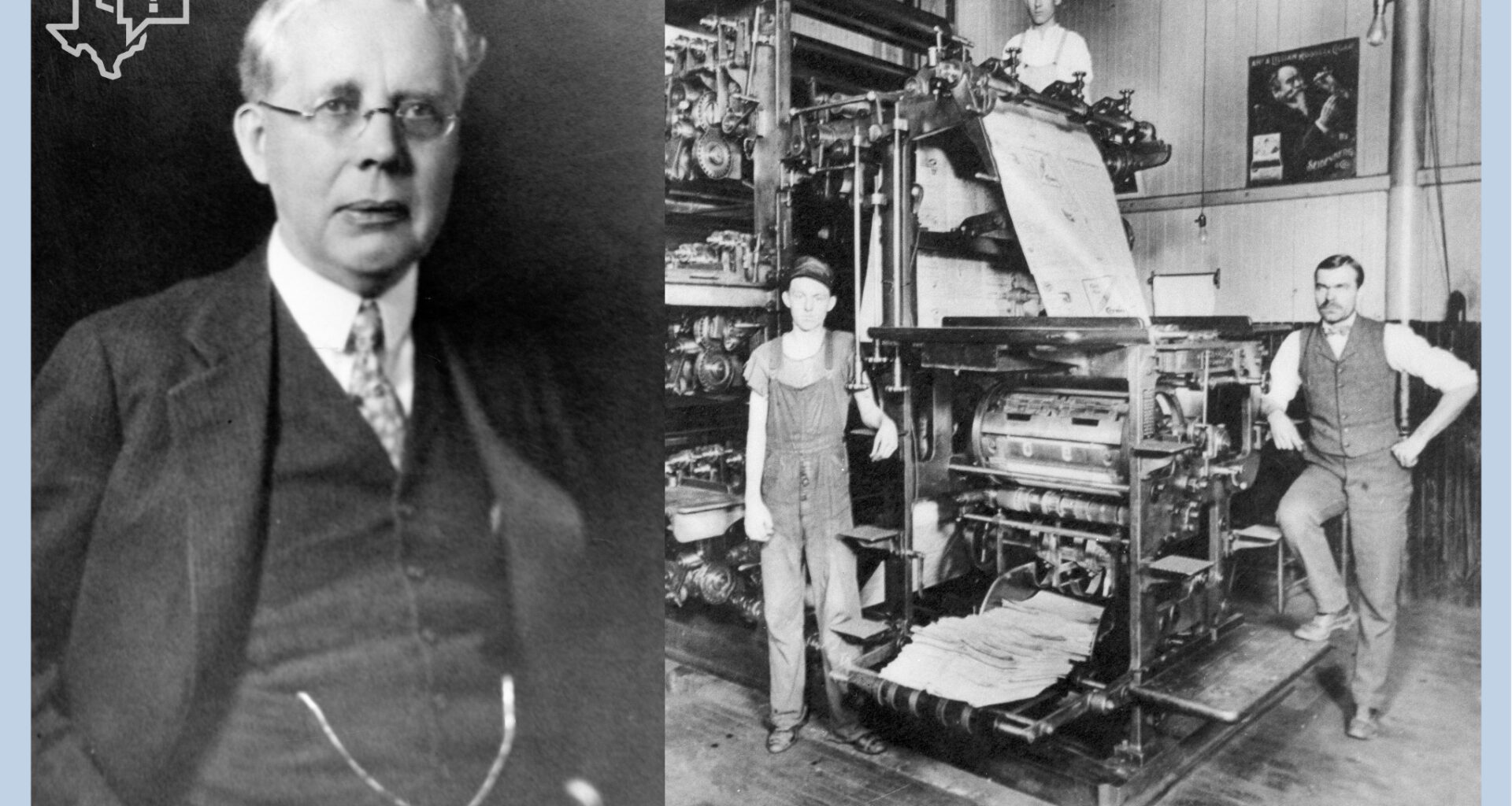
A 1936 portrait of Houston newspaperman Marcellus E. Foster, founder of the Houston Chronicle; The first Chronicles were printed on a rotary printing press that was named the Zaidee Lee after Foster’s wife as well as his daughter.
Houston Chronicle
Join us on a journey to better understand Houston, one question at a time. Sign up to get the Houston Explained newsletter in your inbox every Tuesday and Friday.
Born from the same oil gusher that made Houston as we know it, the Houston Chronicle, the paper that has documented every boom and bust, every moon shot and hurricane, every industrial explosion and corruption scandal the city has seen since the beginning of the last century, turns 125 this year.
The chronicle of the Chronicle starts with the Kentucky-born son of a Confederate captain, a young Houston Post reporter (and also its managing editor) who, in January 1901, was sent to Beaumont to cover that oil prospect we call Spindletop. Thanks to a little financial investment he made in the oilfield while he was there, the reporter walked away with much, much more than a news story.
Article continues below this ad
Nine months later, with that small fortune that was just one of many that Spindletop accorded, he launched the Houston Chronicle as an eight-page afternoon daily that sold for just two cents (or five cents on trains) on Oct. 14, 1901. Houston, from the two-cent readers of the past to the digital subscribers of today, has been reading ever since.
And behind the moment was a man worth knowing: Marcellus E. Foster.
Who was Marcellus E. Foster?
Foster was born in Pembroke, Kentucky, in 1870, the son of Marcellus Aurelius Foster, that Confederate captain we mentioned earlier, and Mariella Fitzhugh. But his family moved to Texas in 1873, and he was raised in Huntsville, where he got into the newspaper business as a printing apprentice at the Huntsville Item before he even got to college.
Article continues below this ad
But he did eventually get to college, and he graduated from the Sam Houston Normal Institute (now Sam Houston State University) in 1890.
Foster moved to Houston about five years later, landing at the Post with a weekly salary of $24 (that’d be around $950 today). He became the Post’s managing editor in 1899, when he was only 28.
How he founded the Chronicle
When Spindletop blew in on Jan. 10, 1901, Foster was there as a reporter. But he left as an investor after gambling $30 of his own money on an option on the well that he sold a week later for $5,000.
Article continues below this ad
Foster raised another $20,000 and launched the Chronicle that October out of a three-story building on Texas Avenue that was demolished ages ago.
The paper, by the end of its first month, had more than 4,000 readers in a city of fewer than 45,000 people.
The Chronicle’s growth kept pace with the city’s, and when it outgrew its digs on Texas Avenue in 1908, Foster struck a deal with a young builder named Jesse H. Jones for a new ten-story headquarters in downtown Houston in exchange for a 50% stake in the newspaper.
And as the paper’s profile rose, so did Foster’s reputation for picking fights the rest of Houston’s press corps wouldn’t touch, even if it cost him readership and advertisers. In the 1920s, when the Ku Klux Klan had enough power in Harris County that local officeholders were known members, Foster used the Chronicle to go after them with blistering editorials.
Article continues below this ad
His fellow editors even begged him to ease up, but he did not flinch. He had built this paper from a gamble and a gusher, and how could anyone dare tell him what to print?
“Before I do that,” Foster said, “I’ll dismantle the presses and throw the pieces into Buffalo Bayou.”

What is your Houston question?
The Chronicle’s only record of its first edition on Oct. 14, 1901, is a photocopy of one-half of the front page.
Houston Chronicle