
The director Margaret Brown thought her docuseries “The Yogurt Shop Murders” was largely behind her when its fourth and, at that time, final episode aired last August on HBO. She had spent years working on the story, about the unsolved 1991 murders of four teenage girls in Austin, Texas. And the work had taken a toll.
“It was very naïve, when I took the job,” she said last week on a video call. “I didn’t understand the kind of emotional space it would put me in for three and a half years.”
She didn’t anticipate that only weeks later, an explosive announcement would change everything. Nor did she imagine that her work would factor into the newest chapter, which she then scrambled to film. That chapter, titled “The End of Wondering,” debuts Friday night on HBO.
The first four episodes presented a haunting portrait of the protracted suffering such a horrific, seemingly random unsolved crime can inflict on a community. When Brown accepted the project, she wasn’t focused on solving the case, she said. She had wanted instead to explore how people handle such extraordinary trauma and grief.
But the sense of mission shifted when Detective Dan Jackson of the Austin Police Department’s cold case homicide unit, who was assigned the case in 2022, solved the murders, linking them definitively to a serial killer and rapist who had committed similar crimes across the country before eventually killing himself.
Suddenly Brown and her team found themselves hustling to tell a story unfolding in real time, a growing trend in the true-crime genre. Her tale of justice deferred became one of resolution and vindication.
“This is just the strangest coincidence,” Jackson said by video call about the timing. “But it’s appropriate for this case — of how weird this case is — that all of a sudden there’s a documentary and then it gets solved a month later.”
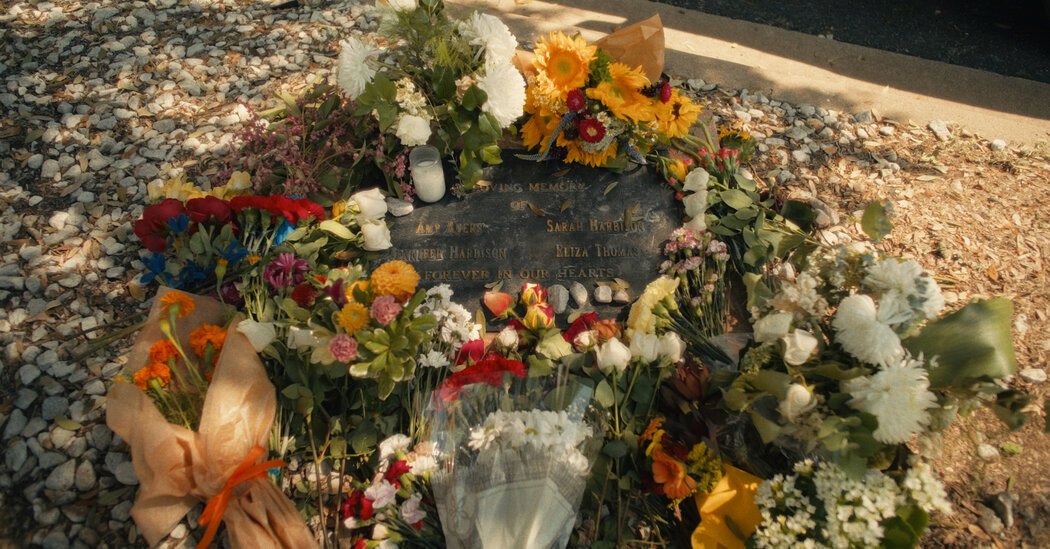
The Yogurt Shop Murders, as they’ve long been called, sent shock waves through Austin, a city with a very different energy in 1991 and half the current population — what Brown called “a lost time.” Amy Ayers, 13; Eliza Thomas, 17; and the sisters Jennifer, 17, and Sarah Harbison, 15, were killed at the frozen yogurt shop where Thomas and Jennifer Harbison worked. All four girls were shot in the head. At least three of them were raped, and the shop was set ablaze.
Four teenage boys were wrongly accused of the crimes — more young victims of another kind. Robert Springsteen and Michael Scott gave false confessions under aggressive police interrogation; both were convicted of murder (Springsteen in 2001; Scott in 2002). Maurice Pierce and Forrest Welborn were charged and never convicted, but each spent significant time in jail.
Scott’s and Springsteen’s convictions were eventually overturned because of a Sixth Amendment violation, and the men were freed in 2009. (In February, a Texas judge declared all four men “actually innocent.”) Pierce, who spent three years in jail awaiting trial, was killed by the police during a 2010 traffic stop, after injuring an officer with a knife.
The new episode opens at a news conference from Sept. 29, 2025, in which Jackson identifies Robert Eugene Brashers as the yogurt shop killer. He died by suicide in 1999 during a police standoff.
Brown, who lives in Austin, was at that news conference with her crew, anticipating big news. She and Detective Jackson had become good friends during the production of her docuseries, and the two had met for coffee shortly after Aug. 24, when Episode 4 aired. She detected a shift in his demeanor.
“She goes, ‘You’re fidgety,’” Jackson recalled. “I knew we had solved it. We just weren’t 100 percent yet.”
He wasn’t going to divulge any details prematurely at the time. “I could tell he wanted to tell me something, but he felt morally obligated to not,” Brown said, “and I wanted to honor that.”
But when she asked him directly if she was going to need an Episode 5, Jackson said, “I was like, ‘Yes.’” He had a solid lead, he told her, but suggested it could take weeks, even months, to confirm it.
She left Austin for her next project. Then just days after that coffee, Jackson had his answer. He suggested she come quickly, and Brown hurried back.
Jackson had identified Brashers, the result of a concerted effort across multiple states to match DNA and ballistic evidence, combined with work from the genetic genealogist Cece Moore.
In the month before the series originally debuted, and as the episodes were rolling out, the case kicked into high gear. Early that July, Jackson had resubmitted a .380 bullet casing from the crime scene — one of the few pieces of physical evidence — to a national ballistics information database called NIBIN. (“I don’t know why, something told me to go down that rabbit hole,” Jackson says in the series.)
The casing had last been tested against that database in 2007, when ballistics technology was significantly less sophisticated. This time there was a hit: a casing from an unsolved 1998 murder in Lexington, Ky., which hadn’t been uploaded until 2024. After 34 years, the puzzle came together quickly.
“It’s been insinuated,” Jackson said, that because of the documentary, the Austin Police Department “finally got off their ass to do something, and that couldn’t be further from the truth.”
“There was never a time when it was just filed away,” he added. “It really just took technology to catch up.”
Brown said she had wondered whether Jackson’s presence at an Austin screening of her first episode, in March 2025, might have spurred him to think differently about the bullet casing. Jackson said he didn’t think the viewing had necessarily made a difference.
“I had looked into doing something with the casing back in 2022,” he wrote in an email, but when he and “a group of subject-matter experts on cutting-edge DNA” triaged all the evidence based on its potential to yield new DNA information, the casing was near the bottom of the list.
As Brown filmed the final episode, she found that the first four installments had reverberated among many people connected to the story.
“Almost everyone talked about watching the show in their interview,” she said of shooting Episode 5, adding, “It was part of how everyone was processing it.”
Some of that footage made the final cut. Speaking about the decades-old false confessions, Jackson says in one scene, “The first time I heard any footage from the confessions was the HBO documentary.”
Later, he describes an August 2025 conversation with a South Carolina detective about an unsolved murder there — which turned out to be a key link in the case. That detective wasn’t familiar with the yogurt shop killings.
“I said, ‘If you want to get up to speed, there’s a really good documentary that’s on HBO,” Jackson says. “I’m in Episode 4.”
In the new episode, viewers see how the case was finally cracked, learn what happened to the boys who were wrongly accused, and hear how the girls’ families are coming to think about the tragedy, now that they finally have the truth.
As Brown visited with the families again, there was a lightness in them, she said, which she hadn’t seen before.
She described it with a quote from Shawn Ayers, Amy’s brother — the phrase that gave the final episode its name.
It was, she said, the “end of wondering.”