
AUSTIN, Texas — A University of Texas breakthrough could change how the U.S. sources some of its most critical materials by pulling them straight out of industrial waste.
A “Chemical Sponge” for Critical Minerals
China currently dominates much of the global supply chain for critical minerals, materials essential for everything from semiconductors to advanced weapons systems. But researchers at the University of Texas at Austin say they’ve developed a new way to recover those materials domestically.
Their solution: a “chemical sponge.”
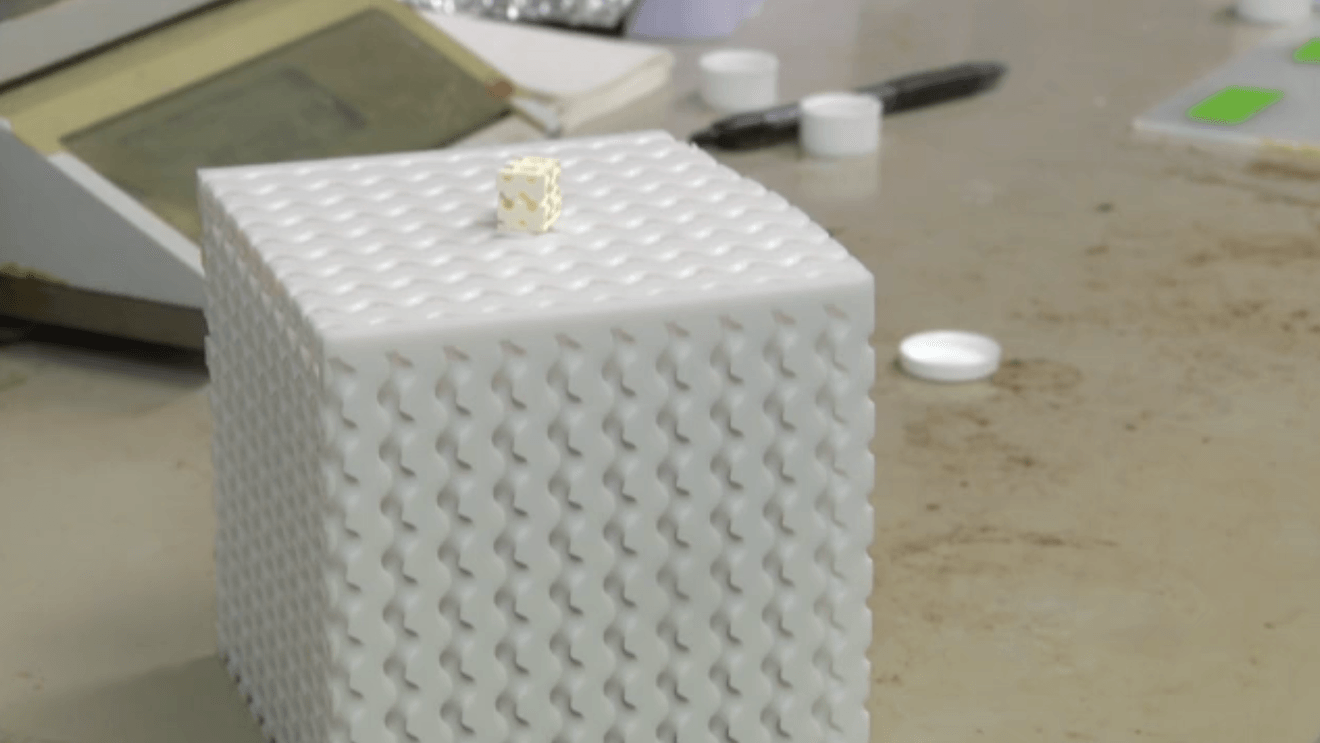
Developed inside a UT lab, the technology uses a 3D-printed, nanoporous material embedded with specialized chemical receptors. These receptors are designed to selectively capture valuable minerals from industrial wastewater.
“It works like a chemical sponge,” said Zachariah Page, Associate Professor of Chemistry at UT Austin. “We integrate novel receptors—supramolecular chemicals—that can selectively pull-out critical minerals.”
How It Works
The process combines elements of traditional solvent extraction and ion exchange—but packages it into a highly engineered, 3D-printed structure.
Wastewater flows through a cube-like material filled with microscopic channels. These “gyroid-like” structures are designed to optimize fluid movement, allowing the solution to pass through efficiently while extraction happens inside.
As the liquid moves through, the embedded receptors act with precision—almost like a glove designed for a specific catch.
“We think of the receptors like a baseball glove,” Page explained. “They have a very specific size and attraction for certain minerals.”
ALSO| Tech This Out: Put the Phone Down and Let the App Send a Creator Instead
KEYE
The system can pull out elements like gallium and scandium—materials that are critical for:
Semiconductor manufacturingRadar and hypersonic defense systemsAdvanced aerospace alloys
Once captured, these metals are recovered in a refined form, ready to be reused in high-tech applications.
From Lab to Startup
The breakthrough isn’t staying in the lab.
UT researchers have launched a startup called SUPRA to commercialize the technology. The company is part of the university’s “Discovery to Impact” program, which aims to bring academic innovations to market.
“Our goal is to take groundbreaking research and move it into the commercial marketplace,” said Mark Arnold, Associate Vice President of Discovery to Impact.
National Security Implications
The stakes go beyond business.
As global competition for critical minerals intensifies, access to these materials is increasingly tied to national security.
“Critical minerals have become strategic geopolitically,” Arnold said. “They influence trade, access to technology, and national defense.”
By enabling domestic recovery of these resources, technologies like this could reduce reliance on foreign supply chains, especially as demand for advanced tech continues to grow.
What Comes Next
Researchers say this is just the beginning.
As the U.S. looks to expand its tech and manufacturing base, innovations like UT’s chemical sponge could play a key role in building new industries.
“It’s critical for the competitiveness of the United States,” Arnold said, “And for the types of startups and industries we can continue to grow here in Austin and across Texas.”