
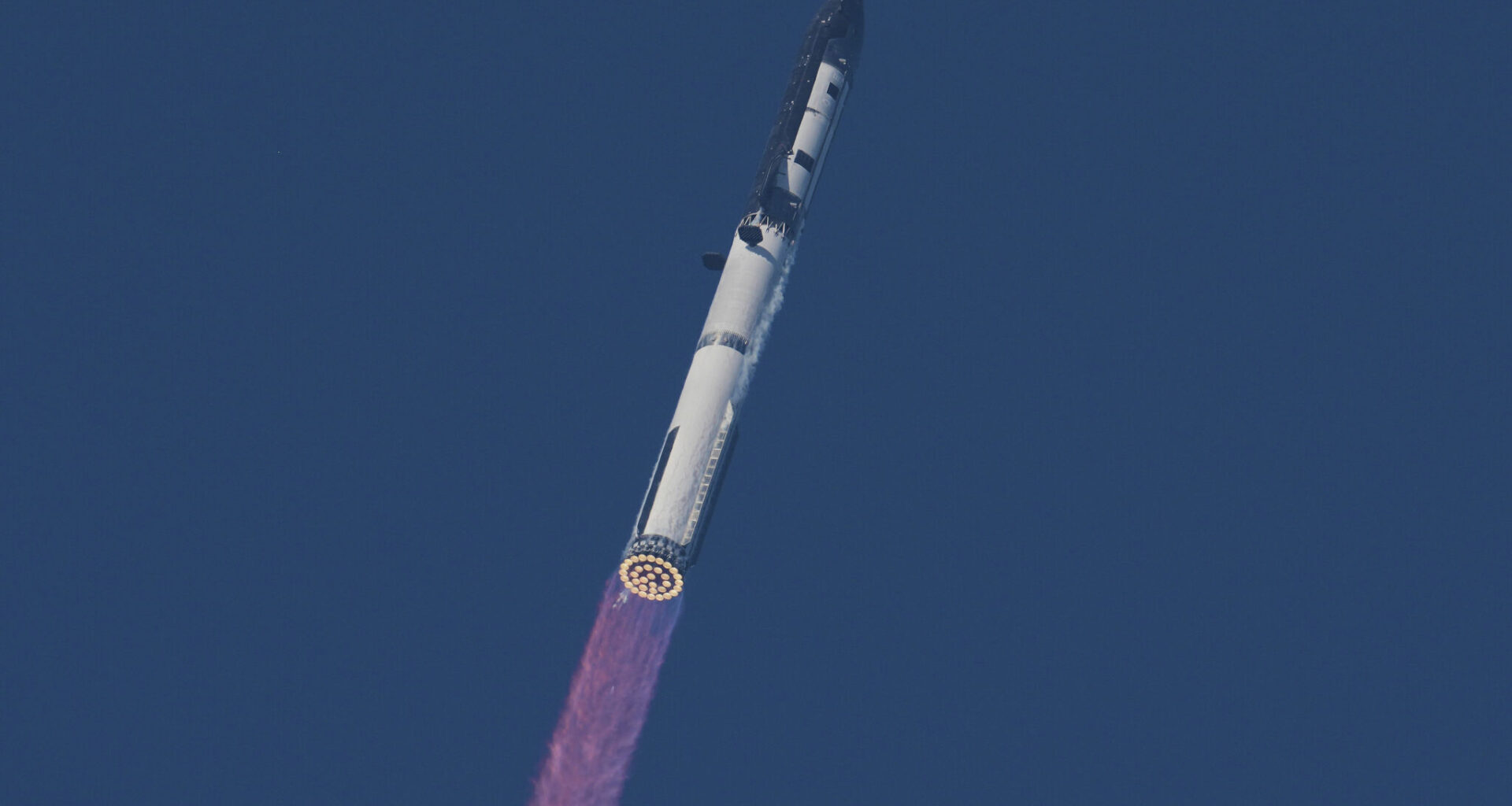
The SpaceX Starship rocket launches on its 12th flight test from Starbase, Texas, on Friday, May 22, 2026. (AP Photo/Eric Gay)
Eric Gay/Associated Press
SpaceX struggled with its Starship engines on Friday while debuting the latest version of its rocket from South Texas.
Starship, consisting of the Super Heavy rocket booster and Starship spacecraft, launched its flight test from Starbase at 5:30 p.m. It was the company’s 12th combined launch outside of Brownsville, ending a seven-month hiatus as the company redesigned its various rocket components.
Engines on both the booster and spacecraft turned off early, though Starship made it around the world to perform a controlled water landing in the Indian Ocean.
Article continues below this ad
IPO: SpaceX is aiming for the world’s largest IPO. Texas communities could feel the impact for years.
SpaceX is being pressured to accelerate Starship’s development and to move beyond these suborbital launches that don’t fully circle the planet. It needs to demonstrate new capabilities — orbiting the Earth and transferring supercold propellant between two separate Starships — as it races against Blue Origin to land NASA astronauts on the moon before China lands its first crew.
NASA Administrator Jared Isaacman was in Texas for Friday’s launch.
“Congrats @SpaceX team and @elonmusk on a hell of a V3 Starship launch,” Isaacman said on X. “One step closer to the Moon…one step closer to Mars.”
Article continues below this ad
SpaceX founder Elon Musk was equally upbeat after the flight, calling it an “epic” launch and landing. “You scored a goal for humanity,” he said on X.
The flight started as the Super Heavy booster ignited its 33 engines and propelled Starship over the Gulf of Mexico. One of its engines cut out early. And after the two vehicles separated, Super Heavy did not reignite as many engines as expected when coming back to land in the water.
Starship’s six engines initially ignited, but then one cut out prematurely. The spacecraft still entered space and ejected 20 fake satellites and two actual SpaceX Starlink satellites. The Starlink satellites were modified to test new hardware and scan Starship’s heat shield.
Starship landed in the Indian Ocean with two engines instead of three, though that did not appear to affect its controlled descent into the water.
“The flight test’s primary goal will be to demonstrate each of these new pieces in the flight environment for the first time,” SpaceX wrote on its website ahead of the launch, “with each element of the Starship architecture featuring significant redesigns to enable full and rapid reuse that incorporate learnings from years of development and test.”
Article continues below this ad
These redesigns began with the launch pad, which has additional pumps to more quickly load propellant. The tower has shorter mechanical arms that can move faster when catching vehicles on future flights.
Super Heavy’s upgrades included a redesigned tube for moving propellant to its 33 Raptor engines, enabling them to ignite faster and all at the same time. Starship underwent a “clean-sheet redesign” of its propulsion systems, SpaceX said, including improvements to its reaction control system used for steering during flight.
The Raptor engines powering both vehicles were made lighter and more powerful.
TEXAS: Elon Musk’s SpaceX is going for a dual-listed IPO in Texas. Here’s why experts say that’s a win.
SpaceX has spent more than $15 billion on its Starship rocket, including $930 million on research and development during the first quarter of this year and $3 billion on research and development in 2025, according to the registration statement the company filed this week with the U.S. Securities and Exchange Commission ahead of its planned initial public offering.
Article continues below this ad
Its various priorities — launching larger broadband internet satellites, putting data centers in space and manufacturing on the moon — depend on Starship becoming an operational rocket.
“Starship is a key enabler of our growth objectives,” SpaceX said in its SEC filing.
The IPO should provide additional funds for research and development as SpaceX works toward its goals, including putting NASA astronauts on the moon in 2028. NASA’s Orion spacecraft cannot land on the lunar surface, so its astronauts will transfer from Orion into a vehicle built by SpaceX or Blue Origin to reach the moon.
Starship might not be ready for this mission in 2028, said Phil Smith, a space industry analyst with BryceTech. But he believes the rocket will become operational.
SpaceX has proven it can build and fly complex hardware with the Falcon 9 rocket and Dragon spacecraft, which routinely carry people, cargo and satellites into space.
Article continues below this ad
“These are extremely reliable, complex capabilities that they have made possible,” Smith said. “(Starship) is a bigger rocket, but it also has new capabilities that have, frankly, never been done before.
“I’m confident they’ll do it,” Smith added. “I just don’t know if it’s within the timeframe that is set by the Artemis schedule.”