
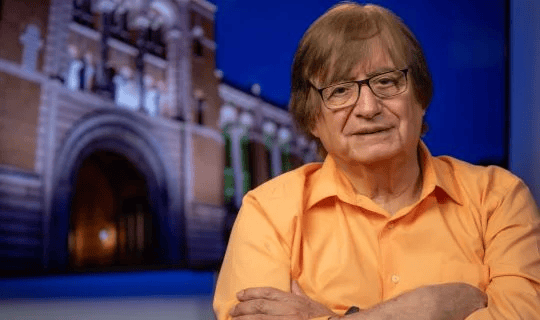
Rice officials described Tapia as a groundbreaking scholar, mentor and advocate who spent decades shaping both the university and generations of students in mathematics, science and engineering.
“Richard Tapia was a trailblazer in every sense of the word,” Rice President Reginald DesRoches said in the university’s announcement. “He transformed the lives of countless students through his mentorship, scholarship and unwavering belief that excellence in mathematics and diversity in STEM go hand in hand.”
Born in Santa Monica, California, to parents who emigrated from Mexico, Tapia was the first in his family to attend university, where he earned his bachelor’s, master’s and doctorate degrees from the University of California, Los Angeles.
Tapia joined Rice University in 1970 and became internationally recognized not only for his work in computational and applied mathematics, but also for pushing universities and scientific institutions to create more opportunities for underrepresented students in STEM fields.
Over the years, Tapia received numerous national honors, including the National Medal of Science, which was awarded to him by former President Barack Obama in 2011.
But in Houston, Tapia’s legacy extended far beyond classrooms and research papers.
At the time, Tapia reflected on what the recognition meant not only for him, but for the broader Latino community in Houston.
“I’ve been at Rice for over 50 years, 55 years, ” he said. “I’m a mathematician and I’ve tried very hard to be as good a mathematician as I could be but I never forgot who I was. My mother and father are so proud of being Mexican, but they’re also extremely proud of being American.”
Rice University also emphasized Saturday that Tapia’s impact was deeply personal for many students and colleagues who viewed him as both a mentor and role model.
“Dr. Richard A. Tapia changed the face of STEM education as ‘the Lion’ of underrepresented communities,” said Nicolás Medina, chair of the Tapia Center Board of Advisors. “We will miss his indefatigable roar’ to increase the number of minority students and women entering and succeeding in STEM, insisting that ‘yes we can’ and ‘yes we belong.’ The Tapia Center at Rice University is committed to keeping his legacy alive: STEM is for everyone.”
Even as Houston continues growing and changing around it, the bridge bearing Tapia’s name now stands as a permanent reminder of the educator whose influence helped shape not only mathematics, but generations of people who saw themselves reflected in his success.