
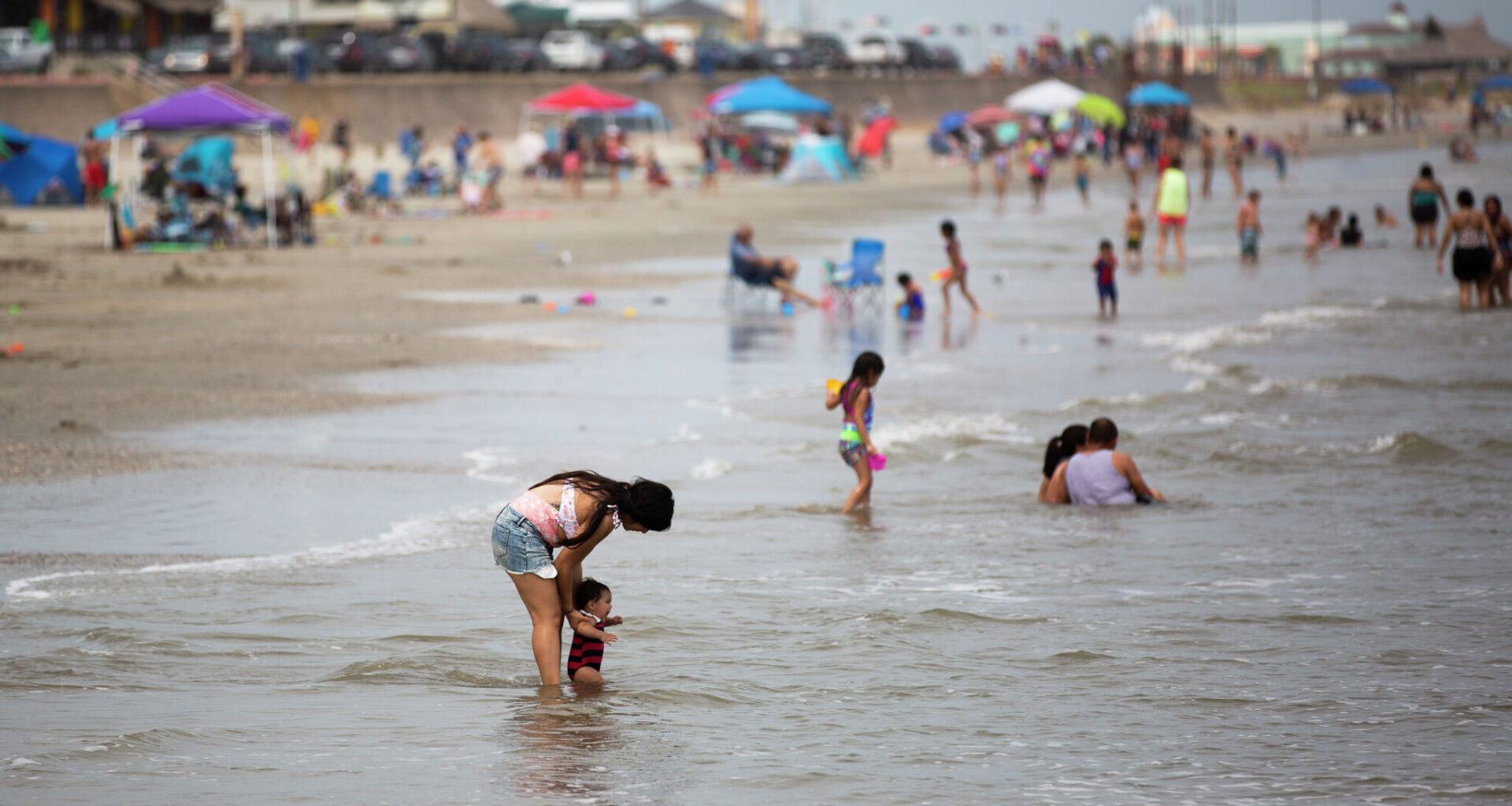
People gather to enjoy the beach at the Galveston Seawall on Labor Day weekend Saturday, Sept. 5, 2020, in Galveston. Ahead of the 2026 Memorial Day weekend, testing by Texas Beach Watch shows the highest levels of fecal matter indicator bacteria in Corpus Christi and Galveston.
Houston Chronicle/Hearst Newspap/Houston Chronicle via Getty Imag
Memorial Day weekend is upon us. It’s the official kickoff to summer. It’s the time of year when the temperatures begin to rise and the days get longer, and the call of Texas’ sunny, sandy beaches becomes harder to ignore.

But could there be something lurking in those warm Gulf of Mexico waters? The Texas General Land Office, or GLO, tracks levels of fecal bacteria at dozens of sites across Texas’ 367 miles of coastline as part of the Texas Beach Watch program.
Article continues below this ad
GLO volunteers and contractors gather and test water samples for enterococcus bacteria, a potentially harmful bacteria that can indicate the level of fecal matter in the water. GLO officials call enterococcus “an umbrella bacteria,” whose presence can serve as a sort of canary in a coal mine indicating the presence of other harmful pathogens.
Texas Beach Watch regularly posts water quality test results online with a stoplight system of red, yellow or green-colored pins on a map that allows people to know at a glance how their local beaches are faring. Green pins mean fecal matter bacteria are low — at a “most probable number,” or “mpn,” of 35 or fewer per 100 milliliters of water, which would be indicated as 35 mpn/100 ml. Yellow pins mean bacteria levels are slightly elevated — what Texas Beach Watch labels as “medium” — and fall somewhere between 35 and 104 mpn/100 ml. And red pins indicate high levels of bacteria — anything above 104 mpn/100 ml.
As of Wednesday, May 20, testing at several sites in Port Aransas, Matagorda and the Bolivar Peninsula indicated high levels of bacteria. A number of factors can cause bacteria levels to spike, including stormwater and agricultural runoff. Recently, Texas has seen several weeks of heavy rain that have caused an influx of freshwater into Texas’ bays and the Gulf of Mexico. Below are the levels at some of the most popular beaches in Texas.
Article continues below this ad
A Texas Beach Watch sign is seen at Boca Chica Beach in 2014. Ahead of the 2026 Memorial Day weekend, several beaches across the state have high levels of fecal matter indicator bacteria, likely brought on by runoff from weeks of rain.
Houston Chronicle/Hearst Newspap/Houston Chronicle via Getty Imag
Highest levels of fecal matter levels in Corpus Christi
Date Sampled: May 20, 2026
Article continues below this ad
Reading: Three testing sites on the north end of the Nueces Bay Causeway showed high levels between 160 and 2,489 mpn/100ml. Twelve out 13 testing sites at the Corpus Christi Marina, Magee Beach and south to University Beach tested high between 158 and 24,196 mpn/100ml. That includes two sites at Coles Park and Ropes Park that all tested high at 24,916 mpn/100ml. However, four testing sites at North Beach tested low between 10 to 31 mpn/100ml.
High levels of fecal matter on the Bolivar Peninsula
Date Sampled: May 18, 2026
Article continues below this ad
Reading: Fifteen testing sites all along the gulfside of the Bolivar Peninsula showed high levels between 221 and 1,950 mpn/100ml. The highest levels were found at Church Street and at a Crystal Beach testing site at O’Neil Road, which tested at 1,950 mpn/100ml and 1,040 mpn/100ml, respectively.
High levels of fecal matter in Galveston
Date Sampled: May 19, 2026
Article continues below this ad
Reading: Nearly all 24 testing sites at city of Galveston testing sites showed high to medium levels between 63 to 448 mpn/100ml
Fecal matter levels at Galveston Island State Park
Date Sampled: May 13, 2026
Article continues below this ad
Reading: Four testing sites showed levels at 5 mpn/100ml
Fecal matter levels at McFaddin State Park, Sabine Pass
Date Sampled: May 12 and May 18, 2026
Article continues below this ad
Reading: One site tested on May 18 showed high levels of bacteria at 262 mpn/100ml at McFaddin National Wildlife Refuge. Five other sites further south, tested on May 12, showed low levels between 5 and 10 mpn/100ml.
Fecal matter levels at Sea Rim State Park, Sabine Pass
Date Sampled: May 18, 2026
Article continues below this ad
Reading: Two sites at Sea Rim State Park showed high levels of bacteria between 120 and 141 mpn/100ml. Three other sites showed low- to medium levels between 5 and 52 mpn/100ml.
Fecal matter levels at Mustang Island State Park
Bacteria level: Mixed
Date Sampled: May 18, 2026
Article continues below this ad
Reading: One testing site at Mustang Island State Park showed high levels at 110 mpn/100ml. Three other testing sites within the state park tested at medium levels between 41 and 63 mpn/100ml, while the two southernmost testing sites showed low levels of bacteria.
Fecal matter levels at Mustang Island
Bacteria level: Low to Medium
Date Sampled: May 12, 2026
Article continues below this ad
Reading: Elsewhere on Mustang Island, nine testing sites at showed low levels at between 5 and 20 mpn/100ml. Three other testing sites tested at medium levels between 80 and 86 mpn/100ml, while the two southernmost testing sites showed low levels of bacteria.
Fecal matter levels at Port Aransas
Bacteria level: Medium to low
Date Sampled: May 18-20, 2026
Article continues below this ad
Reading: Six testing sites in Port Aransas showed low to medium levels between 5 and 96 mpn/100ml.
Fecal matter levels at Matagorda Beach
Bacteria level: Medium to low
Date Sampled: May 20, 2026
Article continues below this ad
Reading: Four testing sites at Jetty Park showed medium to levels between 5 and 97 mpn/100ml.
Levels of fecal matter outside Freeport
Date Sampled: May 18-20, 2026
Article continues below this ad
Reading: Two testing sites in Brazoria County, just outside Freeport, showed medium levels between 86 and 97 mpn/100ml. That includes County Beach Access #3.
Fecal matter levels at Boca Chica Beach
Date Sampled: May 18, 2026
Article continues below this ad
Reading: Six testing sites showed levels between 5 and 31 mpn/100ml
Fecal matter levels at Isla Blanca Park, South Padre Island
Date Sampled: May 11-13, 2026
Article continues below this ad
Reading: Four testing sites showed levels between 5 and 10 mpn/100ml
Fecal matter levels at South Padre Island city beach accesses
Date Sampled: May 11, 2026
Article continues below this ad
Reading: Eight testing sites within the city limits showed levels between 5 and 20 mpn/100ml
Fecal matter levels at Cameron County Beach Access #6, South Padre Island
Date Sampled: May 13, 2026
Article continues below this ad
All other Cameron County-owned South Padre Island beach accesses also showed low bacteria levels.
Fecal matter levels at Surfside
Bacteria level: Low to Medium
Article continues below this ad
Date Sampled: May 18, 2026
Reading: Three sites — Bay Street, Stahlman Park and at 9th Street — showed medium levels at 41 mpn/100ml. Four other Surfside test sites showed low levels between 10 and 31 mpn/100ml.
Fecal matter levels at Jamaica Beach
Article continues below this ad
Date Sampled: May 13, 2026
Reading: One site showed levels at 5 mpn/100ml